— Nonlinear Platform Development
Geophysical & Solar
Prediction Platform
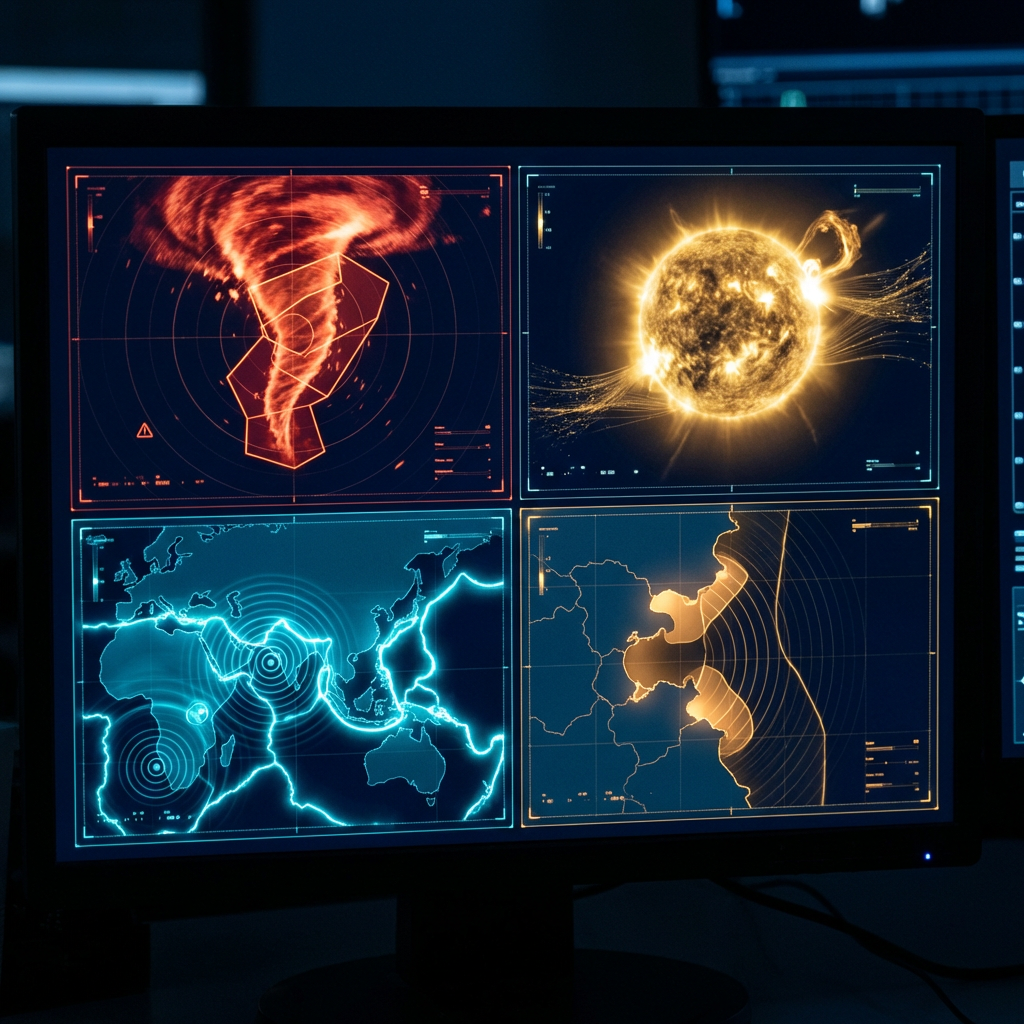
A research-grade Java platform engineered to forecast volcanic eruptions, seismic events, geomagnetic storms, and solar activity — with extended medium-to-long-range weather prediction as an integrated secondary capability. Krick Suite fuses Irving Krick’s synoptic climatology framework with tidal-gravitational modelling, solar-terrestrial physics, and adaptive machine-learning ensembles to flag high-risk geophysical windows days to months in advance.

The Problem
Geophysical Early-Warning Is Fragmented.
Lives and Infrastructure Pay the Price.
Analysis Categories
Forecast Accuracy by Range
Blind Spots in Hazard Forecasting
Volcanic unrest, major earthquakes, geomagnetic superstorms and solar flares are still flagged in hours-to-days windows — far too late for evacuation planning, grid hardening, or aviation rerouting. Each domain runs on isolated monitoring networks with no shared probabilistic framework.
Fragmented Signal Streams
Seismic catalogues, volcanic gas-flux data, GOES X-ray feeds, Kp/Dst indices, tidal-gravitational forcings, and atmospheric reanalysis products live in separate silos. No unified platform correlates them to detect cross-domain precursor patterns.
Static, Single-Domain Models
Existing tools forecast one hazard at a time with fixed equations. Adaptive ensemble methods that weight geophysical, solar-terrestrial and atmospheric signals dynamically — the core of Krick’s wartime forecasting edge — are absent from mainstream prediction toolkits.
The Solution
Krick Suite:
Unified Geophysical & Solar Intelligence
A Java-powered multi-hazard forecasting platform that fuses seismic and volcanic precursor signals, solar activity indices, geomagnetic storm tracking, tidal-gravitational forcings and synoptic atmospheric analogues into one probabilistic engine. Operators receive unified risk windows for eruptions, earthquakes, solar flares, CMEs, geomagnetic storms — and extended medium-range weather — days to months ahead, with calibrated uncertainty at every horizon.
Volcanic & Seismic Precursor Engine
Ingests global seismic catalogues, ground-deformation (InSAR/GNSS), gas-flux and thermal-anomaly feeds. Machine-learning classifiers flag eruption and large-magnitude earthquake probability windows by matching current unrest patterns against a historical precursor library spanning decades.
Solar Activity & Space-Weather Forecaster
Tracks sunspot evolution, 10.7 cm solar flux, X-ray flare classes, coronal-hole geometry and CME kinematics. Generates probabilistic forecasts for M/X-class flares, radiation storms, and Kp/Dst geomagnetic indices on horizons from hours to full solar-cycle projections.
Tidal-Gravitational Forcing Module
High-precision ephemeris engine computes lunar and planetary tidal stresses on the solid Earth and crustal loading cycles. Correlates these forcings against historical eruption and seismic catalogues to identify elevated-risk windows for subduction zones, rift systems and active volcanic arcs.
Multi-Hazard Bayesian Ensemble
Combines seismic precursors, volcanic unrest, solar-terrestrial indices, tidal forcings and atmospheric synoptic analogues through adaptive Bayesian weighting. Automatically recalibrates model confidence from live skill scores and verification feedback.
Regional Calibration & Extended Weather
Pre-calibrated profiles for major tectonic provinces, volcanic arcs and climate zones. Integrates local seismograph, tiltmeter and weather-station feeds. Delivers extended medium-range atmospheric forecasts as a built-in secondary capability powered by the same ensemble core.
Verification Dashboard
Real-time forecast verification against observed conditions. Brier skill scores, reliability diagrams, and ROC curves for continuous model performance assessment and improvement.
Architecture
How It Works
Ingest
Seismic catalogues, InSAR/GNSS deformation, volcanic gas-flux, GOES X-ray feeds, Kp/Dst indices, CME kinematics and atmospheric reanalysis are ingested and normalised in real-time.
Classify
Precursor-pattern typing engine classifies current unrest regimes — volcanic inflation, seismic quiescence, coronal-hole geometry — against a regional analogue library.
Correlate
Tidal-gravitational forcing module computes lunar and planetary crustal-loading stresses and cross-references them against historical eruption and earthquake catalogues for each forecast window.
Ensemble
Bayesian ensemble engine combines all signal sources with dynamic weighting to produce probabilistic forecasts.
Verify
Automated verification pipeline scores forecasts against observations and feeds corrections back into the model.
Who Benefits
Built for Professionals
Who Demand Precision
Volcanic & Seismic Agencies
Raise alert levels earlier and with calibrated confidence. Cross-reference unrest signals with tidal forcing windows and regional analogues to prioritise evacuation planning and field-team deployment.
Space-Weather & Grid Operators
Harden HV transmission, pipelines, and satellite fleets ahead of geomagnetic storms. Actionable CME arrival, flare-probability and Kp-forecast feeds for aviation polar-route planning, HF communications and GNSS-dependent operations.
Risk & Climate Researchers
Insurance-linked securities desks, reinsurers and geophysical researchers use the unified ensemble to quantify compound-hazard risk, validate precursor hypotheses, and model long-horizon climate-transition scenarios.
Performance
Measurable Impact
Licensing
Flexible Plans
for Every Scale
Professional
Contact for Pricing
Full platform access for individual practitioners and researchers.
Institution
Contact for Pricing
Multi-seat licensing for teams, departments, and organisations.
Enterprise
Custom
White-label deployment with custom integrations and dedicated support.
Contact
Ready to Get Started?
Reach out to discuss licensing options, schedule a demonstration, or request a custom integration proposal.
Email: [click to reveal]