Psychosomatic Dream Analysis Platform
Dreams Speak.
Your Body Is
Already Listening.
The Psychosomatic Dream Interpreter is a multilingual AI-powered research platform that analyses the narrative and symbolic content of dreams to identify physiological stress patterns, psycho-emotional indicators, and probable health correlates. By crossing the language of the unconscious mind with modern biomedical and psychosomatic research, it transforms reported dream content into structured, clinically-informed insights — for researchers, practitioners, and individuals committed to understanding the body-mind interface.

Scientific Foundation
Dreams Are Not Random.
They Are Data.
Four decades of psychosomatic research have established that dream content reliably reflects the physiological and emotional state of the dreamer. Recurring motifs, themes, sensory qualities, and emotional intensities in dreams correlate with measurable health indicators — from autonomic nervous system dysregulation to immune suppression, from unresolved grief to cardiovascular arousal. The Psychosomatic Dream Interpreter operationalises this research at scale.
Body-Mind Integration
The psychosomatic model holds that emotional and psychological states are inseparable from physiological processes. Dream content — generated by the same neural systems that regulate autonomic function, immune response, and hormonal balance — offers a window into states the waking mind has not yet consciously processed. The interpreter decodes that window systematically.
Symbolic Pattern Recognition
The platform analyses dream narratives across multiple symbolic layers: environmental context (water, fire, height, confinement), social dynamics (pursuit, abandonment, confrontation), bodily sensations (paralysis, flying, falling, injury), and emotional tone (dread, ecstasy, grief, rage). Each pattern carries established psychosomatic correlates mapped from clinical literature.
Longitudinal Tracking
Single dream reports yield useful insights. Longitudinal series — tracking dream patterns over weeks or months — reveal the trajectory of psychosomatic states: whether stress indicators are escalating or resolving, whether specific organ-system correlates are persisting or shifting, whether therapeutic interventions are producing measurable changes in dream content.
Core Analysis Dimensions
Six Lenses.
One Integrated Report.
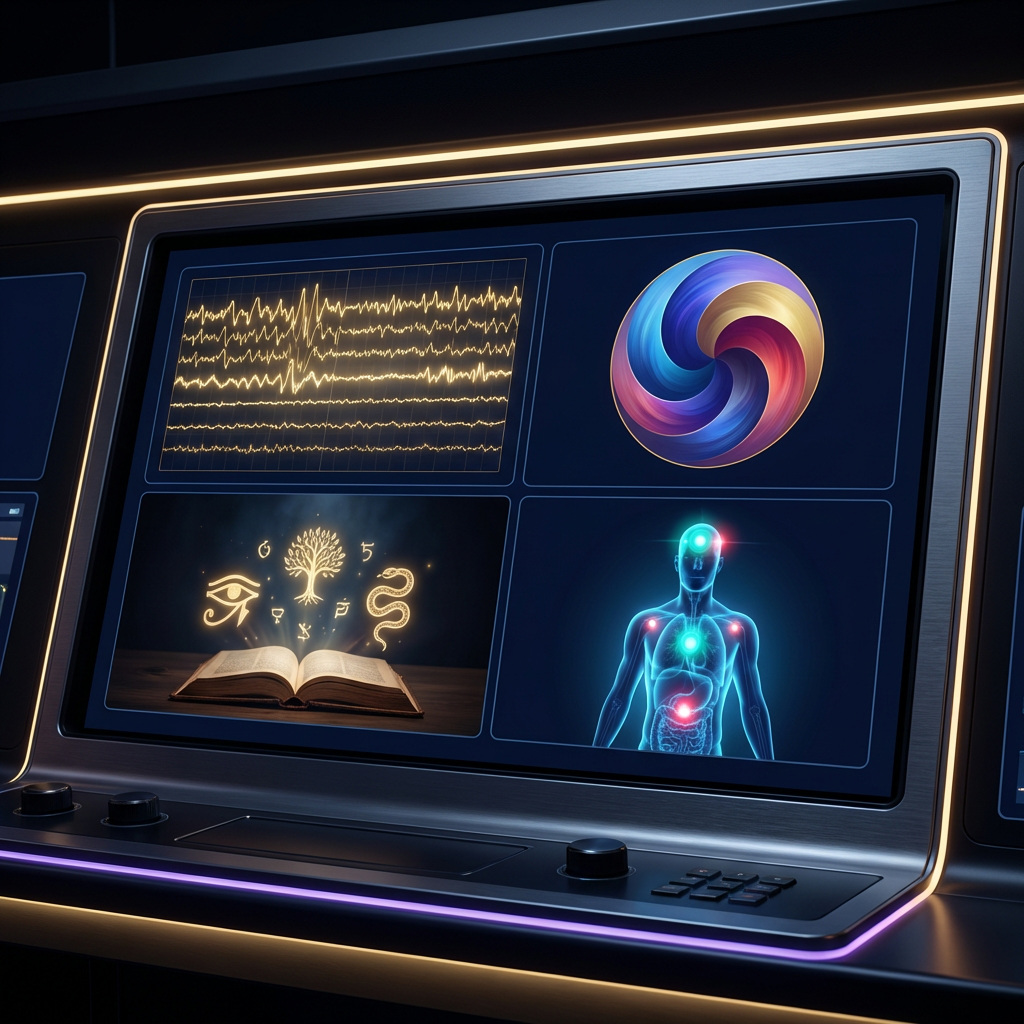
Every dream report processed by the platform is analysed across six interconnected psychosomatic dimensions, producing a structured multi-layer output that maps dream content to probable health indicators and emotional states.
Physiological Stress
- Autonomic nervous system activation indicators
- Cardiovascular arousal dream correlates
- Adrenal and cortisol-linked dream motifs
- Sleep-stage quality markers embedded in content
Psycho-Emotional State
- Primary emotional tone and valence mapping
- Unresolved grief and loss pattern detection
- Anxiety spectrum indicator scoring
- Suppressed versus expressed affect profiling
Organ System Correlates
- Gastrointestinal system dream signature mapping
- Respiratory and cardiac symbolic indicators
- Musculoskeletal tension and injury correlates
- Immune system depletion pattern recognition
Symbolic Decoding
- Cross-cultural archetypal symbol library
- Personal vs universal symbol disambiguation
- Recurrence weighting for persistent motifs
- Jungian, Freudian, and somatic framework overlays
Probable Health Issue Detection
The platform's most powerful analytical layer maps clusters of psychosomatic dream indicators to probable health domains — not diagnoses, but evidenced-based signal clusters. Water imagery combined with breath-related dream anxiety and blue-toned colour dominance, for example, correlates with respiratory system stress patterns documented in clinical psychosomatic literature. The system scores these correlations by confidence level and presents them as structured hypotheses for clinical consideration.
Integrative Pattern Synthesis
The sixth analytical dimension synthesises outputs from all five preceding layers into a coherent psychosomatic narrative — a plain-language interpretation that connects the dream's symbolic content to its emotional context, its physiological correlates, and its probable organ-system implications. This synthesis layer is powered by the user's selected AI model (OpenAI GPT-4, Anthropic Claude, Google Gemini, or self-hosted proxy) for maximum interpretive depth and linguistic precision.
Input Modalities
Record Your Dream
Any Way You Remember It.
Dreams are most vivid and detail-rich in the first moments after waking. The platform is designed for immediate capture — whether you type, speak, or dictate at any hour in any language.
Text Entry
Type or paste dream narratives of any length directly into the analysis interface. The platform handles everything from a single sentence fragment ("I was running but couldn't move") to extended multi-scene dream journals of thousands of words. Long-form entries receive deeper symbolic analysis due to richer contextual material available to the interpretation engine.
Live Voice Dictation
Speak your dream aloud directly into the platform using the browser's Web Speech API with live transcription. Available in all supported languages with real-time text display and correction capability. Ideal for users who prefer not to write immediately on waking — simply speak and the platform captures the narrative in full, ready for analysis at the tap of a button.
Multilingual — 30+ Languages
Record and analyse dreams in the language you dream in. The platform supports over 30 languages including English, Russian, Spanish, French, German, Arabic, Chinese, Japanese, Korean, Portuguese, Italian, Hindi, Dutch, Polish, Turkish, and more. Psychosomatic analysis frameworks are culturally calibrated — the symbolic weight of specific imagery is adjusted for cultural context during interpretation.
Dream Reversal & Inversion
A unique analytical tool that applies symbolic inversion to dream content — reading the narrative in reverse sequence or inverting key symbols to reveal latent meaning obscured by the dreamer's waking-mind narrative frame. This technique, rooted in Jungian compensatory dream theory, often surfaces complementary psychosomatic indicators not visible in the forward reading.
Structured Context Input
Enrich analysis by providing structured context alongside the dream narrative: patient age, known health conditions, current medications, sleep quality rating, emotional state before sleep, recent life events, and recurring dream history. Context inputs are incorporated into the psychosomatic weighting model — a dream reported alongside known hypertension, for example, receives adjusted cardiovascular indicator scoring.
Multi-AI Model Support
Choose your interpretation engine from four leading AI providers: OpenAI (GPT-4 and GPT-4o), Anthropic (Claude 3 Opus and Sonnet), Google (Gemini 1.5 Pro and Flash), or a self-hosted proxy via the platform's API relay system. Users with API keys for multiple providers can run comparative analysis — submitting the same dream to two models simultaneously and comparing interpretive outputs for convergence and divergence.
Global Language Coverage
Dream in Any Language.
Analyse in Any Language.
The platform's UI switches between English and Russian interface modes, while the dream content itself can be submitted and analysed in over 30 world languages with full psychosomatic framework support.
Intended Users
For Those Who Understand
That Sleep Is Not Silence
Integrative Health Practitioners
Practitioners working at the intersection of conventional medicine and mind-body approaches — including integrative physicians, psychosomatic specialists, naturopathic doctors, and functional medicine practitioners — will find the platform invaluable for extending patient intake assessments. Dream content analysis adds a zero-cost anamnesis layer that surfaces psychosomatic hypotheses for clinical exploration.
Psychotherapists & Counsellors
For depth psychologists, Jungian analysts, psychodynamic therapists, and trauma-informed counsellors, the platform provides structured analytical scaffolding around client dream material — augmenting clinical intuition with systematic psychosomatic cross-referencing. Session preparation is transformed: clients submit dream reports before sessions, and the practitioner arrives with a structured multi-dimensional analysis ready for exploration.
Sleep & Psychosomatic Researchers
Academic researchers studying the relationship between sleep content, emotional processing, and physical health can use the platform as a structured annotation and categorisation tool for dream content in study populations. The multi-language capability is particularly valuable for cross-cultural dream research — enabling consistent psychosomatic coding across linguistically and culturally diverse participant groups.
Wellness & Self-Development
Individuals engaged in serious self-development work — whether through mindfulness practice, somatic bodywork, trauma recovery, or simply deep self-knowledge — will find the platform a powerful tool for understanding the signals their body sends during sleep. Regular dream journalling with psychosomatic analysis creates a longitudinal map of emotional and physiological patterns that complements any wellness practice.
Medical Schools & Training Institutions
Medical and psychology training programmes incorporating psychosomatic medicine, mind-body integration, or narrative medicine into their curricula will find the platform a practical teaching tool. Students learn to read dream content as a clinical data source — developing interpretive skills that are rarely taught in conventional training but are increasingly valued in integrative and holistic healthcare contexts.
Multilingual & International Clinics
Clinics and practices serving multilingual populations — common in major metropolitan areas and international healthcare settings — gain a significant clinical tool: the ability to receive and process dream reports from patients in their native language, with culturally-calibrated symbolic interpretation, without requiring the practitioner to speak the patient's language or commission expensive translation and cultural consultation services.
Research & Wellness Context
Important Scope Notice
The Psychosomatic Dream Interpreter is a research and wellness decision-support tool. It is not a medical diagnostic device and does not produce medical diagnoses. All outputs — including probable health correlates and psychosomatic indicator scores — are research-grade hypotheses derived from established psychosomatic literature and should be treated as prompts for clinical exploration, not clinical conclusions.
The platform is intended for use by qualified health practitioners as an adjunct to established clinical assessment processes, and by research institutions operating under appropriate ethical oversight. Individual users utilising the platform for personal wellness insight should consult qualified healthcare professionals for any health concerns identified through dream analysis.
Nonlinear Platform Development licenses this platform in accordance with its standard research-grade terms. All AI-generated interpretations reflect the analytical frameworks of the selected AI model provider and do not represent the clinical opinion of Nonlinear Platform Development or any affiliated practitioners.
Licensing & Access
Begin Reading the Language
of Your Sleeping Mind
The Psychosomatic Dream Interpreter is available to qualified practitioners, research institutions, and individual wellness subscribers on our standard subscription licensing model. Contact us to discuss your use case, data privacy requirements, and the most appropriate access tier for your practice or institution.