Nine candidate pathways from finger configuration to cortical state, with quantitative biophysical exclusion of endogenous field mechanisms.
In brief: The paper evaluates nine candidate pathways by which ritual hand gestures — mudrā, Kabbalistic finger-letter meditation and runic hand postures — might influence brain states. Four are established (mu-rhythm gating, per-digit somatotopy, corticomuscular coherence and respiratory baroreflex entrainment), three are physically certain but untested, and two endogenous electromagnetic pathways are excluded by calculation.
Key Takeaways
- Established and directly supportive: sensorimotor mu-rhythm gating, per-digit somatotopy at 8.6–15.5 mm inter-digit spacing in primary somatosensory cortex, beta-band corticomuscular coherence during isometric hold, and respiratory entrainment to baroreflex resonance through rhythmic recitation.
- Physically certain but untested in this context: arteriovenous-anastomosis autonomic coupling, the isometric metaboreflex, and a hydrostatic effect of gesture height computed at up to 42.9 mmHg.
- Excluded: Faraday induction in a closed thumb–index loop yields at most 5.0 nA and is extra-cranial; self-generated hand fields fall to roughly 10⁻¹¹–10⁻¹² T at the skull, six to seven orders of magnitude below the geomagnetic field.
- A stacked-mechanism model links each parameter the traditions over-specify — digit identity, gesture height, contact territory, recitation rate and symbolic content — to a distinct physiological layer.
- Seven discriminating experiments are specified to test the model.
In This Article
- Abstract
- 1. Introduction
- 2. Method: Mechanism-Space Mapping
- 3. The Cortical Layer
- 4. The Peripheral Vascular and Autonomic Layer
- 5. The Afferent and Reflex Layer
- 6. Endogenous Field Mechanisms: Quantitative Evaluation
- 7. The Recitation Layer: Demonstrated Cross-Tradition Convergence
- 8. Synthesis: The Stacked-Mechanism Model
- 9. Mechanism Ranking and Discriminating Experiments
- 10. Limitations
- 11. Conclusion
- Frequently Asked Questions
- Appendix A. Computational Derivations
- References
Abstract
Manual ritual practice — Vedic and Buddhist mudrā, Kabbalistic finger-letter meditation deriving from Sefer Yetzirah, and the twentieth-century runic hand postures of Marby and Kummer — is frequently claimed to induce specific brainwave states and to act upon specific cerebral regions. This paper subjects that claim to systematic mechanism-space analysis rather than claim-triage. Nine candidate causal pathways are identified and evaluated for physical existence, magnitude, spatial and spectral specificity, and experimental discriminability. Four pathways are found to be established and directly supportive: sensorimotor mu-rhythm gating by sustained attention to the hand representation; per-digit somatotopic separation in primary somatosensory cortex at 8.6–15.5 mm inter-digit spacing; beta-band corticomuscular coherence during isometric hold; and respiratory entrainment to baroreflex resonance by rhythmic recitation. Three further pathways — arteriovenous-anastomosis-mediated autonomic coupling, the isometric metaboreflex, and an apparently unremarked hydrostatic effect of canonical gesture height computed here at up to 42.9 mmHg — are physically certain but experimentally untested in this context. Two endogenous electromagnetic pathways are quantitatively excluded: Faraday induction within a closed thumb–index loop yields at most 5.0 nA under worst-case ambient exposure and is anatomically extra-cranial; and dipole fall-off places any self-generated hand field at approximately 10⁻¹¹–10⁻¹² T at the practitioner’s own skull, six to seven orders of magnitude below the ambient geomagnetic field. The radical-pair mechanism is shown to remove the blanket thermal objection to weak-field bioeffects without supplying a field for gesture to act through. A stacked-mechanism model is proposed in which the parameters that traditions over-specify — digit identity, gesture height, contact territory, recitation rate, and symbolic content — each load a distinct physiological layer, reframing these practices as empirically refined multi-layer protocols rather than arbitrary symbolism. Seven discriminating experiments are specified.
Keywords: mudrā; mu rhythm; somatotopy; corticomuscular coherence; baroreflex; arteriovenous anastomosis; applied semiotics; magnetoreception; embodied cognition; Sefer Yetzirah
1. Introduction
Across cultures that had no documented contact, human beings converged on the practice of holding the hands in precisely specified configurations while reciting, breathing, or meditating in prescribed ways. The Vedic and Buddhist traditions elaborate catalogues of mudrā; Sefer Yetzirah maps the ten fingers onto the ten Sefirot and locates a covenant “between the fingers of the hands”; Christian benediction encodes christological doctrine in finger arrangement; the Jewish priestly blessing forms a letter with the hands. Practitioners across all of these traditions report that the configurations do something — that they are instruments rather than ornaments.
The scientific question this raises is unusually badly posed in most treatments. Asking whether such practices “work” invites either credulous affirmation or reflexive dismissal, and both responses skip the analysis. The productive question is mechanistic and plural: through which physically available routes could a hand configuration alter cortical state; what is the magnitude of each; which of them deliver the spatial or spectral specificity that practitioners’ claims require; and what observation would distinguish one from another?
This paper takes that approach. It is not a systematic review in the Cochrane sense — the primary literature on mudrā specifically is too thin to support one — but a mechanism-space mapping, in which candidate pathways are enumerated exhaustively, quantified where quantification is possible, and ranked by evidence strength against experimental accessibility. Two pathways are excluded by direct computation rather than by appeal to plausibility. Seven survive, and four of those are supported by established, independently replicated literature that has not previously been brought to bear on this question.
1.1 Scope and the Provenance Problem
A comparative analysis must first establish that its comparanda are commensurable. They are not, and the discrepancy is material to how convergence arguments may be constructed.
Vedic and Buddhist mudrā traditions possess continuous documented transmission across many centuries, attested in a substantial Sanskrit textual and iconographic corpus and surviving as living practice. Kabbalistic finger-letter meditation is likewise continuous and well documented: Sefer Yetzirah (conventionally dated third to sixth century CE, with earlier roots) provides the foundational finger–Sefirot mapping; Abraham Abulafia (1240–c.1291) develops letter-permutation technique; the Lurianic circle at Safed elaborates yichudim in the sixteenth century; and Hasidic communities preserve finger-specific kavvanot during ritual hand-washing into the present.
The runic material is different in kind. The eighteen-rune “Armanen” row on which it depends was devised by Guido von List in 1908 and is not attested in the historical runic corpus, whose genuine futharks span roughly the second to eleventh centuries CE. Friedrich Bernhard Marby published Runengymnastik from 1931; Siegfried Adolf Kummer extended it to seated hand postures — which he explicitly termed “Runic Hand Postures (or Mudras)”, borrowing the Sanskrit — in Runen-Magie (1933). Multiple independent runological sources state that the postural system has no ancient attestation, notwithstanding its creators’ claims of Indo-European antiquity. Both men worked within the Ariosophic movement, whose organising premise was ancestral-spiritual inheritance; both were later suppressed by the National Socialist regime following denunciation by Karl Maria Wiligut, in what Goodrick-Clarke characterises as factional rivalry within a racialist esoteric milieu rather than ideological repudiation of it.
It is essential to state clearly what this does and does not entail. Dating a practice and evaluating its mechanism are orthogonal operations. A gesture system devised in 1933 engages the same primary somatosensory cortex, the same sensorimotor rhythm, and the same sympathetically innervated vasculature as one transmitted since antiquity. If the mechanisms identified in Sections 3 to 5 are what drive the reported effects, a well-constructed modern gesture system should perform comparably to an ancient one — a prediction that is directly testable (Experiment E6, Section 9). Antiquity is evidence about cultural selection and transmission, not about physiology.
| Tradition | Earliest genuine attestation | Continuity | Primary sourcing | Antiquity claim |
|---|---|---|---|---|
| Vedic / Buddhist mudrā | Pre-Common Era (text-dependent) | Continuous, cross-sectarian, extant | Extensive Sanskrit corpus; living lineages | Accurate |
| Kabbalistic finger-letter | Sefer Yetzirah, c. 3rd–6th c. CE | Continuous, documented lineage | Sefer Yetzirah; Abulafia; Lurianic corpus; Hasidic sources | Accurate |
| Bardon Hermetic finger-mudrā | 1956 (published) | Single-author, c. 70 years | Initiation into Hermetics, Step IV | Not claimed as ancient |
| Runic hand postures | 1932–33 (Kummer) | c. 90 years; revived 1980s | Marby; Kummer; Thorsson | Claimed; unsupported |
2. Method: Mechanism-Space Mapping
For each candidate pathway, four questions are posed in fixed order. First, does a physical route exist — not “is it proven”, but “is there an unbroken chain of causation”? Second, what is its magnitude, computed where computation is possible rather than asserted? Third, does it deliver spatial or spectral specificity, which is the property the hypothesis actually requires? Fourth, what observation would distinguish it from competing pathways?
Pathways are then ranked on the product of evidence strength, effect magnitude, specificity, and testability. This ordering deliberately does not track disciplinary respectability: a well-evidenced pathway that cannot be measured with available instrumentation ranks below a moderately evidenced one that can, because the purpose of the exercise is to generate experiments.
Evidence is graded on a four-tier scheme. T1 denotes findings supported by peer-reviewed, independently replicated evidence or by uncontested textual record. T2 denotes coherent theoretical accounts or preliminary peer-reviewed evidence not yet replicated at scale. T3 denotes defensible analogies performing conceptual work without empirical support. T0 denotes claims for which no credible evidentiary path exists or which are contradicted by computation.
All quantitative results reported below were computed directly from standard physical constants (μ₀ = 4π × 10⁻⁷ T·m·A⁻¹; ρ_blood = 1060 kg·m⁻³; g = 9.80665 m·s⁻²; 1 mmHg = 133.322 Pa). No fitted parameters are used. Full derivations appear in Appendix A.
3. The Cortical Layer
3.1 The Mu Rhythm as the Hand’s Own Oscillation
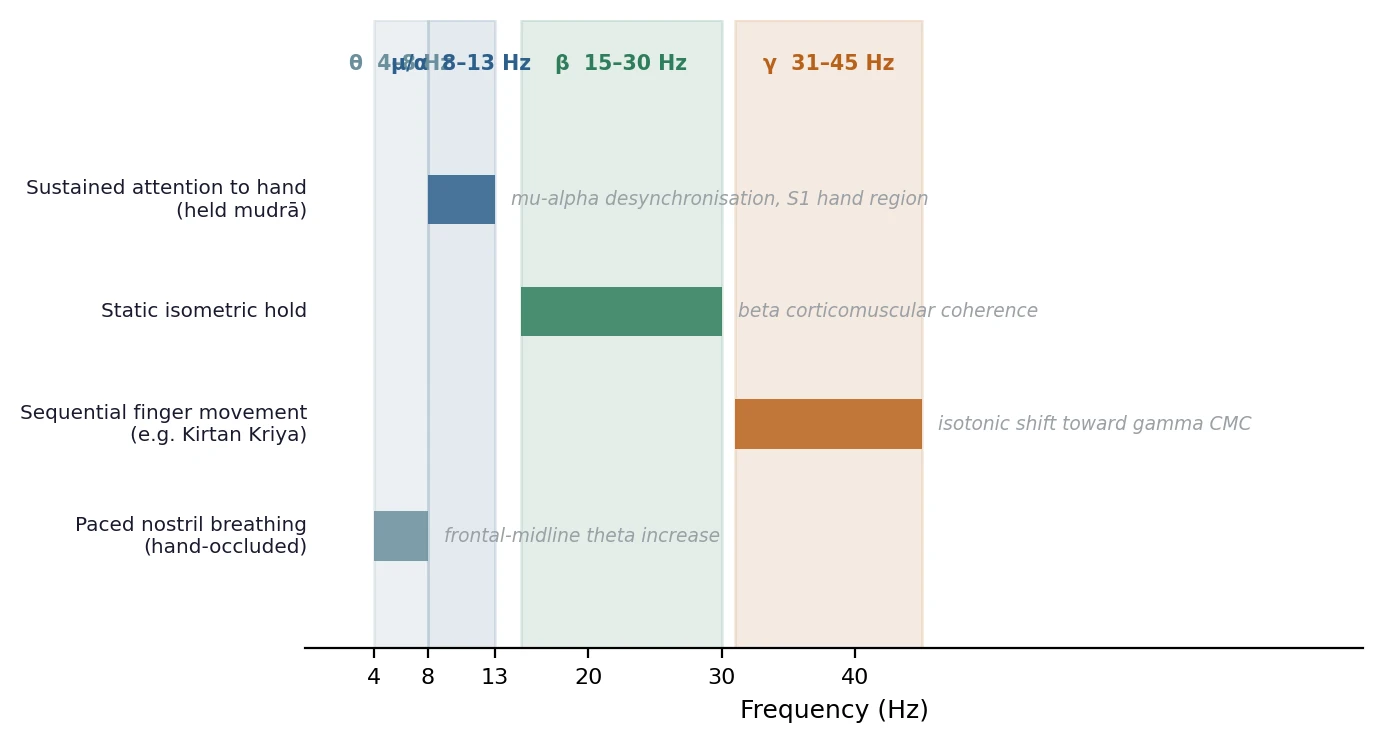
The sensorimotor mu rhythm is an 8–13 Hz oscillation, with an accompanying 15–29 Hz mu-beta component, recorded over central scalp regions and generated in the postcentral gyrus and hand primary motor area. It is strongly and symmetrically suppressed during contralateral motor acts, its modulation reflecting synchronisation of motor-cortical pyramidal neurons. Gastaut and Bert observed in 1954 that desynchronisation occurs also during mere observation of another’s action.
The finding decisive for the present hypothesis is not movement-related suppression, which is trivial, but attentional modulation. Magnetoencephalographic work demonstrated that cued spatial attention modulates mu-alpha within the somatotopically localised hand representation of primary somatosensory cortex: power decreased following attentional cueing to the hand and increased following cueing to the foot, with the divergence reaching significance 500–1100 ms after cue onset, and mu-beta differences emerging at 800–850 ms.
Read against the practice, this is not an analogy for the hypothesis but an instance of it. A mudrā held with sustained attention directed to the point of thumb–index contact constitutes, in electrophysiological terms, a sustained attentional cue to the hand representation — which produces measurable, spatially localised, alpha-band power change in a defined cortical territory. The practice and the paradigm are the same manipulation described in two vocabularies.
Two further properties are operationally significant. Test–retest reliability of mu modulation is high, and individual peak mu frequency is stable within participants across motor-execution and action-observation tasks, permitting per-individual biomarker use rather than group-level statistics alone. Mu and occipital alpha, though overlapping in frequency, are dissociable by topography and separable by independent component analysis.
3.2 Per-Digit Somatotopy in Primary Somatosensory Cortex
The claim that manual practice can address specific cortical territories is often treated as metaphorical. At the level of primary somatosensory cortex it is measured anatomy.
Ultra-high-field functional magnetic resonance imaging at 7 T resolves the cortical representation of each individual digit at single-subject resolution. Each finger is represented within three subregions of the postcentral gyrus corresponding to Brodmann areas 3b, 1, and 2, with digits organised sequentially D1 to D5 in lateral-to-medial succession within each. Reported mean inter-digit distances are 15.5 mm in BA 3b, 15.1 mm in BA 1, and 8.6 mm in BA 2, with significant thumb magnification in BAs 1 and 2 and greater finger selectivity in 3b than in the more integrative areas 1 and 2. A probabilistic digit-dominance atlas has been constructed and cross-validated in 22 right-handed participants, and intra-digit phalangeal organisation is consistently ordered for D5 though variable for D1–D3.
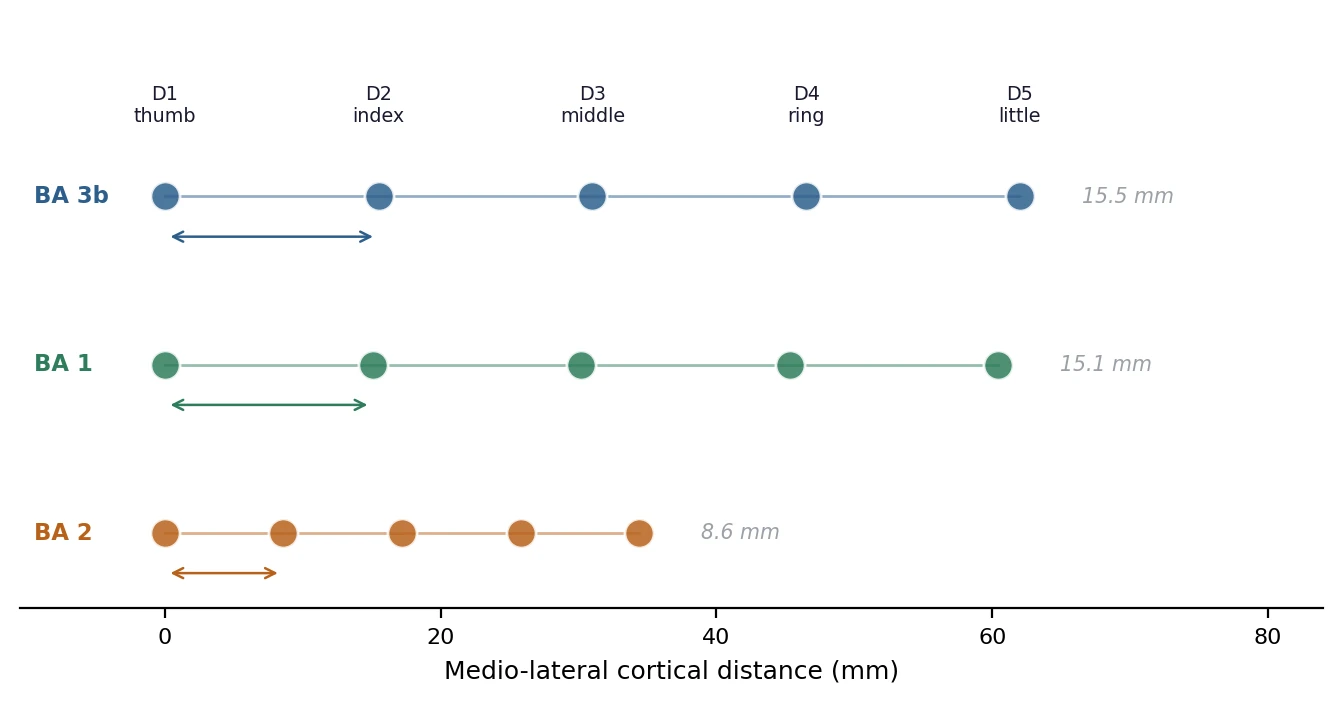
The implication is direct. Traditions that assign different elements, planets, Sefirot, or divine names to different fingers — the Sefer Yetzirah decad mapping, Hasidic per-finger kavvanot during netilat yadayim, the Vedic five-element assignments, Kummer’s per-rune finger allocations — are indexing distinct cortical territories separated by roughly 1.5 cm. Contact at the index finger and contact at the ring finger are not the same neural event; they are different events in different places. This does not establish that the traditional semantic assignments correspond to anything. It establishes that the addressing scheme has a real cortical substrate, which is a materially stronger position than the sceptical default.
3.3 Corticomuscular Coherence During Sustained Hold
A held mudrā is, mechanically, a low-force isometric contraction. This is not incidental. Conway and colleagues demonstrated in 1995 significant beta-band (13–35 Hz) coherence between cortical activity and electromyographic signal from contralateral hand muscles, indicating that synchronised cortical neuronal activity relates directly to motor-unit firing. Corticomuscular coherence is most commonly observed during isometric contraction, is associated with stable force output, and lies predominantly in the 15–30 Hz range. It has been validated across electroencephalography, magnetoencephalography, electrocorticography, and surface electromyography, and across species.
This constitutes a literal, measurable, phase-locked oscillatory coupling between hand state and cortical rhythm. The finding of greatest interest here is that contraction type determines frequency band: isotonic contractions shift corticospinal oscillations toward the gamma range (31–45 Hz) while isometric contractions favour beta. This yields a sharp and previously unstated prediction — a sustained static mudrā should exhibit beta-band corticomuscular coherence, whereas a sequential finger-movement practice such as Kirtan Kriya should shift measurably toward gamma.
Beta-band corticomuscular drive appears to reflect intermuscular binding into functional synergies rather than steady force production per se, and beta activity at single-trial resolution is transient rather than sustained even during continuous gripping. Alpha-band corticomuscular coherence, ordinarily absent in healthy participants and characteristic of pathological tremor, can be induced by mechanically destabilising the stretch-reflex loop — a finding with implications for practices involving deliberately unsupported or loaded hand positions.
4. The Peripheral Vascular and Autonomic Layer
4.1 Arteriovenous Anastomoses as a High-Gain Autonomic Effector
The glabrous skin of the digits and palms contains a vascular specialisation largely absent elsewhere: arteriovenous anastomoses, also termed glomus bodies. Their density in the nail beds reaches approximately 600 per cm² and in palmar and plantar skin approximately 100 per cm², by a wide margin the highest concentration in the body; two hands carry on the order of 10⁴. Each is roughly 0.5 mm in overall dimension with a lumen of 10–40 μm, enclosed in a firm capsule with a thick muscular coat, and richly supplied with non-myelinated sympathetic fibres permitting complete closure.
Because volumetric flow scales with the fourth power of radius, an open anastomosis carries approximately 256 times the flow of a capillary of equal length. These are shunts that bypass the nutritive capillary bed entirely. Critically, they are governed principally by hypothalamic signalling, so their state indexes whole-body autonomic and thermoregulatory set-point rather than local conditions. Infrared thermography and laser Doppler flowmetry show sympathetic stimuli producing near-immediate vasoconstriction most prominently in fingertip skin, with fingertip temperature following at approximately 15 s lag.
4.2 Bidirectionality: The Thermal Biofeedback Loop
The decisive property is that this coupling is bidirectional and volitionally trainable, a matter of established clinical practice rather than contested claim. Because hand vasoconstriction is predominantly sympathetic — the peripheral vasculature possessing little parasympathetic innervation — hand temperature serves as a single-variable index of sympathetic outflow under limbic–hypothalamic control. The autogenic biofeedback literature records spontaneous bilateral vasodilation raising hand temperature by 5.5 °C within 2 minutes, and controlled protocols have trained participants to produce temperature differentials between the two hands in a specified direction, demonstrating lateralised volitional vasomotor control. In patients with advanced heart failure, a single skin-temperature biofeedback session produced finger temperature increases of approximately 1.7 °C accompanied by changes in systemic vascular resistance and circulating catecholamines.
The explanatory model in that literature is explicitly cybernetic: peripheral somatic activity perceived, producing limbic response, hypothalamic response, autonomic response, and returning peripheral somatic response. This is functionally identical to the closed-loop control description arrived at independently within comparative ritual analysis. A practitioner attending closely to fingertip sensation during a sustained configuration is operating the input side of a documented, trainable, hypothalamically mediated control loop — a genuine and unexotic route by which manual practice reaches deep cerebral structures.
4.3 The Isometric Metaboreflex
Isometric handgrip training is now recommended as adjunct therapy for hypertension in joint American Heart Association and American College of Cardiology clinical practice guidance. Meta-analyses report brachial blood pressure reductions exceeding 6/4 mmHg across normotensive, prehypertensive, and hypertensive populations. Proposed mechanisms include central autonomic vasomotor control, baroreflex enhancement, endothelial adaptation, and the metaboreflex, with systematic review evidence that muscle sympathetic nerve activity rises during isometric handgrip and remains elevated during post-exercise circulatory occlusion, implicating the metaboreflex independently of the exercise pressor reflex.
Mechanistic detail remains genuinely contested and findings are inconsistent — some meta-analyses report systolic without diastolic effects, and ambulatory blood pressure effects are weaker than resting measures. The directional conclusion is nonetheless secure: a sustained hand grip constitutes a systemic autonomic intervention with guideline-level recognition. Canonical protocols of four sets of two minutes at 30 % maximal voluntary contraction are not distant from the duration profile of a held mudrā sequence, though force levels in contemplative practice are considerably lower and whether they cross the relevant threshold is untested.
4.4 Gesture Height: An Unremarked Hydrostatic Effect
The following observation appears not to have been made previously in this literature, and is quantitatively substantial.
The hydrostatic gradient within a blood column is 0.780 mmHg per centimetre of height for ρ = 1060 kg·m⁻³. Computing local arterial pressure change at the hand across the gesture heights that traditions actually encode yields the values in Table 2 and Figure 3.
| Gesture position | Δh vs. heart (cm) | ΔP at hand (mmHg) |
|---|---|---|
| Hands in lap (dhyāna mudrā) | −15 | +11.7 |
| Heart centre (añjali at hṛdaya) | 0 | 0.0 |
| Throat level | +15 | −11.7 |
| Forehead / ājñā (raised añjali) | +30 | −23.4 |
| Above crown (ūrdhva; orans; šuilla) | +55 | −42.9 |
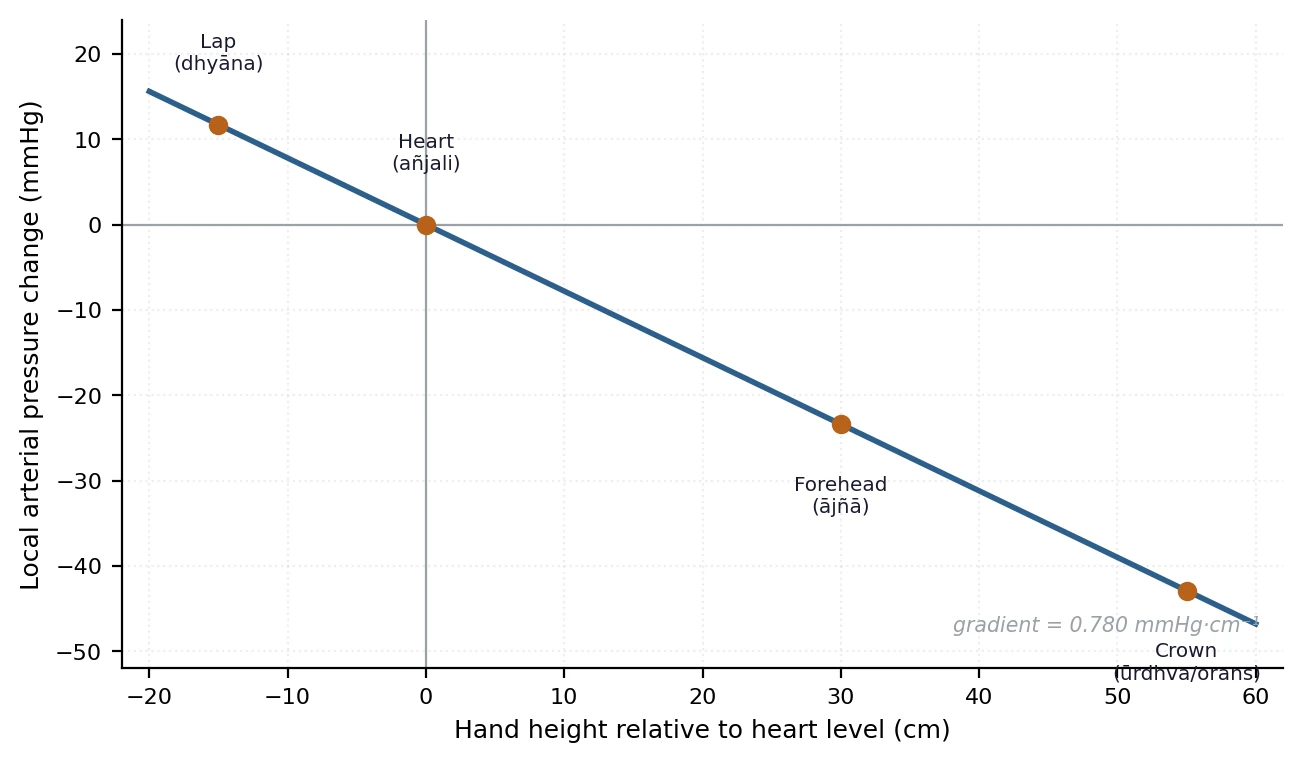
Comparative ritual analysis documents that traditions systematically encode gesture height as doctrinally significant. Añjali is specified at the heart for greeting the divine, at the forehead for higher reverence, and above the head for supreme reverence or for the guru; orans, šuilla, and duʿāʾ are defined by verticality. The standard interpretation treats this as embodied metaphor — the conceptual mapping of elevation onto sanctity.
That reading may well be correct, but it is not the only available reading, and the alternative has never been tested. Gesture height is simultaneously a large, graded, involuntary hemodynamic manipulation applied for minutes to the most densely innervated vascular effector surface in the body. Traditions that ranked gesture height by intensity of reported effect may have been ranking a real physiological gradient. The full lap-to-overhead excursion of approximately 55 mmHg is unambiguously sufficient to alter digital perfusion, anastomotic behaviour, skin temperature, and the afferent signalling consequent on all three.
5. The Afferent and Reflex Layer
5.1 Molecular Transduction: PIEZO2
The molecular basis of the afferent layer was resolved by work recognised with the 2021 Nobel Prize in Physiology or Medicine. Patapoutian and colleagues identified PIEZO1 and PIEZO2 as mechanically activated cation channels directly gated by force on the cell membrane — the largest transmembrane ion channel subunits yet identified, comprising some 2500 amino acids in a distinctive 38-transmembrane-helix topology whose curved membrane geometry flattens under stretch to open the pore.
PIEZO2 was subsequently established as essential for the sense of touch and as the principal mechanotransduction channel for proprioception, with conditional knockout producing severely uncoordinated movement and abnormal limb positioning, and analogous deficits observed in humans lacking functional PIEZO2. The channel has since been implicated in interoception, including bladder and pulmonary stretch sensing via vagal nodose neurons. Every mechanical parameter a manual tradition specifies — contact pressure, joint angle, sustained apposition, digit position — is transduced through this molecular machinery, which supplies the previously missing bottom stratum of the causal chain.
5.2 C-Tactile Afferents and the Interoceptive Route
A second afferent class is directly relevant to contact-based practice. C-tactile afferents are unmyelinated low-threshold mechanoreceptors that respond preferentially to slow, gentle, caress-like stroking. Their firing is strikingly velocity-tuned, discharging most vigorously between 1 and 10 cm·s⁻¹, with an inverted-U stimulus–response function that correlates positively with subjective pleasantness ratings.
Their projection target differs fundamentally from that of discriminative touch. Selective C-tactile activation produces activation of dorsal posterior insular cortex — a primary target of ascending lamina I spinothalamic projections — with no corresponding activation of primary sensory cortex, which receives the Aβ dorsal-column medial-lemniscal input. Lesions of dorsal posterior insula disrupt the pleasantness of touch delivered at C-tactile-optimal velocities. These afferents are therefore positioned within a system that is more interoceptive than exteroceptive. Functionally, C-tactile-optimal stroking reduces heart rate and blood pressure, elicits greater heart-rate deceleration and lower-amplitude skin conductance responses than non-optimal velocities, and has been linked to oxytocin release.
One anatomical asymmetry deserves emphasis because it constrains interpretation of contact practices such as laying-on of hands, nyāsa, and semikhah: C-tactile afferents innervate hairy skin and are not thought to innervate glabrous palmar skin. The practitioner’s palm is therefore not the C-tactile-bearing surface; the recipient’s hairy skin is. Any affective-touch account of such practices is thus intrinsically asymmetric between giver and receiver — and gentle stroking of the palm is nonetheless rated pleasant, indicating that C-tactile afferents cannot be the sole substrate of tactile hedonics.
5.3 Hand Acupoints and Limbic Network Modulation
A substantial neuroimaging literature examines manual stimulation of hand acupoints. The core replicated finding is that manual acupuncture at LI4 (Hegu), ST36, and LV3 deactivates a limbic–paralimbic–neocortical network while concurrently activating somatosensory regions. In a 46-participant study restricted to those reporting deqi sensation, point-differentiated effects were observed, with LI4 predominant in pregenual cingulate and hippocampal formation, ST36 in subgenual cingulate, and LV3 in posterior hippocampus and posterior cingulate. Real-versus-sham contrasts in independent studies show differential activation across somatosensory cortex, cingulate, parahippocampal gyrus, precuneus, basal ganglia, and cerebellum.
The anatomical coincidence is notable: LI4 lies on the radial aspect of the second metacarpal, precisely the region engaged when thumb and index finger are brought into sustained apposition — as in jñāna and cin mudrā, in the Latin benediction hand, and in a substantial fraction of the world’s meditative finger configurations. Two caveats apply. Acupoint specificity remains contested within the field, with several reviews noting broadly overlapping activation between adjacent points and a theoretical drift toward hypothalamic–pituitary–adrenal rather than point-specific accounts. And acupuncture involves needle insertion with deqi sensation, a far stronger stimulus than light finger apposition; whether contemplative contact forces cross any threshold is unknown. The pathway nonetheless generates a sharp testable prediction, stated as Experiment E3 below.
5.4 Hand-Mediated Modulation of the Nasal Cycle
The nasal cycle — alternating congestion and decongestion between nostrils, regulated by sympathetic and parasympathetic balance — has been reported to couple to alternating cerebral hemispheric dominance, with greater integrated electroencephalographic amplitude in the hemisphere contralateral to predominant airflow. Werntz and colleagues subsequently reported that forced unilateral nostril breathing produces relative increase in electroencephalographic amplitude in the contralateral hemisphere, and related work found alternating catecholamine concentrations in blood sampled simultaneously from both arms.
The traditional connection is explicit rather than retrofitted: recent high-density electroencephalographic work opens by observing that controlling nostril airflow through hand manipulation is an ancient yogic technique proposed to provide targeted modulation of neuronal excitability and lateralised autonomic regulation, with the relevant textual tradition being the Shiva Svarodaya. The technique set includes direct nostril occlusion by the fingers (viṣṇu mudrā) and also mechanical means — the yoga daṇḍa placed in the axilla, and axillary crutch pressure — used to shift nostril dominance.
Modern findings are mixed but not null. Paced nostril breathing decreased alpha/mu oscillations over central and parietal regions and increased frontal-midline and occipital theta relative to spontaneous breathing, with alternate-nostril breathing suppressing alpha/mu more than left-nostril breathing alone. A separate study found dominant-airway unilateral breathing elicited higher delta, theta, alpha, and beta activity frontally and centrally with lower posterior activity, and an inverted pattern in gamma, supported by source localisation. Against this, a randomised three-condition study in 13 participants found no change in cerebral hemispheric symmetry, only reduced relative theta during and reduced beta amplitude after practice. The general claim that hand-mediated nostril manipulation measurably alters spectral distribution is reasonably supported; the specific hemispheric-lateralisation claim is inconsistent across studies.
5.5 Finger Gnosis and Numerical Cognition
Sefer Yetzirah maps ten fingers onto ten Sefirot, and finger-based enumeration is near-universal across cultures. A relevant and genuinely contested literature bears on this. Gerstmann described in 1924 a syndrome associating finger agnosia, acalculia, dysgraphia, and left–right disorientation, localised to the dominant angular gyrus. Repetitive transcranial magnetic stimulation over left angular gyrus disrupts both finger-schema access and number-magnitude processing in the same participants, and direct electrostimulation of the angular gyrus produces temporary disturbance of both finger recognition and calculation.
The developmental picture is less secure. Several studies report finger gnosis predicting later numerical ability, and intervention studies suggest finger training improves arithmetic performance. However, a large study of 197 typically developing children found no meaningful association between finger gnosis and arithmetic skill once counting and symbolic magnitude comparison were accounted for, and a separate study concluded that finger gnosis predicts a unique but small portion of variance. The honest summary is that a neural association between finger representation and numerical processing is well supported in lesion and stimulation work, while the developmental-predictive claim is contested. This suffices to make the decad mapping neurologically non-arbitrary without licensing stronger inference.
6. Endogenous Field Mechanisms: Quantitative Evaluation
Claims that manual configuration operates through electromagnetic means are common in the practitioner literature and recur in contemporary bioelectromagnetic frameworks. These are here evaluated by computation rather than by appeal to plausibility.
6.1 Faraday Induction Within a Closed Finger Loop
A jñāna mudrā closes a conductive loop from thumb tip to index tip through both digits and the interdigital web. Treating this as a single-turn loop of 4.5 cm diameter (A = 1.590 × 10⁻³ m²) and applying EMF = 2πfBA with a conservative 1 kΩ finger-to-finger tissue impedance yields the values in Table 3.
| Exposure scenario | B (μT) | f (Hz) | Induced EMF | Current (1 kΩ) |
|---|---|---|---|---|
| Typical home background | 0.1 | 50 | 50.0 nV | 50 pA |
| Near household appliance | 2.0 | 50 | 999 nV | 999 pA |
| Directly beneath HV transmission line | 10.0 | 50 | 5.00 μV | 5.00 nA |
| Earth’s static geomagnetic field | 50.0 | 0 (DC) | 0 | 0 |
| Persinger-class circumcerebral coil | 1.0 | 10 | 99.9 nV | 100 pA |
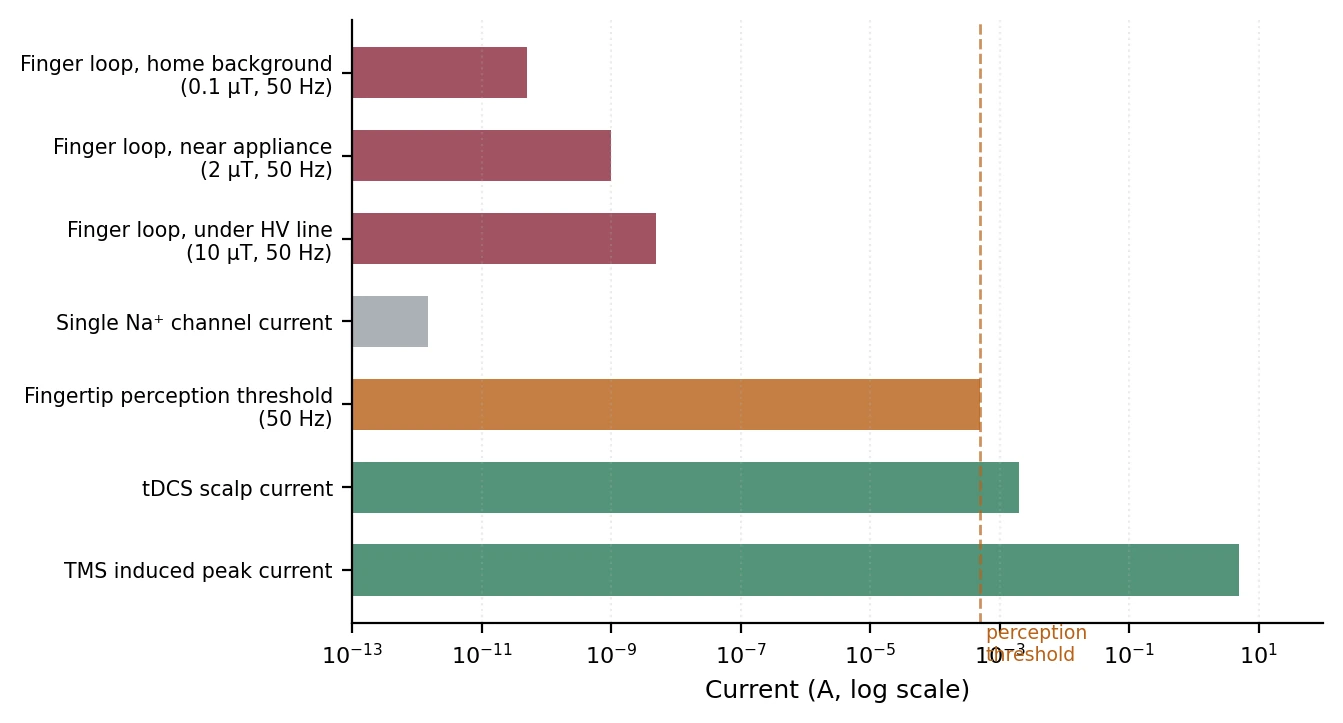
Two conclusions follow, and it matters which does the work. The magnitude objection is real but moderate: the best case, standing directly beneath a transmission line, yields approximately 5 nA against transcranial direct current stimulation currents of 1–2 mA, a ratio of about 4 × 10⁵, or 5.6 orders of magnitude. It is likewise some five to six orders below the fingertip electrical perception threshold of roughly 0.5–1 mA at 50 Hz, so the subject cannot detect it. The anatomical objection, however, is decisive: this current circulates within the finger. It is not a transcranial current and is not present in the head at all. No degree of waveform complexity, pattern sophistication, or resonance tuning alters the fact that a current loop in the hand does not stimulate the brain. It should be noted additionally that the Earth’s static field contributes exactly zero induction to a stationary loop, since dΦ/dt = 0; any claim that a static hand configuration couples the practitioner to the geomagnetic field fails on elementary electrodynamics unless the hand is in motion.
6.2 Dipole Fall-Off of Endogenous Hand Fields
A separate claim holds that the hand emits a biomagnetic field acting upon the practitioner’s own brain. Taking the strongest published measurements at face value — Seto and colleagues reported 4–10 Hz magnetic oscillation adjacent to the palms of qigong practitioners, and subsequent work reported milligauss-range oscillation near the hands of energy-therapy practitioners — and granting a generous 1 mG (10⁻⁷ T) at 2 cm with dipole 1/r³ fall-off, the field arriving at the practitioner’s own skull across a seated hand-to-head distance of 40–70 cm is approximately 10⁻¹¹ to 10⁻¹² T.
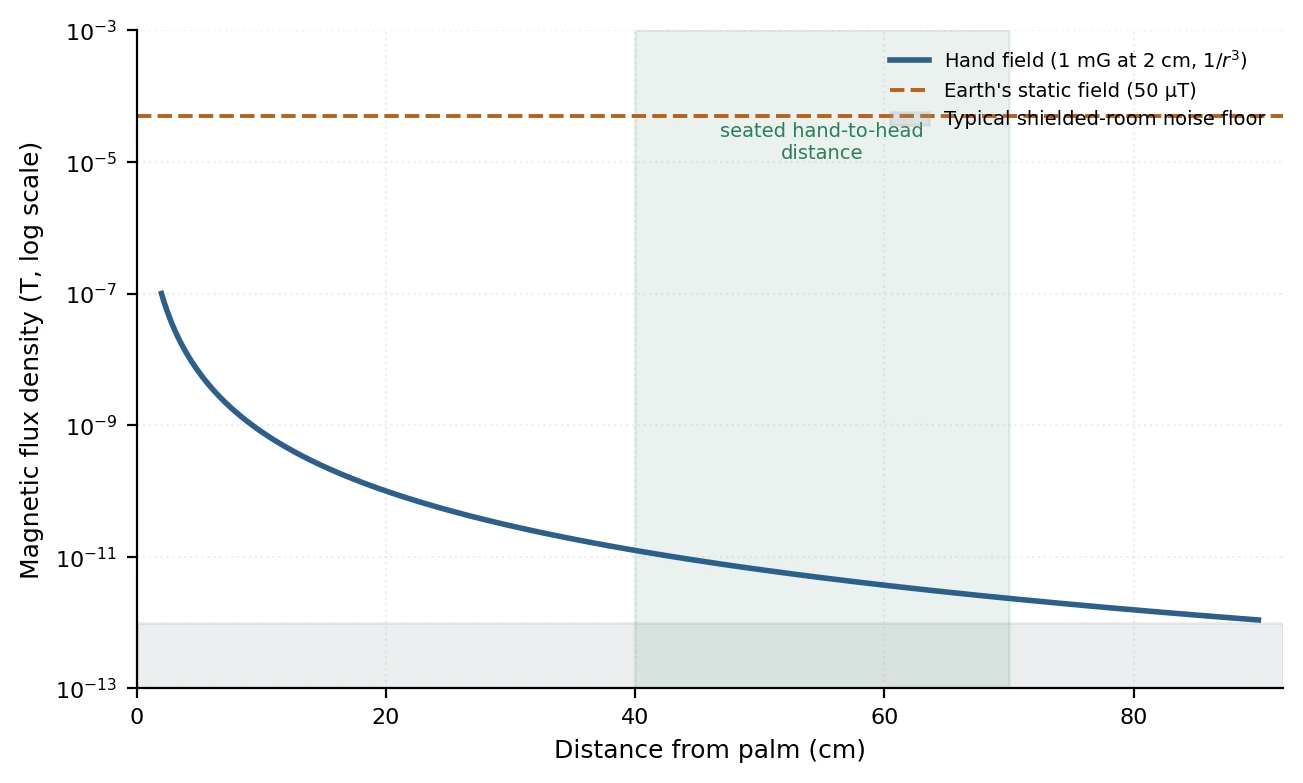
This is six to seven orders of magnitude below the geomagnetic field in which the head is already immersed, and well below ambient magnetic noise in any unshielded environment. A self-directed field mechanism is therefore not viable. Three qualifications are nonetheless warranted. The computation bears only on self-action and says nothing about hand-to-other-person claims at contact range, where r is an order of magnitude smaller and the inverse-cube term correspondingly 10³ times more favourable. It says nothing against the hand field as a marker rather than cause of autonomic state, which is a legitimate instrumentation proposal. And the underlying measurements are themselves weak: Seto and colleagues observed the effect in only 3 of 37 practitioners, and Baldwin and colleagues, from the same research group that reported the Reiki finding, were unable to duplicate it in three practitioners. Much material circulating as established fact traces to a 1985 report that did not undergo peer review.
6.3 Amplitude Windows and the Adey–Blackman Literature
The literature deserving the most careful hearing is that on calcium efflux windows, because it constitutes the strongest existing precedent for the general principle that very weak fields with specific frequency and amplitude characteristics produce effects that stronger fields do not — the same logic later adopted, apparently independently, in circumcerebral field research.
Bawin and Adey reported that sinusoidal electric fields near 16 Hz altered calcium binding in avian cerebral tissue within narrow intensity ranges. Blackman and colleagues confirmed both a frequency window and a narrow power-density window using 147 MHz radiation amplitude-modulated between 3 and 30 Hz, finding significant efflux enhancement at 16 Hz modulation and 0.75 mW·cm⁻². The 1985 extension found 16 Hz producing enhanced efflux in two separate intensity regions centred on 6 and 40 V·m⁻¹ — an explicitly non-monotonic dose–response, and the theoretically most consequential feature of the entire literature. Fine frequency structure was reported: no effect at 42 Hz but effect at 45 Hz; 60 Hz effective only at 35–40 V·m⁻¹; significant responses at 30 Hz intervals from 15 to 315 Hz, with 165 Hz breaking the pattern inconsistently with a simple Lorentz-force model.
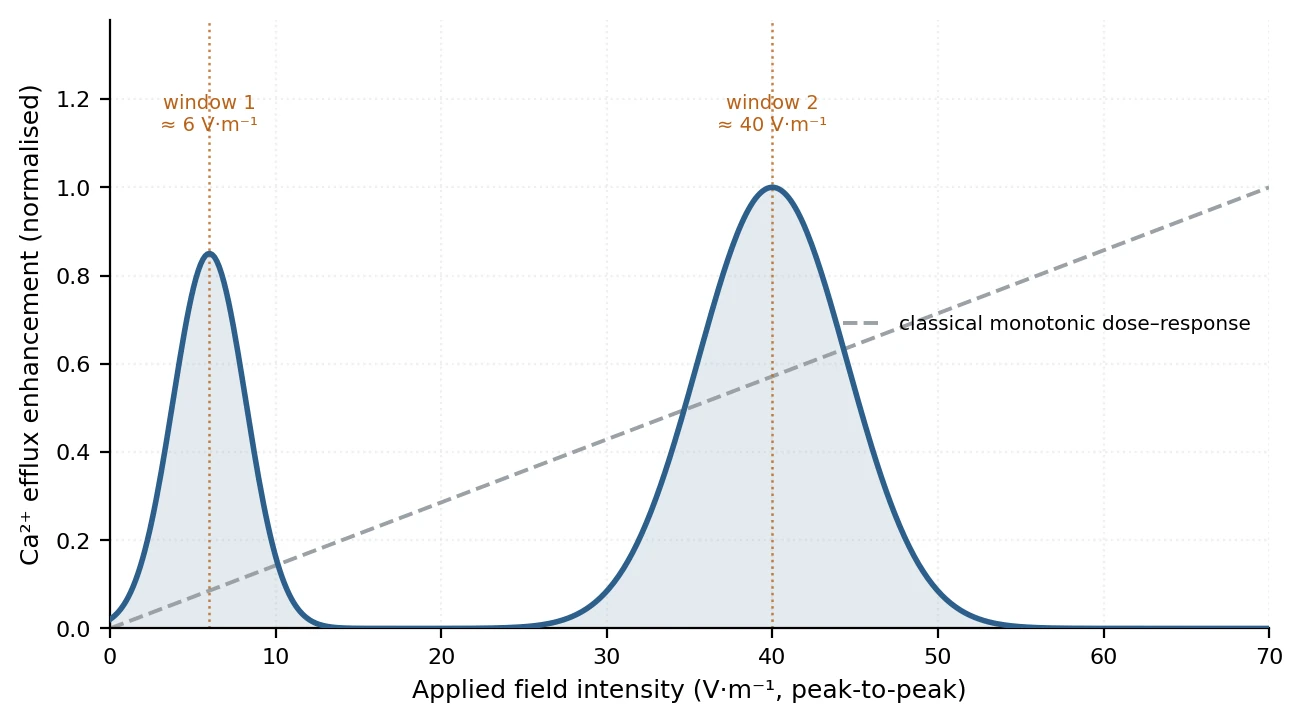
Non-monotonic dose–response is what makes this literature simultaneously difficult to dismiss and difficult to accept, since it violates the monotonicity assumption underlying most safety and efficacy reasoning. The contestation is genuine: Parsad and colleagues failed to reproduce increased calcium uptake in human lymphocytes under purported cyclotron-resonance conditions. The literature is graded T2 — real peer-reviewed in vitro findings, real replication difficulty, mechanistically unresolved. Crucially for the present hypothesis, however, it does not assist: these are effects of externally applied fields upon tissue, and there is no applied field in a manual gesture. It establishes that the category of weak-field bioeffects is scientifically live; it supplies no field for a gesture to act through.
6.4 The Radical-Pair Mechanism as Permissive Physics
The standard objection to weak-field biology is thermal: interaction energies fall orders of magnitude below kT and should be obliterated by thermal noise. The radical-pair mechanism is the physically serious response. Following Schulten’s 1978 proposal, photoinduced electron transfer generates radical pairs whose singlet–triplet interconversion is sensitive to weak magnetic fields through hyperfine and Zeeman interactions; because singlet and triplet states yield different recombination products, a field far too weak to matter energetically can nonetheless steer reaction yields. The exploited resource is spin correlation, not energy.
Recent work strengthens the account considerably. Tightly bound radical pairs — specifically the FAD–superoxide pair in cryptochrome, previously assumed unresponsive owing to arrested spin dynamics — have been shown capable of responding to Earth-strength fields where recombination is strongly asymmetric, invoking the quantum Zeno effect. Reviews catalogue reported weak-field effects on circadian rhythm, calcium concentration, action potentials, reactive oxygen species, neurogenesis, and microtubule assembly. Human cryptochrome-2 has been demonstrated to possess the molecular capability to function as a light-sensitive magnetosensor.
The role of this mechanism in the present analysis is permissive rather than supportive. It removes the blanket objection that thermal noise renders all weak-field effects impossible, which means claims in this domain must be assessed individually on magnitude and route rather than dismissed categorically. This is a substantive correction to reflexive scepticism. It nonetheless supplies no field for a gesture to act through, and the exclusions of Sections 6.1 and 6.2 stand unaffected.
6.5 The Kirschvink Result and the Methodological Standard
One external finding is of first importance for any research programme in this space. Wang and colleagues reported in eNeuro that rotations of Earth-strength magnetic fields produce a repeatable drop in electroencephalographic alpha-band (8–13 Hz) amplitude in human participants — alpha event-related desynchronisation, the standard neural signature of sensory detection and consequent attentional shift.
What elevates this result beyond its headline is methodological. The protocol employed a Faraday-shielded chamber with fluxgate magnetometer monitoring, 64-channel electroencephalography, and — decisively — double-wrapped coils permitting genuine active sham, in which the control condition passes identical current through the coils in anti-parallel configuration producing no net field. This design answers the suggestibility objection structurally rather than statistically. The observed response was polarity-specific, occurring only for horizontal rotations when the static vertical component pointed downward as in the Northern Hemisphere, and absent when inverted; the authors read this as excluding radical-pair mechanisms, which detect axial alignment only, and favouring biogenic magnetite. Participants reported no conscious awareness of the stimulus, and individual differences were large.
The implication runs in two directions simultaneously. The result vindicates the general premise that weak magnetic fields can produce reproducible, spectrally localised human electroencephalographic change at field strengths comparable to those targeted by circumcerebral devices. And it raises the methodological bar: the reason this finding is credible while the sensed-presence literature remains disputed is the active-sham design and shielded environment, not the effect size.
6.6 Ultraweak Photon Emission
Ultraweak photon emission from the human body is a genuine measured phenomenon — spontaneous emission in the visible range at 10 to 10⁴ photons·s⁻¹·cm⁻², arising predominantly from reactive oxygen species and oxidative metabolism, detected by photomultiplier and electron-multiplying charge-coupled device photon counting, with diurnal rhythm imaged in whole-body preparations.
Directly relevant findings exist. Van Wijk and colleagues reported that meditation reduces emission from hands and forehead, that transcendental meditation practitioners exhibited the lowest values among populations studied, and — the striking detail — that modulation was anatomically specific, concentrated at the palmar hollow. Nakamura and Hiramatsu characterised emission from the human palm and its dependence on temperature and oxygen concentration, concluding that palmar emission partly reflects oxidation reactions both at and beneath the skin surface. This constitutes a legitimate, instrumentable, peer-reviewed measurement channel. Two cautions apply: emission indexes oxidative metabolism, so reduced palmar emission during meditation most parsimoniously indicates reduced local metabolic and oxidative activity — connecting directly back to the vasomotor mechanisms of Section 4 rather than to anything exotic; and coherence interpretations constitute a separate and much weaker theoretical overlay that should not be bundled with the measurement itself.
6.7 Piezoelectricity in Connective Tissue
Fukada and Yasuda established in 1957 that dry bone is piezoelectric in the classical sense, and subsequently demonstrated the effect in the collagen of bovine and equine Achilles tendon, reporting piezoelectric constants among the largest observed in crystalline polymers and attributing the origin to polarisation or displacement of hydrogen bonds within polypeptide chains. This provided a biophysical basis for Wolff’s law and is frequently invoked to support the proposition that sustained manual configurations generate physiologically meaningful electrical signals.
The corrective that practitioner literature almost universally omits is decisive: wet collagen does not exhibit piezoelectric response, and studies of fully hydrated bone raise substantial doubt as to whether wet bone is piezoelectric at all at physiological frequencies. In vivo longitudinal piezoelectric potentials have been calculated at approximately 1 nV locally. Under physiological conditions, streaming potentials driven by interstitial fluid flow appear to dominate over solid-phase piezoelectric charge generation. The phenomenon is real in dry tissue and largely vanishes in the hydrated state; this pathway is accordingly graded T3 and ranked lowest of the surviving candidates.
7. The Recitation Layer: Demonstrated Cross-Tradition Convergence
Manual practice is frequently accompanied by recitation, and here the empirical evidence is stronger than anything in the gesture literature itself. Bernardi and colleagues tested 23 healthy adults reciting either the Latin Ave Maria rosary or the Sanskrit mantra oṃ-maṇi-padme-oṃ. Both forms spontaneously slowed respiration to almost exactly six breaths per minute; both produced striking, powerful, and synchronous increases in existing cardiovascular rhythms at that rate; and baroreflex sensitivity increased significantly, from 9.5 (SD 4.6) to 11.5 (4.9) ms·mmHg⁻¹.
The significance lies in what six breaths per minute is. It is the baroreflex resonance frequency — the rate at which respiratory and cardiovascular oscillations phase-lock and heart rate variability is maximised. Two liturgical traditions with no plausible transmission relationship, in different languages on different continents, converged upon the same physiological resonance frequency, and the convergence is measurable under controlled conditions.
This is convergent evolution of a physiological control technology, empirically demonstrated. It establishes that the class of claim advanced for manual practice is the kind of claim that can be true and can be tested. It also indicates where to look: not toward exotic transmission mechanisms, but toward shared physiological resonances discoverable by iterative refinement over centuries of practice. The methodological warning is equally important — in any combined practice the recitation performs large, quantified autonomic work, so any study attributing an effect to a manual configuration without controlling recitation rate is confounded by an effect of this magnitude.
8. Synthesis: The Stacked-Mechanism Model
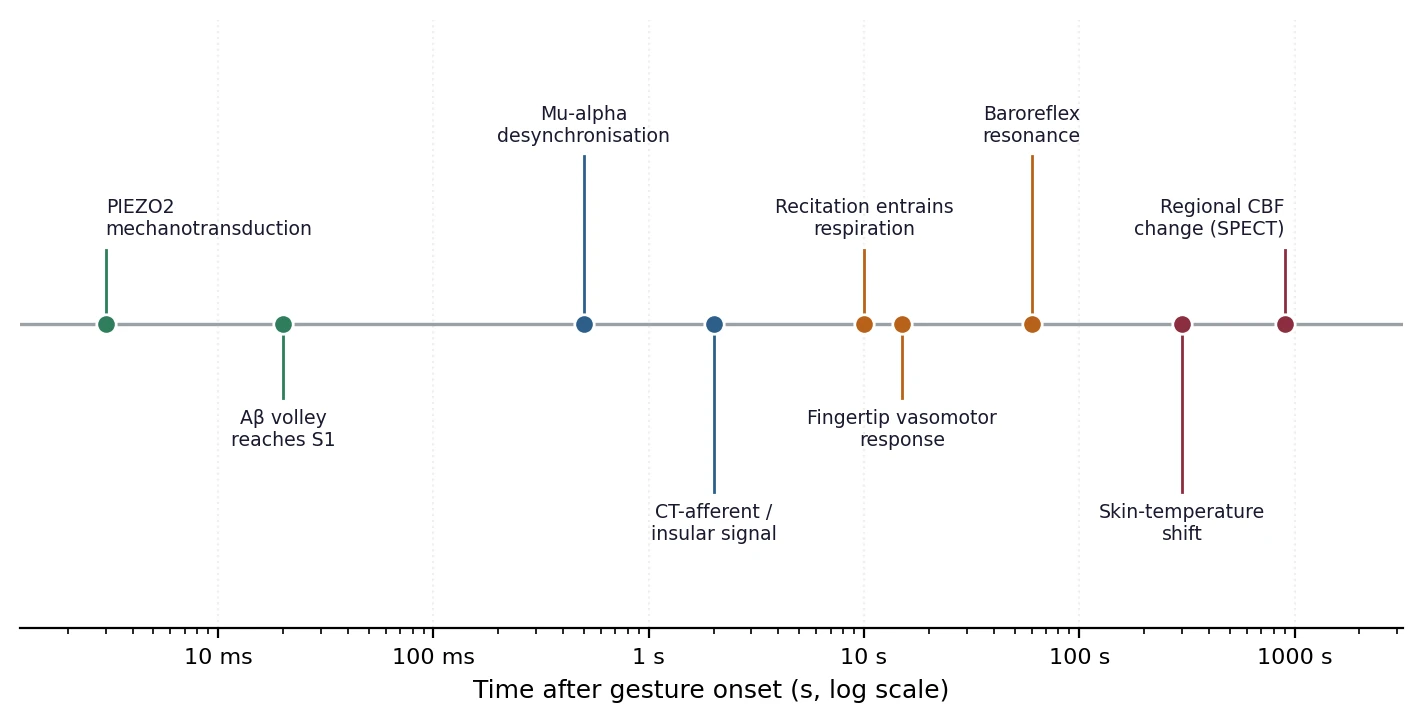
The traditions do not operate a single mechanism. They operate a stack whose layers are largely independent, which explains both the robustness of the practices and the persistent tendency of single-mechanism studies to yield small and ambiguous effects.
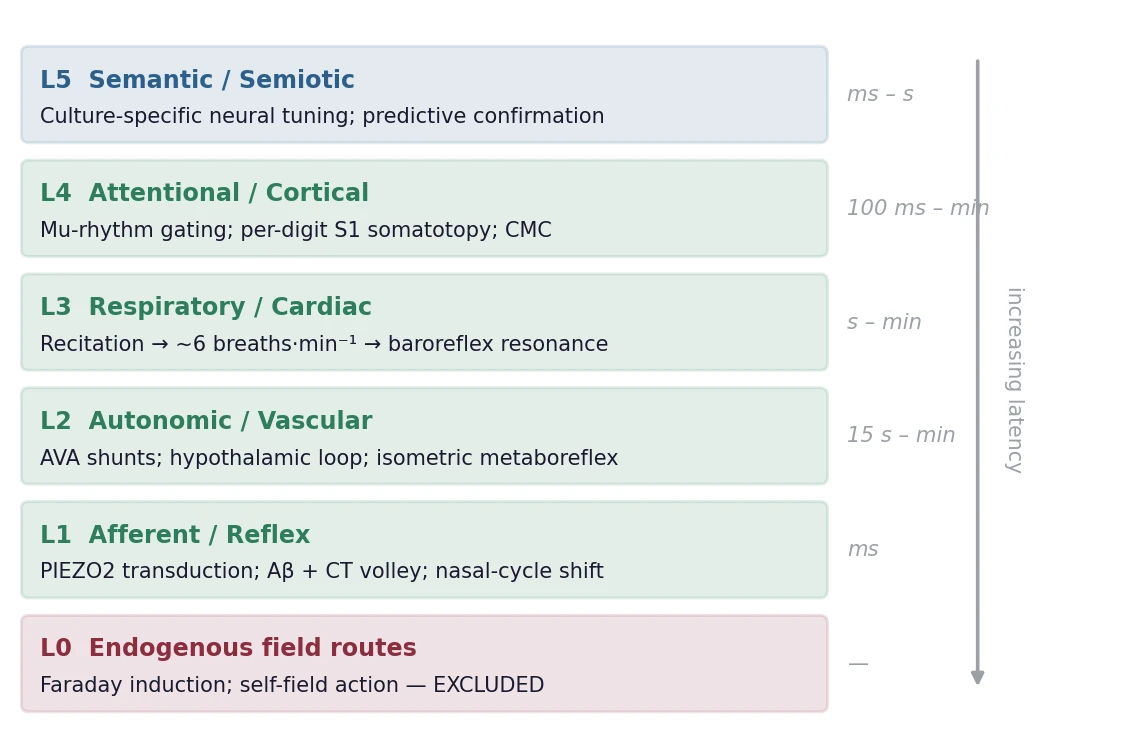
Under this model, the apparent over-specification of traditional practice acquires a different reading. The exact finger contacts, the exact height, the exact duration, the accompanying recitation and its rate, the prescribed breath — these are not redundant ritual elaboration. Each specified parameter loads a different layer of the stack. Digit identity loads Layer 4 through somatotopy. Gesture height loads Layer 2 through hydrostatics. Recitation rate loads Layer 3 through baroreflex resonance. Contact territory loads Layer 1 through differential innervation. Cultural meaning loads Layer 5 through learned neural tuning.
This is the substantive reframe the analysis produces. These practices present as empirically refined multi-layer physiological protocols whose parameters were optimised through centuries of iteration without any practitioner knowing which layer any given parameter was loading. Convergence across independent traditions then requires no mysterious explanation: independent lineages running long optimisation loops against identical physiology will converge upon similar parameter settings, exactly as the rosary–mantra result demonstrates concretely for the respiratory layer. The error in the strong form of the hypothesis lies in locating the mechanism within an endogenous field layer that computation excludes. Its central insight — that these are precise instruments rather than arbitrary symbolism — is better supported by deep mechanistic analysis than by superficial treatment.
8.1 Cultural Specificity Reconsidered
It is sometimes proposed that manual symbol systems operate differently across ethnic populations — runic practice for Western, Kabbalistic for Near Eastern, mudrā for South Asian ancestry. The underlying intuition, that these systems engage brains differently, is correct. The proposed cause is not.
Culture-specific neural tuning is real, measurable, and developmental. Native-language phonological processing differs demonstrably at the neural level from non-native processing; non-native phoneme discrimination degrades within the first year of life; script-specific tuning develops in the visual word form area as a function of reading acquisition. A Hebrew letter presented to a lifelong Hebrew reader and to a non-reader are not the same stimulus neurologically, and the difference is large, measurable, and localisable.
The mechanism is therefore experiential rather than genetic, which matters in three practical respects. It is testable now using standard psycholinguistic and event-related-potential methods, whereas an ancestry account proposes no measurable variable. It predicts the opposite outcome in the discriminating case: a person of Ashkenazi descent raised entirely outside Jewish practice should show no enhanced response to Hebrew letters, while a convert with twenty years of daily liturgical practice should show a large one — a clean falsifiable contrast that the developmental model is overwhelmingly likely to win, since the equivalent question was settled for language decades ago. And it yields a usable design principle: personalise on practice history and symbolic fluency, which are measurable, rather than on ancestry, which is neither causally relevant nor defensible. The developmental account explains everything the ancestry account was intended to explain, is measurable, and predicts more.
9. Mechanism Ranking and Discriminating Experiments
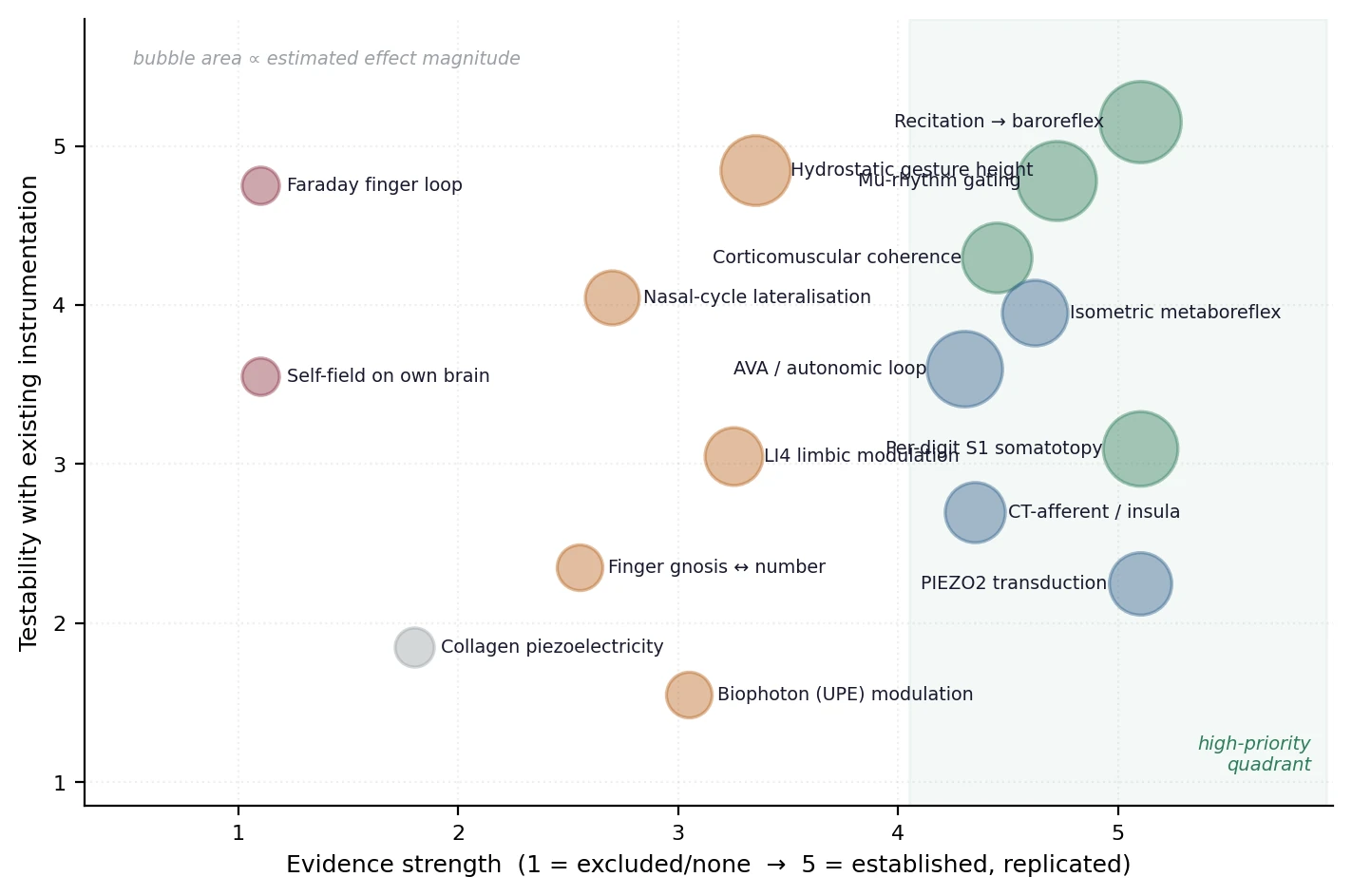
| # | Mechanism | Tier | Magnitude | Specificity | Testability |
|---|---|---|---|---|---|
| 1 | Mu-rhythm attentional gating | T1 | Large | Somatotopic in S1 | Trivial (EEG) |
| 2 | Recitation → baroreflex resonance | T1 | Large | Systemic | Trivial (HRV) |
| 3 | Per-digit S1 somatotopy | T1 | — | 8.6–15.5 mm | 7 T fMRI / HD-EEG |
| 4 | Beta corticomuscular coherence | T1 | Moderate | M1 hand area | Easy (EEG+EMG) |
| 5 | AVA / autonomic loop | T1 | Large | Systemic, hypothalamic | Easy (thermography) |
| 6 | Isometric metaboreflex | T1 | >6/4 mmHg | Systemic | Easy |
| 7 | Hydrostatic gesture height | T2 (computed) | ≤42.9 mmHg | Local | Easy — untested |
| 8 | PIEZO2 mechanotransduction | T1 | Foundational | Molecular | Difficult in vivo |
| 9 | CT-afferent / insular route | T1 | Moderate | Posterior insula | Moderate |
| 10 | LI4-territory limbic modulation | T2 | Moderate | Limbic-paralimbic | fMRI |
| 11 | Hand-mediated nasal cycle | T2 / T3 | Moderate | Hemispheric (disputed) | Easy |
| 12 | Finger gnosis ↔ numerical cognition | T2 (contested) | Small | Angular gyrus | Moderate |
| 13 | Ultraweak photon emission | T2 | Small | Palmar-specific | Specialist |
| 14 | Collagen piezoelectricity | T3 | ~1 nV | Local | Difficult |
| — | Faraday finger-loop induction | T0 excluded | ≤5 nA, extra-cranial | None | — |
| — | Self-field action on own brain | T0 excluded | ~10⁻¹² T at skull | None | — |
9.1 Discriminating Experimental Designs
The following designs separate stack layers rather than confirming the bundle. All are implementable with commercially available instrumentation.
- E1 — Digit-identity isolation (targets mechanisms 1 and 3). Hold contact force, duration, attention instruction, and posture constant; vary only which finger contacts the thumb across D2, D3, D4, and D5. Measure mu-band power at C3 and C4 with high-density source localisation. Prediction if per-digit somatotopy contributes: systematically different topography per digit. This is the cleanest available test of the specific-finger-to-specific-zone claim and appears never to have been performed.
- E2 — Height decoupling (targets mechanism 7). Identical configuration held at lap, heart, forehead, and overhead, with arm support to eliminate postural muscle work as a confound. Measure fingertip temperature, laser Doppler flux, and electroencephalography. Prediction: graded hemodynamic effect tracking the 0.780 mmHg·cm⁻¹ gradient, dissociable from symbolic-meaning effects. If phenomenology tracks height independently of the practitioner’s belief about its meaning, Layer 2 contributes more than Layer 5.
- E3 — Contact-territory contrast (targets mechanism 10). Thumb-to-index apposition engaging LI4 territory versus thumb-to-little-finger at matched force. Prediction if the acupoint pathway contributes: differential limbic–paralimbic response.
- E4 — Recitation decoupling (targets mechanism 2). Three-arm design of gesture alone, recitation alone, and both, with recitation rate metronome-controlled at six per minute and at a non-resonant comparison rate. This isolates the baroreflex effect and is mandatory for any study claiming a gesture-specific result.
- E5 — Contraction-mode band shift (targets mechanism 4). Static held configuration versus sequential finger-thumb sequence at matched force and attention. Prediction: beta-dominant corticomuscular coherence in the static condition shifting toward gamma in the sequential condition.
- E6 — Tradition-age null test (targets Section 1.1). Structurally matched gestures drawn from an ancient tradition and from Kummer’s 1933 system, taught identically to naive participants. Prediction under the stacked model: no difference, since no mechanism in Layers 1 through 4 is sensitive to the date of a gesture’s invention.
- E7 — Fluency versus ancestry (targets Section 8.1). Four groups crossing ancestry with practice depth for a single symbol system. Prediction: practice depth predicts response magnitude; ancestry does not.
Cross-cutting requirements apply to all seven. Pre-registration is not optional given this domain’s replication history. Outcome scoring must be blinded. Acquisition should be multi-channel and simultaneous — electroencephalography, thermography, heart rate variability, and electrodermal activity together — since the stacked model predicts that single-channel designs will systematically underdetect. Sample sizes must be powered for the small effect sizes characteristic of this literature; existing chanting-meditation imaging studies with 11 to 29 participants are consistent with, but nowhere near sufficient to confirm, the effects they report. Any claim of a field effect must adopt double-wrapped active-sham coils in a shielded enclosure, following the design that renders the Kirschvink result credible.
One methodological trap deserves specific mention. Palmar and plantar skin carry the densest eccrine innervation in the body, and electrodermal activity there indexes sympathetic cholinergic outflow directly. Bringing two fingertips into contact physically closes a low-impedance path between two of the body’s highest-conductance skin sites. Any electrodermal measurement taken during a finger-contact configuration is therefore confounded by the configuration itself — a fact worth establishing before designing an instrumented study rather than after.
10. Limitations
Several constraints bound the conclusions offered here. The direct empirical literature on mudrā specifically is thin; most mechanisms identified are established in adjacent domains and applied here by inference, which is legitimate for hypothesis generation but does not substitute for direct test. Effect sizes throughout this domain are small, and the meditation-imaging studies most closely resembling the target practices are small, largely non-blinded, and in several cases produced by groups with organisational interest in the outcome.
A structural epistemic limitation deserves explicit acknowledgement. Kernbach documents a substantial body of Soviet and Russian research from approximately 1917 onward concerning weak electromagnetic effects on biological systems, much of it state-funded, much never published in Western venues, and some still classified. Whatever one concludes regarding the more exotic claims within that tradition, the structural point holds: absence from the Western peer-reviewed corpus constitutes weak evidence of absence when a parallel research tradition was institutionally separated. A meta-analysis restricted to English-language indexed literature surveys what was published within one language community under one funding regime, not what is known. This cuts in both directions and should not be over-claimed — inaccessible literature cannot be evaluated, and unevaluable claims cannot be relied upon, and Kernbach is himself explicit about partial reliance on journalistic materials. But confident negative conclusions should be scaled accordingly.
Finally, primary German-language sources for the runic material were not consulted directly; the historical account rests on secondary scholarly and practitioner-historical sources that agree with one another. Certain widely circulated claims regarding hand-emitted biomagnetic fields trace to a 1985 report that did not undergo peer review and are treated here with corresponding caution.
11. Conclusion
Manual ritual practice across unrelated traditions converges upon a small set of configurations because those configurations engage a stack of genuine physiological mechanisms whose parameters the traditions optimised empirically without knowing what they were optimising. Four of the identified pathways are established and directly supportive: sensorimotor mu-rhythm gating, per-digit somatotopic separation at millimetre resolution, beta-band corticomuscular coherence, and respiratory entrainment to baroreflex resonance. Three further pathways are physically certain but untested in this context, including an apparently unremarked hydrostatic consequence of canonical gesture height computed here at up to 42.9 mmHg. Two endogenous electromagnetic pathways are excluded by direct computation — not on grounds of implausibility, but on grounds of magnitude and, decisively, anatomy.
The proposition that these practices constitute precise physiological instruments rather than arbitrary symbolism survives rigorous mechanistic scrutiny and is better supported by deep analysis than by superficial treatment in either direction. The proposition that they operate through endogenous field effects does not survive. The distinction matters, because the first proposition generates a research programme and the second generates only assertion.
Frequently Asked Questions
Can mudrās and ritual hand gestures change brain states?
The paper concludes that they plausibly can through ordinary physiology: attention to the hand gates the sensorimotor mu rhythm, individual digits map to separate areas of somatosensory cortex, sustained holds produce beta-band corticomuscular coherence, and rhythmic recitation entrains breathing to baroreflex resonance.
Do hand gestures work through bioelectromagnetic fields?
No. By direct calculation, Faraday induction in a closed thumb–index loop yields at most 5.0 nA under worst-case ambient exposure, and any self-generated hand field is about 10⁻¹¹–10⁻¹² T at the skull — six to seven orders of magnitude below Earth’s magnetic field.
What is the hydrostatic effect of gesture height?
Raising or lowering the hands changes the local arterial pressure at the hand relative to heart level. The paper computes this effect at up to 42.9 mmHg for canonical gesture heights and notes that it appears not to have been discussed before.
What is the stacked-mechanism model?
A model in which the parameters traditions specify very precisely — which digits touch, how high the hands are held, which skin territory is contacted, the recitation rate and the symbolic content — each act on a distinct physiological layer, making these practices multi-layer protocols rather than arbitrary symbolism.
Which traditions does the analysis cover?
Vedic and Buddhist mudrā, Kabbalistic finger-letter meditation derived from Sefer Yetzirah, and the twentieth-century runic hand postures of Marby and Kummer.
Appendix A. Computational Derivations
A.1 Constants
μ₀ = 4π × 10⁻⁷ T·m·A⁻¹; ρ_blood = 1060 kg·m⁻³; g = 9.80665 m·s⁻²; 1 mmHg = 133.322 Pa. No fitted parameters are employed at any point.
A.2 Faraday induction in a closed finger loop
Loop treated as single-turn, diameter d = 4.5 cm, hence A = π(d/2)² = π(0.0225)² = 1.590 × 10⁻³ m². Induced electromotive force EMF = 2πfBA. For B = 10 μT at f = 50 Hz: EMF = 2π(50)(10 × 10⁻⁶)(1.590 × 10⁻³) = 4.996 × 10⁻⁶ V. With finger-to-finger tissue impedance conservatively estimated at 1 kΩ, I = 4.996 × 10⁻⁹ A. Ratio to transcranial direct current stimulation at 2 mA: 2 × 10⁻³ / 4.996 × 10⁻⁹ = 4.003 × 10⁵, i.e. 5.60 orders of magnitude. For static field, dΦ/dt = 0 and EMF = 0 identically.
A.3 Hydrostatic gradient
Pressure gradient per centimetre of vertical displacement: ΔP = ρgh/133.322 = (1060)(9.80665)(0.01)/133.322 = 0.780 mmHg·cm⁻¹. For displacement from lap (−15 cm) to overhead (+55 cm), total excursion = 70 cm × 0.780 = 54.6 mmHg.
A.4 Dipole fall-off
Taking B₀ = 1 × 10⁻⁷ T at r₀ = 0.02 m and applying B(r) = B₀(r₀/r)³: at r = 0.50 m, B = 1 × 10⁻⁷ × (0.04)³ = 6.40 × 10⁻¹² T. Ratio to the geomagnetic field of 50 μT: 1.28 × 10⁻⁷.
A.5 Anastomotic shunt capacity
Approximate count across two hands: (10 digits × 600 cm⁻² × 1 cm²) + (100 cm⁻² × 100 cm²) ≈ 1.6 × 10⁴. Poiseuille scaling Q ∝ r⁴ yields an open anastomosis carrying approximately 256 times the flow of a capillary of equal length.
NOTE:
The complete computation script, producing every numerical value reported in this paper, is available from the author on request.
References
- Ackerley, R., Backlund Wasling, H., Liljencrantz, J., Olausson, H., Johnson, R. D., & Wessberg, J. (2014). Human C-tactile afferents are tuned to the temperature of a skin-stroking caress. Journal of Neuroscience, 34(8), 2879–2883.
- Ahn, A. C., & Grodzinsky, A. J. (2009). Relevance of collagen piezoelectricity to “Wolff’s law”: A critical review. Medical Engineering & Physics, 31(7), 733–741.
- Baldwin, A. L., Rand, W. L., & Schwartz, G. E. (2013). Practicing Reiki does not appear to routinely produce high-intensity electromagnetic fields from the heart or hands of Reiki practitioners. Journal of Alternative and Complementary Medicine, 19(6), 518–526.
- Bardon, F. (1956). Der Weg zum wahren Adepten [Initiation into Hermetics]. Verlag Hermann Bauer.
- Bawin, S. M., & Adey, W. R. (1976). Sensitivity of calcium binding in cerebral tissue to weak environmental electric fields oscillating at low frequency. Proceedings of the National Academy of Sciences, 73(6), 1999–2003.
- Bernardi, L., Sleight, P., Bandinelli, G., Cencetti, S., Fattorini, L., Wdowczyc-Szulc, J., & Lagi, A. (2001). Effect of rosary prayer and yoga mantras on autonomic cardiovascular rhythms: Comparative study. BMJ, 323(7327), 1446–1449.
- Besle, J., Sánchez-Panchuelo, R. M., Bowtell, R., Francis, S., & Schluppeck, D. (2014). Event-related fMRI at 7 T reveals overlapping cortical representations for adjacent fingertips in S1 of individual subjects. Human Brain Mapping, 35(5), 2027–2043.
- Blackman, C. F., Benane, S. G., Elder, J. A., House, D. E., Lampe, J. A., & Faulk, J. M. (1979). Induction of calcium-ion efflux from brain tissue by radiofrequency radiation: Effects of modulation frequency and field strength. Radio Science, 14(6S), 93–98.
- Blackman, C. F., Benane, S. G., House, D. E., & Joines, W. T. (1985). Effects of ELF (1–120 Hz) and modulated (50 Hz) RF fields on the efflux of calcium ions from brain tissue in vitro. Bioelectromagnetics, 6(1), 1–11.
- Conway, B. A., Halliday, D. M., Farmer, S. F., Shahani, U., Maas, P., Weir, A. I., & Rosenberg, J. R. (1995). Synchronization between motor cortex and spinal motoneuronal pool during the performance of a maintained motor task in man. Journal of Physiology, 489(3), 917–924.
- Coste, B., Mathur, J., Schmidt, M., Earley, T. J., Ranade, S., Petrus, M. J., Dubin, A. E., & Patapoutian, A. (2010). Piezo1 and Piezo2 are essential components of distinct mechanically activated cation channels. Science, 330(6000), 55–60.
- Daanen, H. A. M. (1991). Arterio-venous anastomoses and thermoregulation. TNO Institute for Perception / DTIC ADA245385.
- Fayol, M., Barrouillet, P., & Marinthe, C. (1998). Predicting arithmetical achievement from neuropsychological performance: A longitudinal study. Cognition, 68(2), B63–B70.
- Fukada, E., & Yasuda, I. (1957). On the piezoelectric effect of bone. Journal of the Physical Society of Japan, 12(10), 1158–1162.
- Fukada, E., & Yasuda, I. (1964). Piezoelectric effects in collagen. Japanese Journal of Applied Physics, 3(2), 117–121.
- Gastaut, H. J., & Bert, J. (1954). EEG changes during cinematographic presentation. Electroencephalography and Clinical Neurophysiology, 6, 433–444.
- Gerstmann, J. (1924). Fingeragnosie: Eine umschriebene Störung der Orientierung am eigenen Körper. Wiener Klinische Wochenschrift, 37, 1010–1012.
- Goldin-Meadow, S. (1999). The role of gesture in communication and thinking. Trends in Cognitive Sciences, 3(11), 419–429.
- Goldin-Meadow, S., & Beilock, S. L. (2010). Action’s influence on thought: The case of gesture. Perspectives on Psychological Science, 5(6), 664–674.
- Goldin-Meadow, S., Nusbaum, H., Kelly, S. D., & Wagner, S. (2001). Explaining math: Gesturing lightens the load. Psychological Science, 12(6), 516–522.
- Goodrick-Clarke, N. (1985). The Occult Roots of Nazism: Secret Aryan Cults and Their Influence on Nazi Ideology. Aquarian Press.
- Granqvist, P., Fredrikson, M., Unge, P., Hagenfeldt, A., Valind, S., Larhammar, D., & Larsson, M. (2005). Sensed presence and mystical experiences are predicted by suggestibility, not by the application of transcranial weak complex magnetic fields. Neuroscience Letters, 379(1), 1–6.
- Gwin, J. T., & Ferris, D. P. (2012). Beta- and gamma-range human lower limb corticomuscular coherence. Frontiers in Human Neuroscience, 6, 258.
- Hore, P. J., & Mouritsen, H. (2016). The radical-pair mechanism of magnetoreception. Annual Review of Biophysics, 45, 299–344.
- Jones, S. R., Kerr, C. E., Wan, Q., Pritchett, D. L., Hämäläinen, M., & Moore, C. I. (2010). Cued spatial attention drives functionally relevant modulation of the mu rhythm in primary somatosensory cortex. Journal of Neuroscience, 30(41), 13760–13771.
- Kaplan, A. (1997). Sefer Yetzirah: The Book of Creation in Theory and Practice (rev. ed.). Weiser Books.
- Kernbach, S. (2013). Unconventional research in USSR and Russia: Short overview. arXiv:1312.1148.
- Khalsa, D. S., Amen, D., Hanks, C., Money, N., & Newberg, A. (2009). Cerebral blood flow changes during chanting meditation. Nuclear Medicine Communications, 30(12), 956–961.
- Kobayashi, M., Kikuchi, D., & Okamura, H. (2009). Imaging of ultraweak spontaneous photon emission from human body displaying diurnal rhythm. PLoS ONE, 4(7), e6256.
- Kolasinski, J., Makin, T. R., Jbabdi, S., Clare, S., Stagg, C. J., & Johansen-Berg, H. (2016). Investigating the stability of fine-grain digit somatotopy in individual human participants. Journal of Neuroscience, 36(4), 1113–1127.
- Kummer, S. A. (1933). Runen-Magie. Hartmann.
- Langevin, H. M., & Yandow, J. A. (2002). Relationship of acupuncture points and meridians to connective tissue planes. Anatomical Record, 269(6), 257–265.
- Löken, L. S., Wessberg, J., Morrison, I., McGlone, F., & Olausson, H. (2009). Coding of pleasant touch by unmyelinated afferents in humans. Nature Neuroscience, 12(5), 547–548.
- Long, I., Malone, S. A., Tolan, A., Burgoyne, K., Heron-Delaney, M., Witteveen, K., & Hulme, C. (2016). The cognitive foundations of early arithmetic skills: It is counting and number judgment, but not finger gnosis, that count. Journal of Experimental Child Psychology, 152, 327–334.
- Marby, F. B. (1931–1935). Runenschrift, Runenwort, Runengymnastik. Marby-Verlag.
- Martuzzi, R., van der Zwaag, W., Farthouat, J., Gruetter, R., & Blanke, O. (2014). Human finger somatotopy in areas 3b, 1, and 2: A 7T fMRI study using a natural stimulus. Human Brain Mapping, 35(1), 213–226.
- McGlone, F., Wessberg, J., & Olausson, H. (2014). Discriminative and affective touch: Sensing and feeling. Neuron, 82(4), 737–755.
- McNeill, D. (1992). Hand and Mind: What Gestures Reveal about Thought. University of Chicago Press.
- Millar, P. J., McGowan, C. L., Cornelissen, V. A., Araujo, C. G., & Swaine, I. L. (2014). Evidence for the role of isometric exercise training in reducing blood pressure: Potential mechanisms and future directions. Sports Medicine, 44(3), 345–356.
- Nakamura, K., & Hiramatsu, M. (2005). Ultra-weak photon emission from human hand: Influence of temperature and oxygen concentration on emission. Journal of Photochemistry and Photobiology B, 80(2), 156–160.
- Norseen, J. D. (1996). Images of mind: The semiotic alphabet. ACSA.
- Norseen, J. D., Kropotov, J. D., & Kremen, I. Z. (1999). Bio-fusion for intelligent systems control. Proceedings of SPIE, 3719, 411–417.
- Olausson, H., Lamarre, Y., Backlund, H., Morin, C., Wallin, B. G., Starck, G., Ekholm, S., Strigo, I., Worsley, K., Vallbo, Å. B., & Bushnell, M. C. (2002). Unmyelinated tactile afferents signal touch and project to insular cortex. Nature Neuroscience, 5(9), 900–904.
- Parsad, A. V., Miller, M. W., Carstensen, E. L., Cox, C., Azadniv, M., & Brayman, A. A. (1991). Failure to reproduce increased calcium uptake in human lymphocytes at purported cyclotron resonance exposure conditions. Radiation and Environmental Biophysics, 30(4), 305–320.
- Penfield, W., & Rasmussen, T. (1950). The Cerebral Cortex of Man: A Clinical Study of Localization of Function. Macmillan.
- Persinger, M. A., & Koren, S. A. (2005). A response to Granqvist et al. “Sensed presence and mystical experiences are predicted by suggestibility, not by the application of transcranial weak magnetic fields.” Neuroscience Letters, 380(3), 346–347.
- Rusconi, E., Walsh, V., & Butterworth, B. (2005). Dexterity with numbers: rTMS over left angular gyrus disrupts finger gnosis and number processing. Neuropsychologia, 43(11), 1609–1624.
- Sánchez-Panchuelo, R. M., Francis, S., Bowtell, R., & Schluppeck, D. (2010). Mapping human somatosensory cortex in individual subjects with 7T functional MRI. Journal of Neurophysiology, 103(5), 2544–2556.
- Schulten, K., Swenberg, C. E., & Weller, A. (1978). A biomagnetic sensory mechanism based on magnetic field modulated coherent electron spin motion. Zeitschrift für Physikalische Chemie, 111(1), 1–5.
- Seto, A., Kusaka, C., Nakazato, S., Huang, W. R., Sato, T., Hisamitsu, T., & Takeshige, C. (1992). Detection of extraordinary large bio-magnetic field strength from human hand during external qi emission. Acupuncture & Electro-Therapeutics Research, 17(2), 75–94.
- Shannahoff-Khalsa, D. S. (2007). Selective unilateral autonomic activation: Implications for psychiatry. CNS Spectrums, 12(8), 625–634.
- Smith, M. J., Keel, J. C., Greenberg, B. D., Adams, L. F., Schmidt, P. J., Rubinow, D. A., & Wassermann, E. M. (1999). Menstrual cycle effects on cortical excitability. Neurology, 53(9), 2069–2072.
- St-Pierre, L. S., & Persinger, M. A. (2006). Experimental facilitation of the sensed presence is predicted by the specific patterns of the applied magnetic fields, not by suggestibility: Re-analyses of 19 experiments. International Journal of Neuroscience, 116(9), 1079–1096.
- Telles, S., Yadav, A., Kumar, N., Sharma, S., Visweshwaraiah, N. K., & Balkrishna, A. (2017). Hemisphere specific EEG related to alternate nostril yoga breathing. BMC Research Notes, 10, 306.
- Vallbo, Å. B., Olausson, H., & Wessberg, J. (1999). Unmyelinated afferents constitute a second system coding tactile stimuli of the human hairy skin. Journal of Neurophysiology, 81(6), 2753–2763.
- Van Wijk, E. P. A., Ackerman, J., & Van Wijk, R. (2005). Effect of meditation on ultraweak photon emission from hands and forehead. Forschende Komplementärmedizin und Klassische Naturheilkunde, 12(2), 107–112.
- Wang, C. X., Hilburn, I. A., Wu, D.-A., Mizuhara, Y., Cousté, C. P., Abrahams, J. N. H., Bernstein, S. E., Matani, A., Shimojo, S., & Kirschvink, J. L. (2019). Transduction of the geomagnetic field as evidenced from alpha-band activity in the human brain. eNeuro, 6(2), ENEURO.0483-18.2019.
- Werntz, D. A., Bickford, R. G., & Shannahoff-Khalsa, D. (1987). Selective hemispheric stimulation by unilateral forced nostril breathing. Human Neurobiology, 6(3), 165–171.
- Werntz, D. A., Bickford, R. G., Bloom, F. E., & Shannahoff-Khalsa, D. S. (1983). Alternating cerebral hemispheric activity and the lateralization of autonomic nervous function. Human Neurobiology, 2(1), 39–43.
- Woo, S.-H., Lukacs, V., de Nooij, J. C., Zaytseva, D., Criddle, C. R., Francisco, A., Jessell, T. M., Wilkinson, K. A., & Patapoutian, A. (2015). Piezo2 is the principal mechanotransduction channel for proprioception. Nature Neuroscience, 18(12), 1756–1762.
- Zhang, Y., Zhang, S., Marin-Burgin, A., & Wang, X. (2024). Magnetosensitivity of tightly bound radical pairs in cryptochrome is enabled by the quantum Zeno effect. Nature Communications, 15, 10714.
- Zimmerman, J. (1985). New technologies detect effects of healing hands. Brain/Mind Bulletin, 10(16), 1–3.
How to Cite This Article
Suprun, A. (2026). Gestural Brain-State Induction: A Mechanism-Space Meta-Analysis of Manual Ritual Practice Across Vedic, Kabbalistic, and Western Esoteric Traditions. Nonlinear Platform Development. https://nonlinearplatform.com/blog/gestural-brain-state-induction-mudra-mechanisms/