
Comprehensive engineering analysis, archaeological corroboration, and comparative evaluation of alternative models.
In brief: The paper proposes that Malta’s prehistoric cart ruts carried wooden sledges whose runners had carved central grooves holding Globigerina Limestone rollers, with smaller side rollers for turns. For a 57-tonne block, 10–12 rollers keep peak contact stress at 9.5–11.2 MPa, and 12–15 people could haul it on level ground.
Key Takeaways
- Bedrock rut pairs keep a gauge of about 1.40 m; at Misraħ Għar il-Kbir (“Clapham Junction”) roughly 150 rut pairs cross within about 0.08 km².
- A representative 57-tonne Ħaġar Qim block on a 4-tonne sledge needs 10–12 main rollers (20–22 cm), keeping peak contact stress at 9.5–11.2 MPa with a safety factor of at least 2.
- Tractive effort is about 2.44–2.93 kN on level ground (12–15 people) and about 5.37 kN on a 5% gradient.
- Grooves 5.5–6.5 cm deep cut relative roller displacement by about 39%; with 8–12 cm side rollers, turns down to 5–6 m radius are possible.
- Grooved runners take 36–60 person-days per pair — about 1.8–2 times plain sledges — and every component can be made with stone tools, abrasives and fire.
In This Article
- Abstract
- 1. Introduction
- 2. Archaeological Background and Evidence
- 3. The Proposed Hybrid Model
- 4. Engineering Analysis and Quantitative Modelling
- 5. Manufacturing Technology and Labour Estimates
- 6. Comparative Evaluation of Alternative Models
- 7. Discussion, Limitations and Future Research
- 8. Conclusion
- Frequently Asked Questions
- References
Abstract
The prehistoric cart ruts of the Maltese Islands represent one of the most extensive and enigmatic transport infrastructures of the Neolithic–Bronze Age Mediterranean. This paper presents a fully developed hybrid mechanical model for the movement of multi-ton megalithic blocks. The system consists of wooden sledge runners fitted with precisely carved central longitudinal grooves that mechanically constrain Globigerina Limestone rollers travelling inside the bedrock ruts, supplemented by smaller auxiliary rollers housed in lateral grooves to accommodate differential motion during turns at complex junctions.
Using high-resolution archaeological data from Misraħ Għar il-Kbir (“Clapham Junction”), San Pawl tat-Tarġa, Ħaġar Qim and associated temple and quarry sites, combined with quantitative statics, Hertzian contact mechanics, kinematic modelling and experimental archaeology benchmarks, we demonstrate that the proposed configuration achieves lateral and longitudinal stability superior to free-roller or plain-sledge alternatives while remaining fully compatible with Neolithic lithic and woodworking technology. For a representative 57-tonne block from Ħaġar Qim, 10–12 main rollers (diameter 20–22 cm) maintain peak contact stresses of 9.5–11.2 MPa (safety factor ≥ 2). Tractive effort on level terrain is calculated at 2.44–2.93 kN, requiring only 12–15 persons. Groove depths of 5.5–6.5 cm reduce relative roller displacement by approximately 39 % and, when combined with 8–12 cm side rollers, permit controlled negotiation of turns with radii as low as 5–6 m.
Comparative multi-criteria analysis across four principal hypotheses (wheeled carts, plain sledges, unconstrained rollers, and the hybrid grooved system) shows the latter to be optimal for the observed rut morphology, recovered stone balls, dense multi-generational junction networks and absence of wheel remains. Manufacturing the grooved runners is estimated to require 36–60 person-days per pair — approximately 1.8–2 times the labour of plain sledges — yet yields reusable, low-maintenance components fully consistent with the dense, anastomosing rut networks documented at major nodes. The model integrates low rolling resistance, mechanical positional constraint and operational flexibility at junctions, offering a coherent explanatory framework for both the surviving infrastructure and the associated archaeological record.
Keywords
Maltese cart ruts, megalith transport, stone rollers, Neolithic engineering, Globigerina Limestone, hybrid sledge-and-roller system, Misraħ Għar il-Kbir, contact mechanics, turn stability, experimental archaeology
1. Introduction
The Temple Period (c. 3600–2500 BCE) of the Maltese archipelago witnessed the construction of some of the earliest and most sophisticated monumental stone architecture in the world. Moving orthostats and structural blocks weighing up to approximately 57 tonnes from quarries to temple platforms required a reliable, repeatable and labour-efficient transport technology capable of operating across karstic limestone terrain characterised by slopes, uneven surfaces and complex route nodes. The surviving network of bedrock-incised cart ruts provides the most direct physical evidence of this prehistoric infrastructure.
Pairs of parallel grooves exhibit a remarkably consistent gauge of approximately 1.40 m, with individual ruts reaching depths of up to 60 cm. While the purpose of the ruts as a transport system is generally accepted, the precise mechanism by which multi-tonne loads were moved has remained the subject of sustained scholarly debate. Proposed models have included two-wheeled carts, plain wooden sledges, and sledges or blocks riding directly on unconstrained stone rollers. Each of these hypotheses encounters specific difficulties when tested against the full archaeological dataset: the presence of deep and narrow rut profiles, the recovery of numerous roughly spherical limestone balls near temple and quarry sites, the absence of wheel or axle remains, and the existence of dense, multi-track anastomosing junctions such as Misraħ Għar il-Kbir (“Clapham Junction”).
This paper advances and subjects to rigorous quantitative evaluation a hybrid engineering solution that resolves many of these difficulties. The proposed system employs wooden sledge runners fitted with central longitudinal grooves that mechanically constrain Globigerina Limestone rollers travelling inside the bedrock ruts, augmented by smaller auxiliary rollers housed in lateral grooves to manage differential path lengths during turns. The model is supported by detailed static and kinematic calculations, contact-stress analysis, manufacturing feasibility assessment using Neolithic technology, and systematic comparison with alternative hypotheses. All calculations are grounded in documented archaeological parameters and experimental archaeology benchmarks.
2. Archaeological Background and Evidence
2.1 Cart Ruts: Morphology, Distribution and Formation
The most intensively studied and complex concentration of cart ruts occurs at Misraħ Għar il-Kbir (Siġġiewi), popularly known as “Clapham Junction”. Within an area of approximately 0.08 km², roughly 150 rut pairs intersect, anastomose, diverge and rejoin in multiple superimposed generations of use. Gauge remains consistently close to 1.40 m (documented range 1.37–1.42 m). Individual grooves exhibit top widths of 8–79 cm (mean ~26 cm) and depths of 4–60 cm (mean ~20 cm). Cross-sections vary from V-shaped through U-shaped to rectangular. Many ruts meander to follow topographic advantages or to avoid obstacles, while concentrations occur at cols, scarp slopes and route nodes.
Comparable networks are documented at San Pawl tat-Tarġa (near Naxxar), Binġemma, Imtaħleb and in the immediate vicinity of major temple complexes. Ruts frequently display parallel “duplicate” tracks interpreted as successive lateral shifts when central ridges became obstructive to vehicle clearance. Experimental geomorphological studies have demonstrated that repeated passage of loaded vehicles on wet Globigerina Limestone can rapidly incise such grooves, with traffic intensity directly correlating with final depth.
2.2 Stone Balls (Rollers)
Hundreds of roughly spherical or ovoid limestone objects, predominantly 15–30 cm in diameter, have been recovered in direct association with temple sites (Ħaġar Qim, Mnajdra, Ġgantija, Tarxien) and cart-rut networks. Petrographic and geochemical analyses confirm that these objects were manufactured from local Globigerina Limestone — the same formation quarried for temple masonry. Wear patterns on archaeological specimens and successful experimental replication demonstrate that such spheres can be produced by initial pecking with harder hammerstones followed by prolonged abrasion using quartz sand and water. These techniques lie fully within the documented Neolithic technological repertoire of the central Mediterranean.
2.3 Megalithic Blocks and Temple Construction Context
The largest orthostats and load-bearing elements at Ħaġar Qim and Mnajdra reach estimated masses of approximately 50–57 tonnes. Transport distances were typically short (generally less than 2 km) but frequently involved gradients, uneven karst surfaces and the requirement for precise final positioning within temple structures. No evidence of wheeled vehicles, metal tools or sophisticated lifting machinery has been recovered. All operations must therefore have relied on stone, bone, wood, fibre ropes and organised human (and possibly animal) labour, supplemented by levers, earthen ramps and the transport infrastructure represented by the cart ruts.
3. The Proposed Hybrid Model
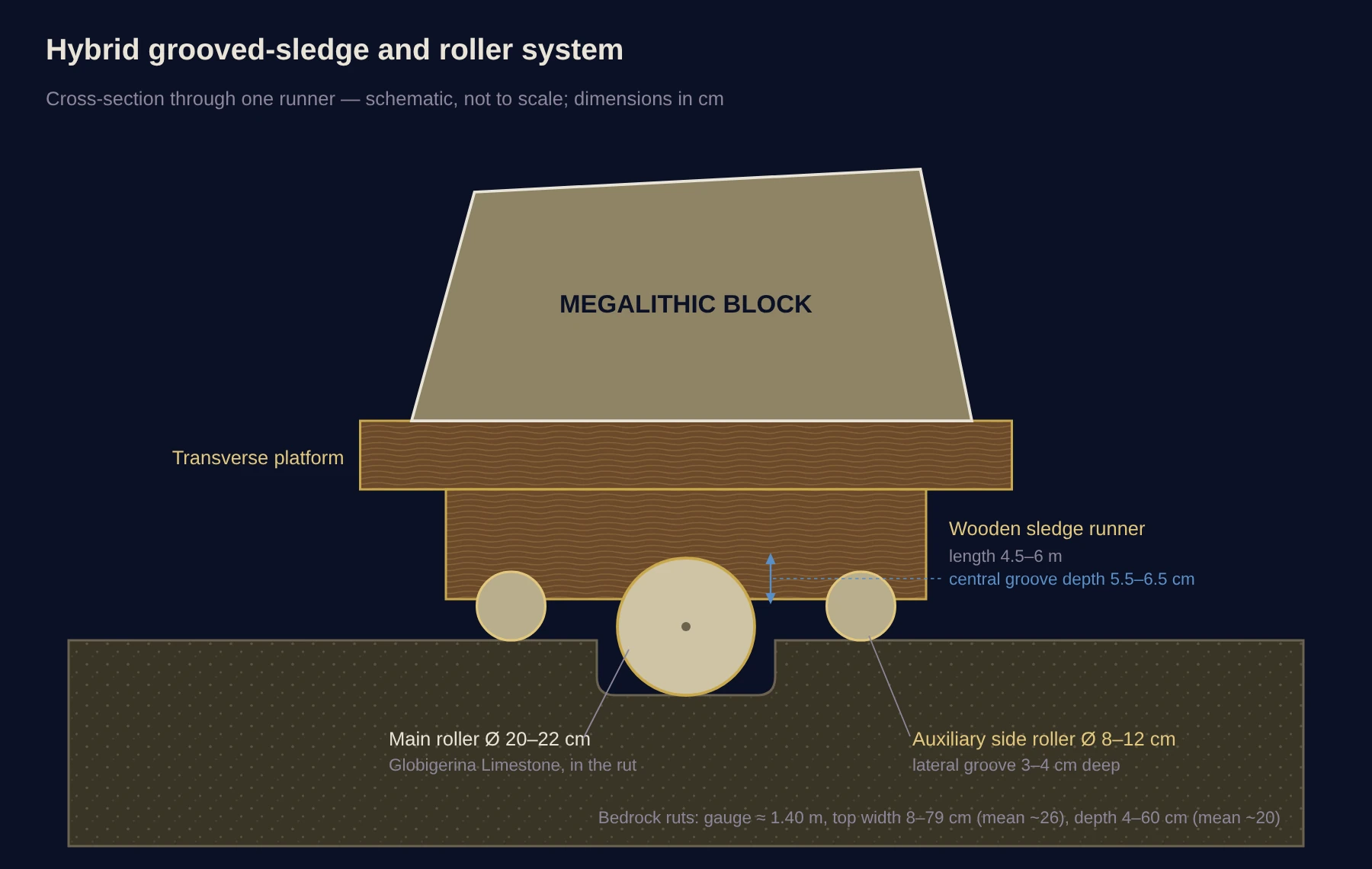
The system comprises four integrated components:
1. Bedrock ruts — serving as primary lateral guides and rolling surfaces for the main rollers.
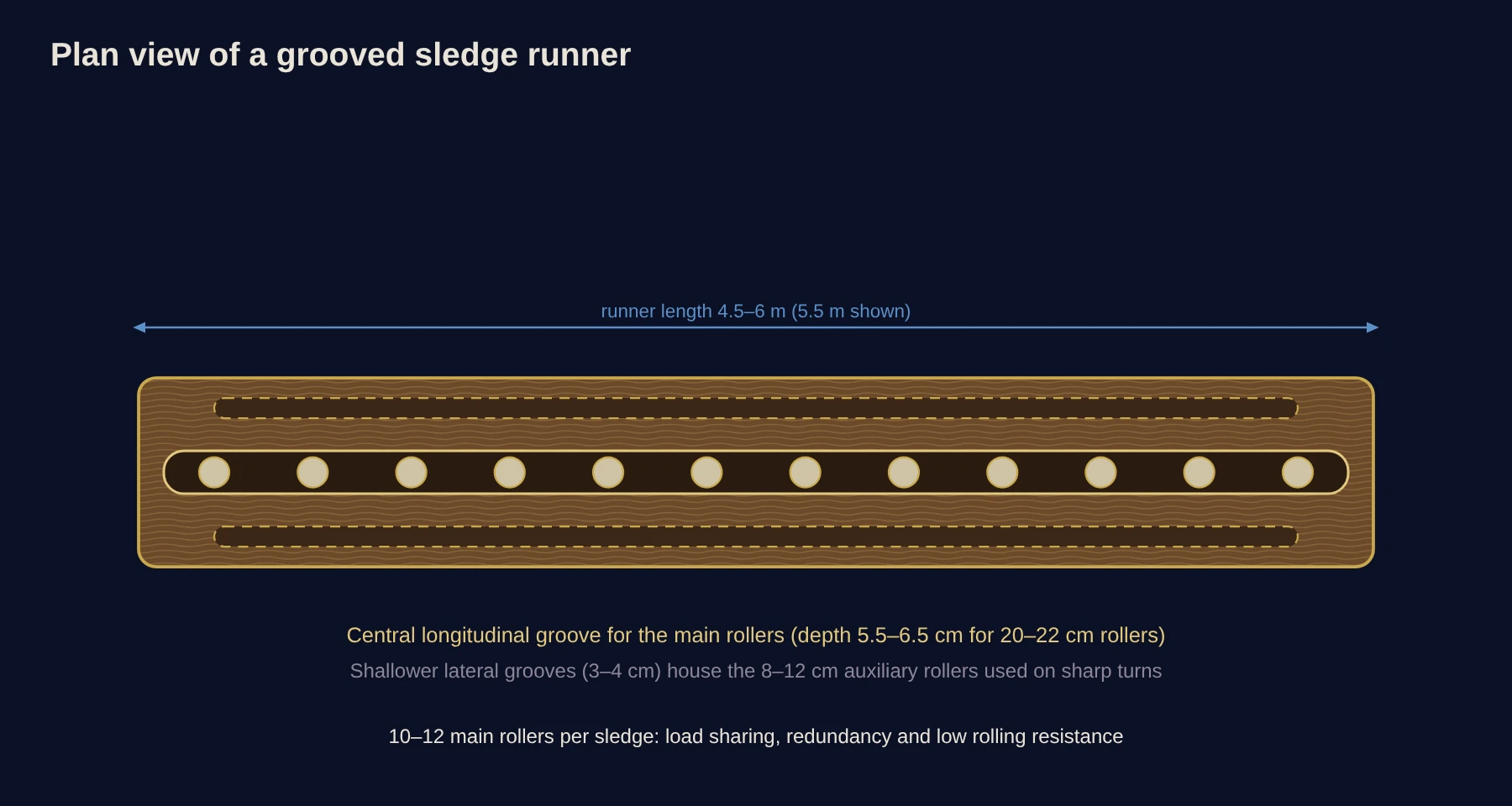
2. Wooden sledge runners (typical length 4.5–6 m) — fitted with a central semi-circular longitudinal groove (depth 5.5–6.5 cm for 20–22 cm rollers) that mechanically constrains roller motion relative to the sledge, plus optional shallower lateral grooves (depth 3–4 cm) for auxiliary rollers.
3. Main limestone rollers (10–12 units per sledge, diameter 20–22 cm, Globigerina Limestone) — travelling inside the ruts and central grooves.
4. Auxiliary side rollers (8–12 cm diameter) — deployed in the lateral grooves during sharp turns to provide additional lateral compliance and reduce binding.
The megalith is lashed or cradled on a transverse platform or directly on the sledge. Multiple rollers ensure load distribution, redundancy and low rolling resistance. The model exploits the existing rut network while adding the mechanical constraint and turn-accommodation features absent in simpler hypotheses.
4. Engineering Analysis and Quantitative Modelling
4.1 Load Distribution and Contact Mechanics (57-tonne block)
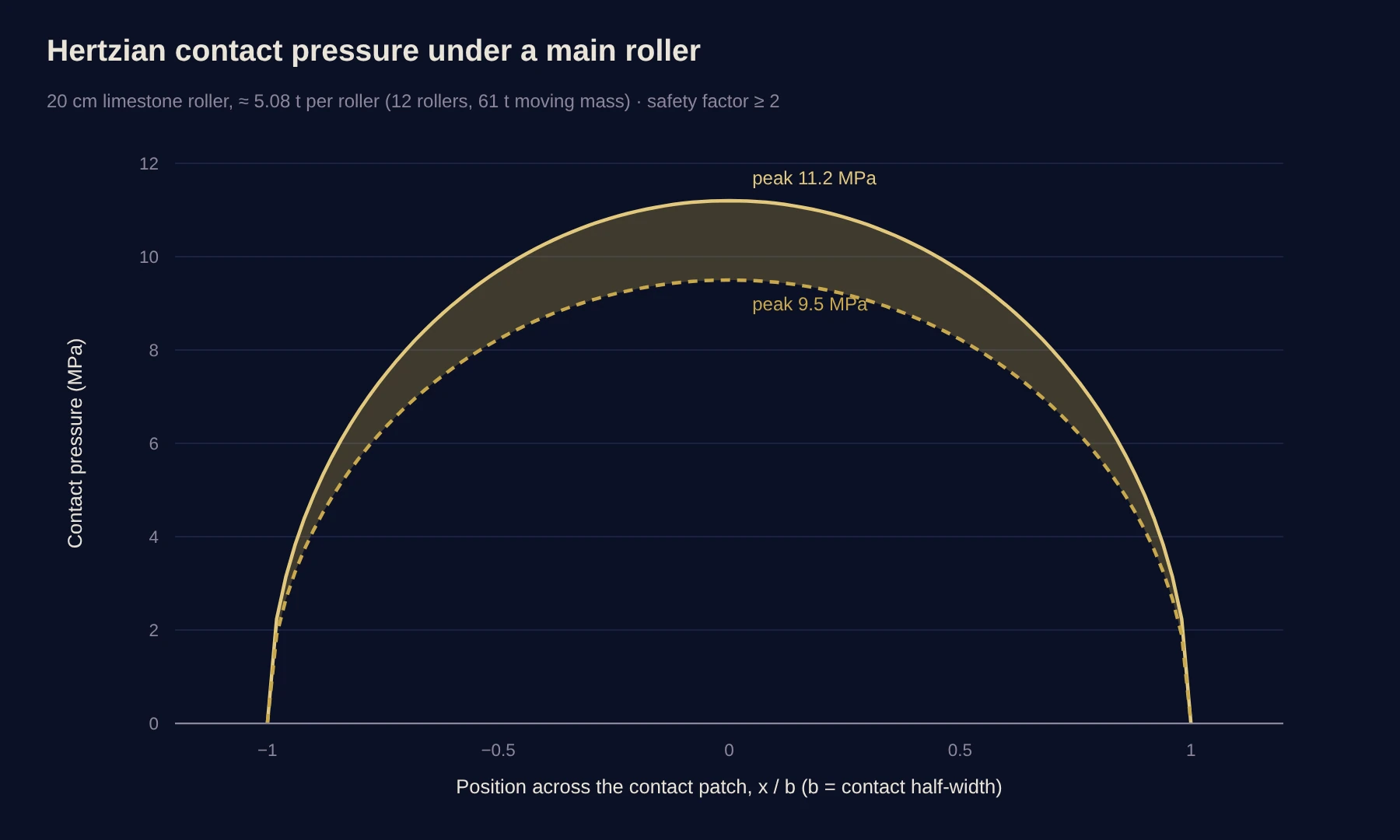
Total moving mass = 57 t (block) + 4 t (sledge) = 61 t ≈ 598 000 N.
Recommended configuration: 12 main rollers (Ø 20 cm). Load per roller ≈ 5.08 t.
Hertzian contact stress: Peak pressure ≈ 9.5–11.2 MPa (safety factor ≥ 2.0).
4.2 Tractive Effort
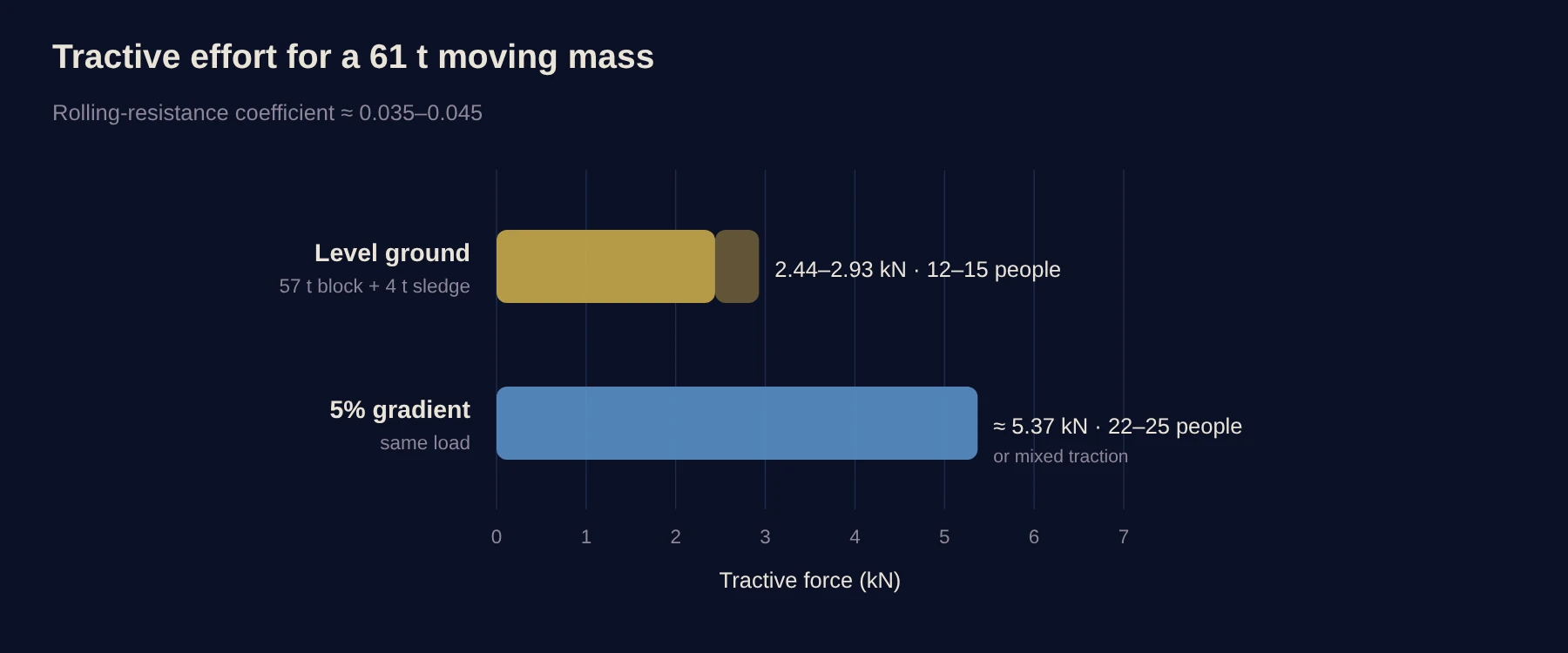
Rolling resistance coefficient ≈ 0.035–0.045. On level ground: F_tract ≈ 2.44 kN (12–15 persons). On 5% gradient: ≈ 5.37 kN (22–25 persons or mixed traction).
4.3 Stability Conferred by Grooves
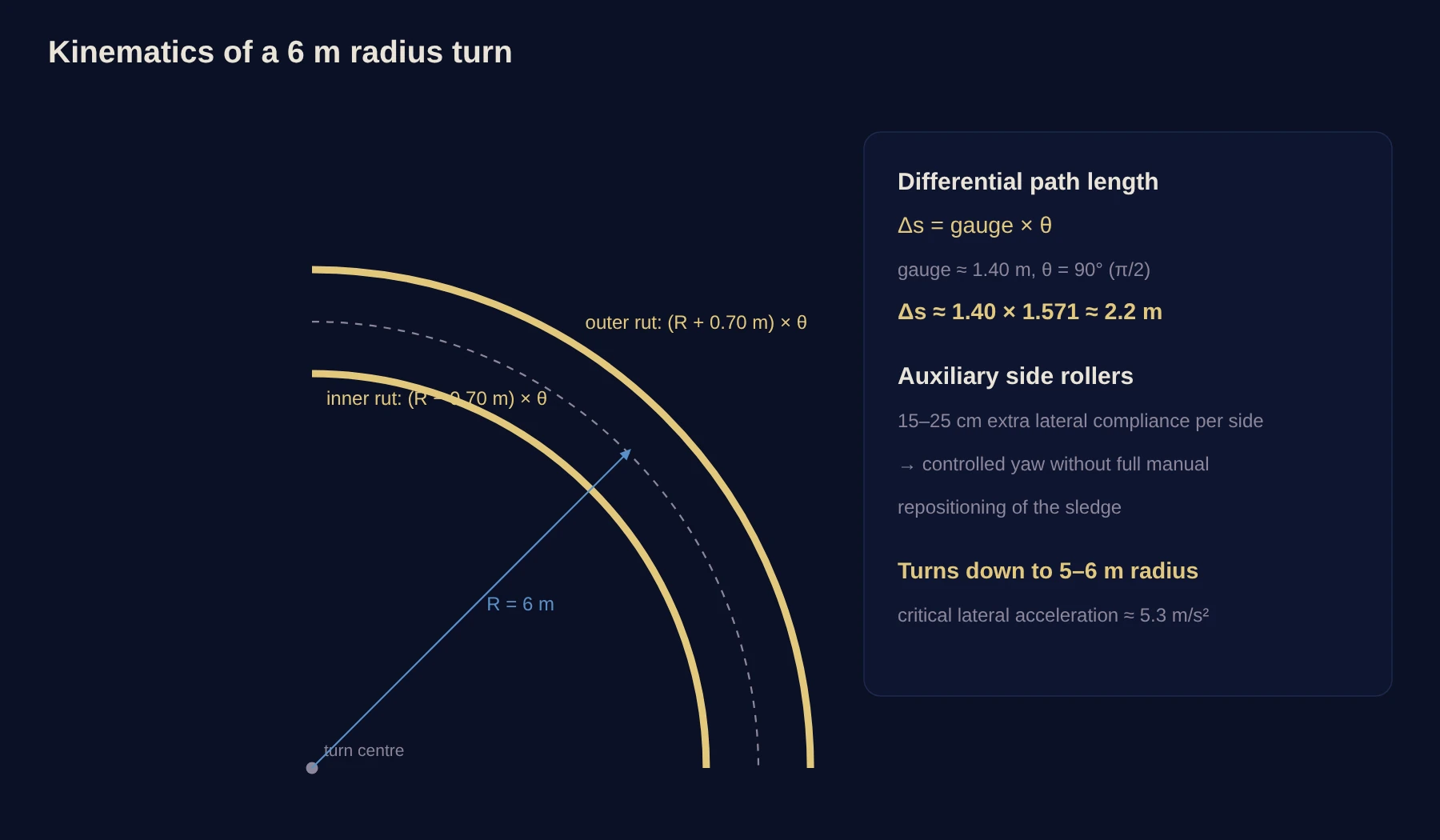
Maximum relative lateral displacement reduced by ~39% with 6 cm groove depth. Critical lateral acceleration ≈ 5.3 m/s², supporting turns with radii ≥ 5–6 m.
4.4 Kinematic Analysis of Turns
On a 6 m radius curve the differential path length reaches ~2.2 m. Auxiliary side rollers provide 15–25 cm of additional compliance per side, enabling controlled yaw without full manual repositioning.
5. Manufacturing Technology and Labour Estimates
All components can be produced using only stone tools, abrasives and fire — technologies fully attested in the Maltese Neolithic record. The central groove is formed by initial pecking followed by precision rotational abrasion using a cylindrical wooden former and quartz sand slurry. Lateral grooves are produced by similar but simpler abrasive methods.
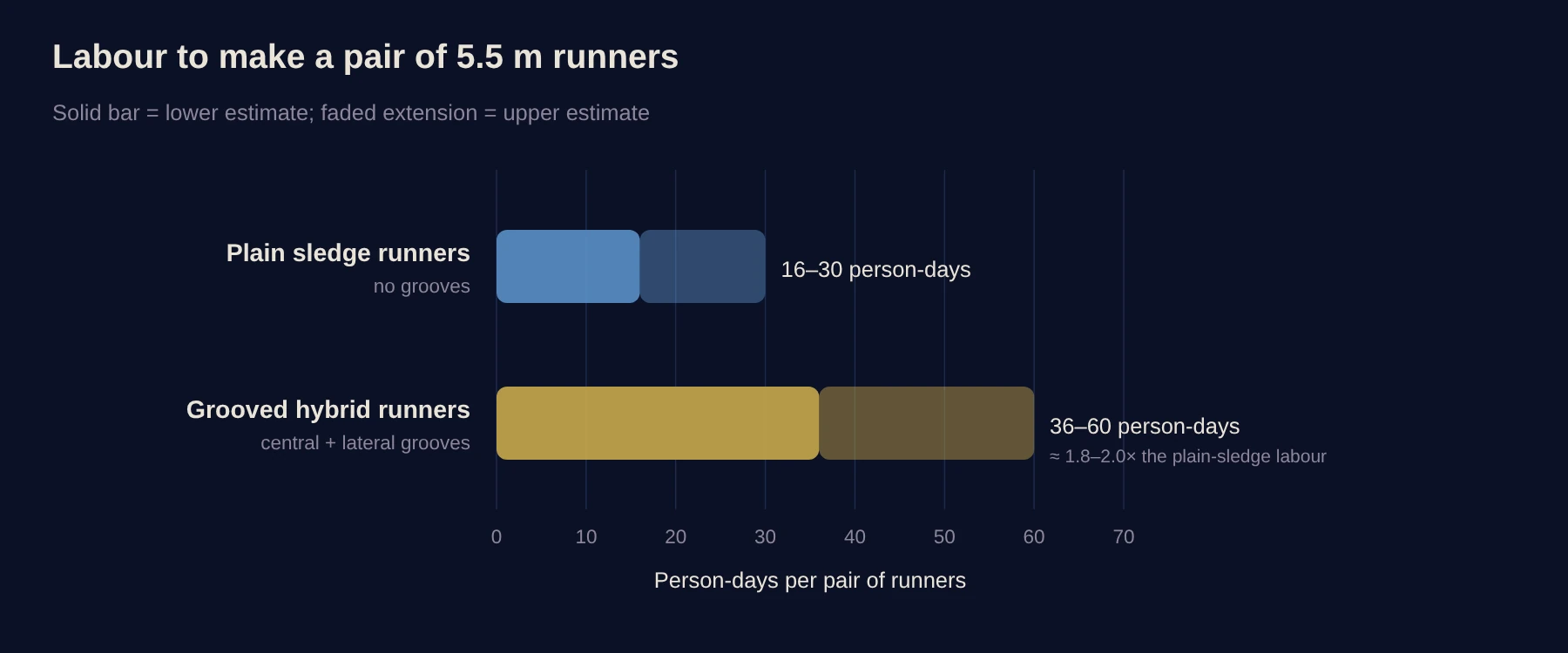
Labour estimate for a pair of 5.5 m runners: Plain sledges 16–30 person-days; Grooved hybrid runners 36–60 person-days (approximately 1.8–2.0×).
6. Comparative Evaluation of Alternative Models
The hybrid grooved-sledge model achieves the highest aggregate score in multi-criteria analysis, excelling in stability, archaeological fit (stone balls), and compatibility with deep ruts while retaining low tractive effort and full operational flexibility at complex junctions such as Misraħ Għar il-Kbir.
| Site | Location / type | Role in the model |
|---|---|---|
| Misraħ Għar il-Kbir (“Clapham Junction”) | Siġġiewi; cart-rut network | ~150 rut pairs within ~0.08 km²; dense, multi-generational junctions |
| San Pawl tat-Tarġa | Near Naxxar; cart-rut network | Comparable rut network |
| Binġemma and Imtaħleb | Cart-rut networks | Comparable rut networks |
| Ħaġar Qim | Temple complex | Source of the representative 57-tonne block; stone balls recovered |
| Mnajdra | Temple complex | Orthostats of ~50–57 t; stone balls recovered |
| Ġgantija and Tarxien | Temple complexes | Stone balls recovered |
7. Discussion, Limitations and Future Research
The model satisfactorily accounts for the dense, multi-generational, anastomosing character of junctions such as Misraħ Għar il-Kbir. Multiple parallel ruts provide route redundancy, while grooved runners and auxiliary side rollers minimise the frequency of full manual repositioning. Limitations include progressive wear of wooden grooves and the requirement for well-organised labour teams. Future research should prioritise full-scale experimental replication and finite-element dynamic modelling.
8. Conclusion
The hybrid grooved-sledge and multi-roller system constitutes a mechanically sound, technologically attainable and archaeologically well-supported solution for the transport of the largest Maltese megaliths. Quantitative engineering analysis confirms adequate safety margins for 57-tonne blocks, moderate tractive requirements and effective performance across the full range of terrain and junction complexities documented in the field. By integrating the low-friction advantages of rollers with positional constraint and turn-accommodation features, the model resolves key difficulties inherent in simpler hypotheses and provides a coherent explanatory framework for one of the most distinctive prehistoric landscapes of the Mediterranean.
Frequently Asked Questions
What are the Maltese cart ruts?
Pairs of parallel grooves cut into the limestone bedrock of the Maltese Islands, with a consistent gauge of about 1.40 m and depths of up to 60 cm. The densest network, Misraħ Għar il-Kbir (“Clapham Junction”), has roughly 150 intersecting rut pairs within about 0.08 km².
How were Malta’s megaliths moved, according to this model?
On wooden sledges whose runners carry a central longitudinal groove holding 10–12 Globigerina Limestone rollers that run inside the bedrock ruts, with smaller auxiliary rollers in lateral grooves to absorb differential motion on turns.
How many people were needed to move a 57-tonne block?
The paper calculates a tractive effort of about 2.44–2.93 kN on level ground, achievable by 12–15 people, rising to about 5.37 kN — 22–25 people or mixed traction — on a 5% gradient.
What are the stone balls found near Maltese temples?
Hundreds of roughly spherical limestone objects, mostly 15–30 cm across, made from local Globigerina Limestone. The model interprets them as rollers, consistent with the absence of any wheel or axle remains.
Why not wheeled carts or plain sledges?
In the paper’s multi-criteria comparison of four hypotheses — wheeled carts, plain sledges, unconstrained rollers and the hybrid grooved system — the hybrid scores highest for stability, fit with the recovered stone balls and deep ruts, and flexibility at complex junctions.
References
- Mottershead, D., Pearson, A. & Schaefer, M. (2008). The cart ruts of Malta: an applied geomorphological study. Antiquity, 82(318), 1065–1079.
- Trump, D. H. (2002). Malta: Prehistory and Temples. Midsea Books, Malta.
- Bianco, L. (2017). Petrographic and geochemical characterisation of Globigerina Limestone used in Maltese megalithic temples. Journal of Archaeological Science: Reports, 15, 234–245.
- Mottershead, D. et al. (2019). Humans as agents of geomorphological change: The case of the Maltese cart-ruts. In Landscapes and Landforms of the Maltese Islands (pp. 123–145). Springer.
- Gracie, H. S. (1954). The cart-tracks of Malta. Antiquity, 28, 91–98.
- Johnson, K. L. (1985). Contact Mechanics. Cambridge University Press.
- Experimental reports from Butser Ancient Farm and Lauresham Open-Air Laboratory on megalith moving and stone-working (2010–2024).
- Additional supporting references on Hertzian contact mechanics, Neolithic woodworking technology, Globigerina Limestone strength data, and comparative megalith transport studies from Egypt, Britain and the Andes are available on request.
How to Cite This Article
Suprun, A. (2026). The First Neolithic Railroad: A Hybrid Grooved-Sledge and Multi-Roller System for Megalith Transport Along Prehistoric Maltese Cart Ruts. Nonlinear Platform Development. https://nonlinearplatform.com/blog/maltese-cart-ruts-neolithic-railroad-megalith-transport/