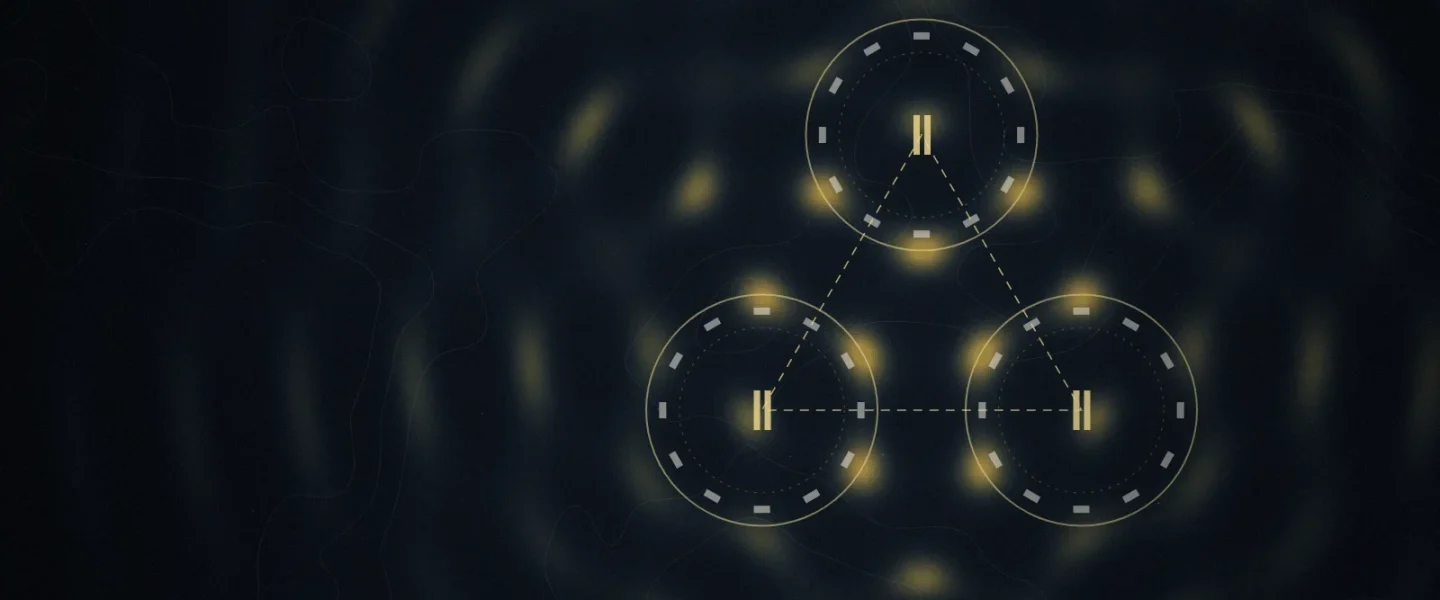
A multiphysics, spectral-geometric and archaeoastronomical framework for testing functional geometry in Göbekli Tepe and comparative monumental architecture.
In brief: Megalithic Geometric Field Processing (MGFP) is a testable research framework, not a claim of ancient technology. It asks whether monument-scale stone layouts such as Göbekli Tepe’s Enclosures B, C and D condition existing acoustic, seismic, thermal, electrical or magnetic fields in ways that are statistically unusual compared with matched random geometries.
Key Takeaways
- MGFP treats a monument’s geometry as a candidate passive transfer function that modifies fields already present in the environment.
- Three evidence streams stay separate: the reported ~19.25 m equilateral relation among the centres of Göbekli Tepe Enclosures B, C and D, Alexander Thom’s contested ~2.72 ft Megalithic Yard, and established wave and materials physics.
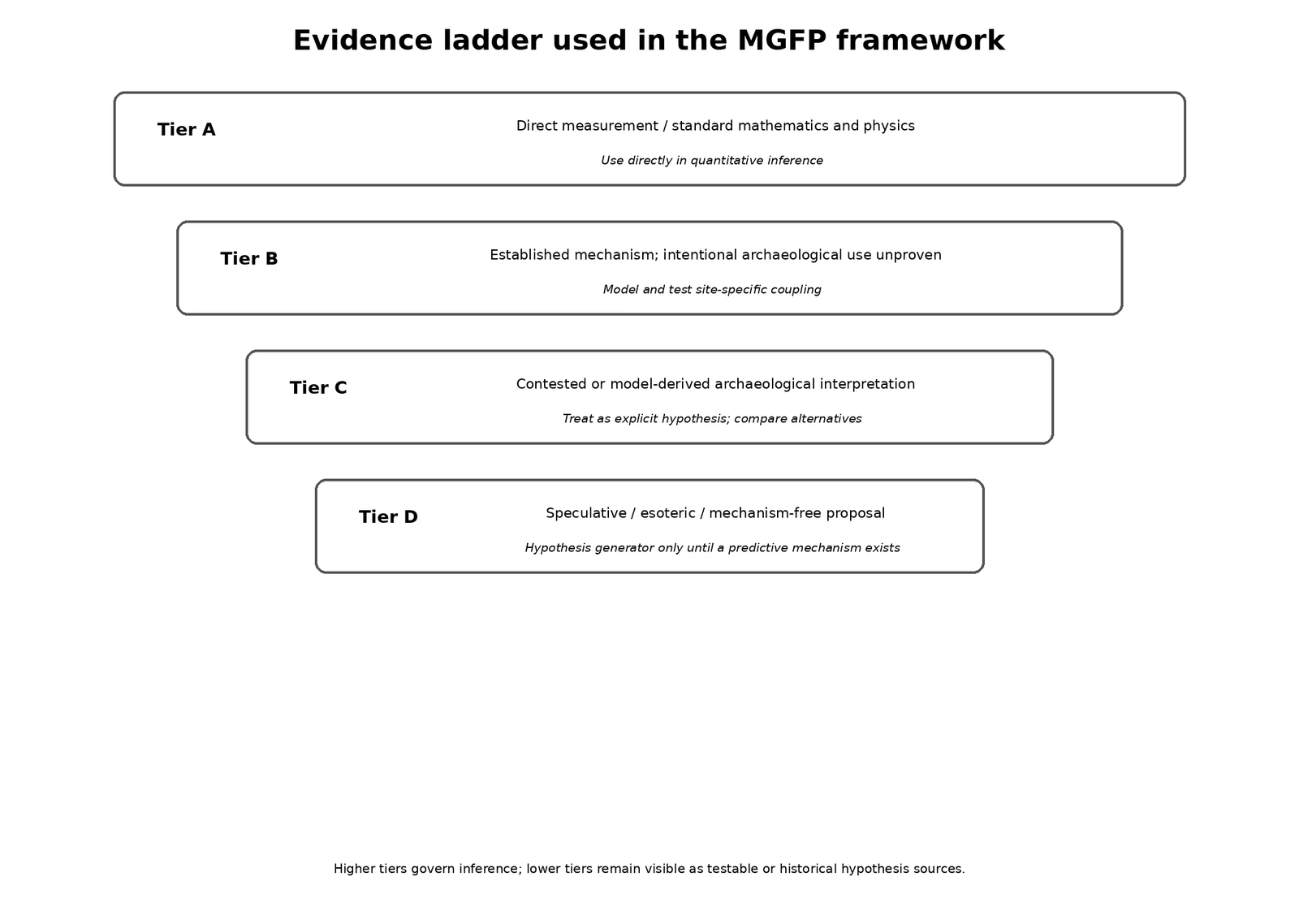
- A four-tier evidence system (A–D) separates measurements and established physics from contested interpretations and speculative frameworks.
- The toolkit includes angular-order parameters, graph Laplacian spectra, Fourier structure factors, scattering approximations, Thom-style metrological residuals and preregistered randomised null models.
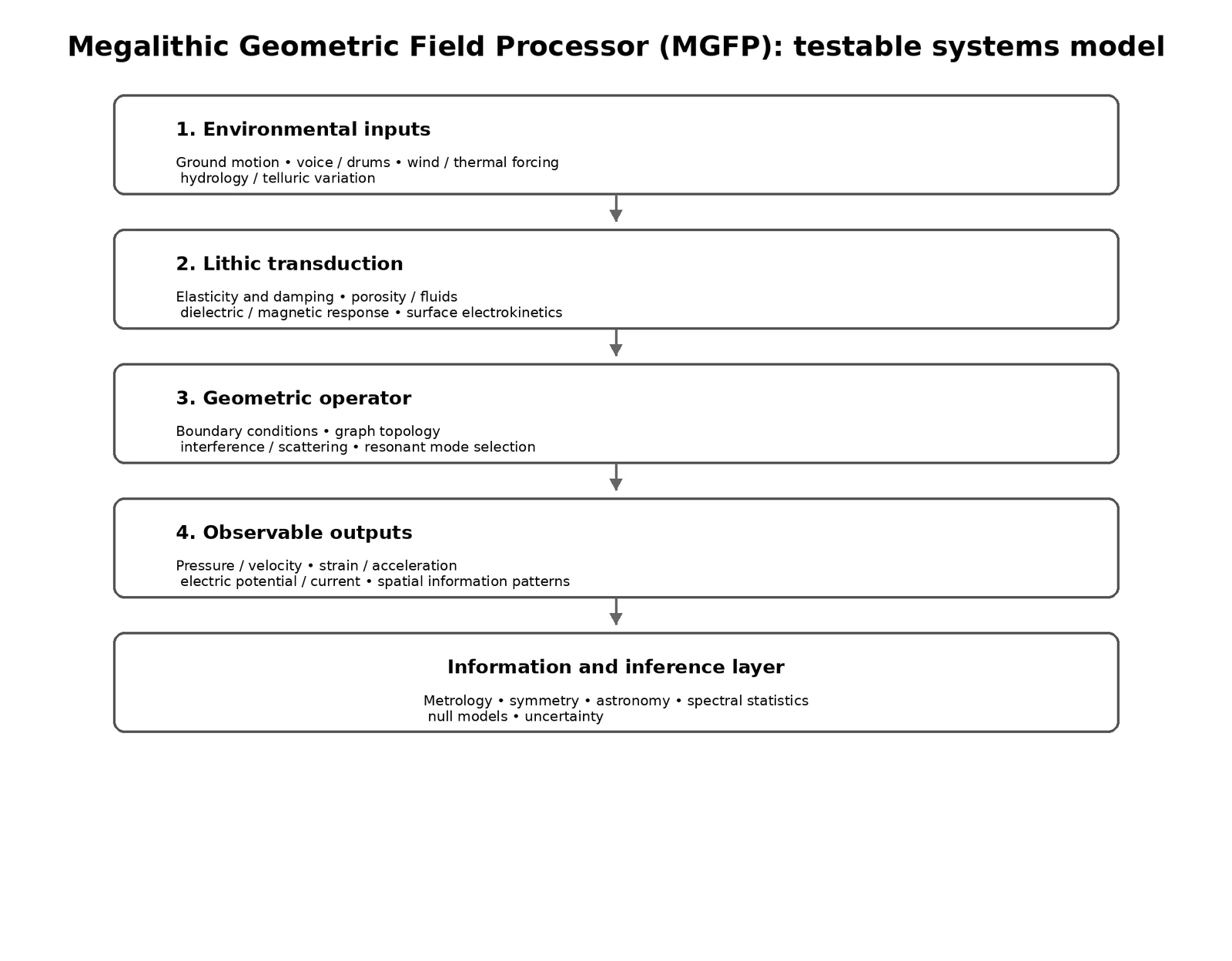
- The defensible chain is geometry → boundary conditions → modes and interference → spatial concentration or attenuation → material-specific transduction; exotic-energy claims stay explicitly speculative.
In This Article
- Abstract
- 1. Introduction
- 2. Scope, epistemic architecture and falsifiability
- 3. Geometric and metrological foundations
- 4. The Megalithic Geometric Field Processor hypothesis
- 5. Mathematical framework for quantitative testing
- 6. Physical mechanisms: what ordinary physics permits
- 7. Comparative lithic-material architecture
- 8. Archaeoastronomy as geometry constrained by the horizon
- 9. Non-mainstream frameworks as constrained hypothesis generators
- 10. Computational implementation: Megalithic Geometric Field Processor v3
- 11. Worked screening example: Göbekli-scale geometry
- 12. Experimental programme
- 13. Discussion
- 14. Limitations
- 15. Conclusions
- Frequently Asked Questions
- 16. Software, data and reproducibility statement
- 17. Mathematical observables and implementation checklist
- References
- Author note
Abstract
Megalithic monuments are commonly studied as archaeological, ritual, social, astronomical, and architectural phenomena, while their geometry is rarely treated as a candidate physical transfer function. This article develops a deliberately testable framework—the Megalithic Geometric Field Processor (MGFP)—for asking whether monument-scale arrangements of stone can condition pre-existing acoustic, elastic/seismic, thermal, hydrological, weak electrical, or magnetic fields in ways that are statistically unusual relative to matched null geometries. The framework is motivated by three bodies of evidence that must remain analytically distinct: (i) documented architectural planning, exemplified by the reported ~19.25 m equilateral relation among the centres of Göbekli Tepe Enclosures B, C, and D; (ii) Alexander Thom’s extensive, though contested, claims concerning a ~2.72 ft Megalithic Yard, constructive ring geometries, Pythagorean layouts, and solar/lunar sight-lines; and (iii) established modern physics in which geometry and material properties control eigenmodes, scattering, attenuation, localization, impedance, and transduction. A computational protocol is specified using dimensionless angular-order parameters, graph Laplacian spectra, Fourier structure factors, acoustic single- and multiple-scattering approximations, elastic resonator screening, geometry-derived geoelectric networks, Thom-style metrological residuals, coordinate-uncertainty propagation, and preregistered randomized null models. The article also reviews lithology-dependent mechanisms relevant to limestone, quartz-rich silcrete and granite, basalt/andesite, and porous volcanic rocks, including electrokinetic streaming potentials, weak stress-electric effects, magnetic susceptibility/remanence, and thermal transport. Non-mainstream frameworks—including Robert Grant’s number-wave theory, Bruce Cathie’s world-grid harmonics, octahedral spectral models, and esoteric ritual-energy narratives—are retained only as hypothesis generators and are separated from established mechanisms by an explicit evidence-tier system. The central proposal is therefore not that megaliths created exotic energy, but that some monuments may be profitably tested as passive, scale-dependent spatial processors whose boundary conditions and material composition modify environmental fields. The article defines falsifiable predictions, identifies major confounds, and proposes a staged experimental programme based on survey-grade geometry, non-invasive field sensing, instrumented replicas, preregistration, and independent replication.
Keywords: Göbekli Tepe; Alexander Thom; megalithic yard; archaeoastronomy; archaeoacoustics; spectral geometry; seismic metamaterials; lithic materials; electrokinetics; graph Laplacian; structure factor; null models; megalithic monuments; field processing.
Research highlights: The MGFP hypothesis reframes “Earth-energy” claims as measurable transfer-function questions; separates established mechanisms from speculative interpretations; integrates Thom metrology with modern spectral and wave analysis; emphasizes lithology-specific coupling rather than a universal stone effect; and requires matched null models, measurement uncertainty, preregistration, and physical replication before archaeological function is inferred.
1. Introduction
Monumental stone architecture occupies an unusual methodological position. It is simultaneously a durable archaeological record, a geometric object, a material assembly, an acoustic and elastic boundary, and a spatial instrument through which people moved, watched horizons, spoke, sang, struck objects, processed food, performed ceremonies, and interacted with local terrain. Archaeological interpretation usually privileges the first of these roles. Physical modelling, where attempted, often addresses only one domain—such as architectural acoustics—rather than the coupled consequences of geometry, material properties, topography, and environmental forcing. The present article asks a narrower but technically demanding question: can the physical arrangement of megalithic architecture be tested as a passive field-conditioning system without presupposing an exotic energy source or advanced lost technology?
The proposed term Megalithic Geometric Field Processor (MGFP) is intentionally operational. A “processor” here means a passive spatial operator that transforms the amplitude, phase, directionality, persistence, or localization of fields already present in its environment. Modern analogues include resonant cavities, acoustic scatterer arrays, photonic and phononic crystals, seismic metamaterials, antenna arrays, impedance networks, and analog spatial filters. None of these analogies implies technological equivalence. Their relevance is conceptual: geometry and constitutive material properties can select modes and alter transfer functions even when the structure contains no active power source.
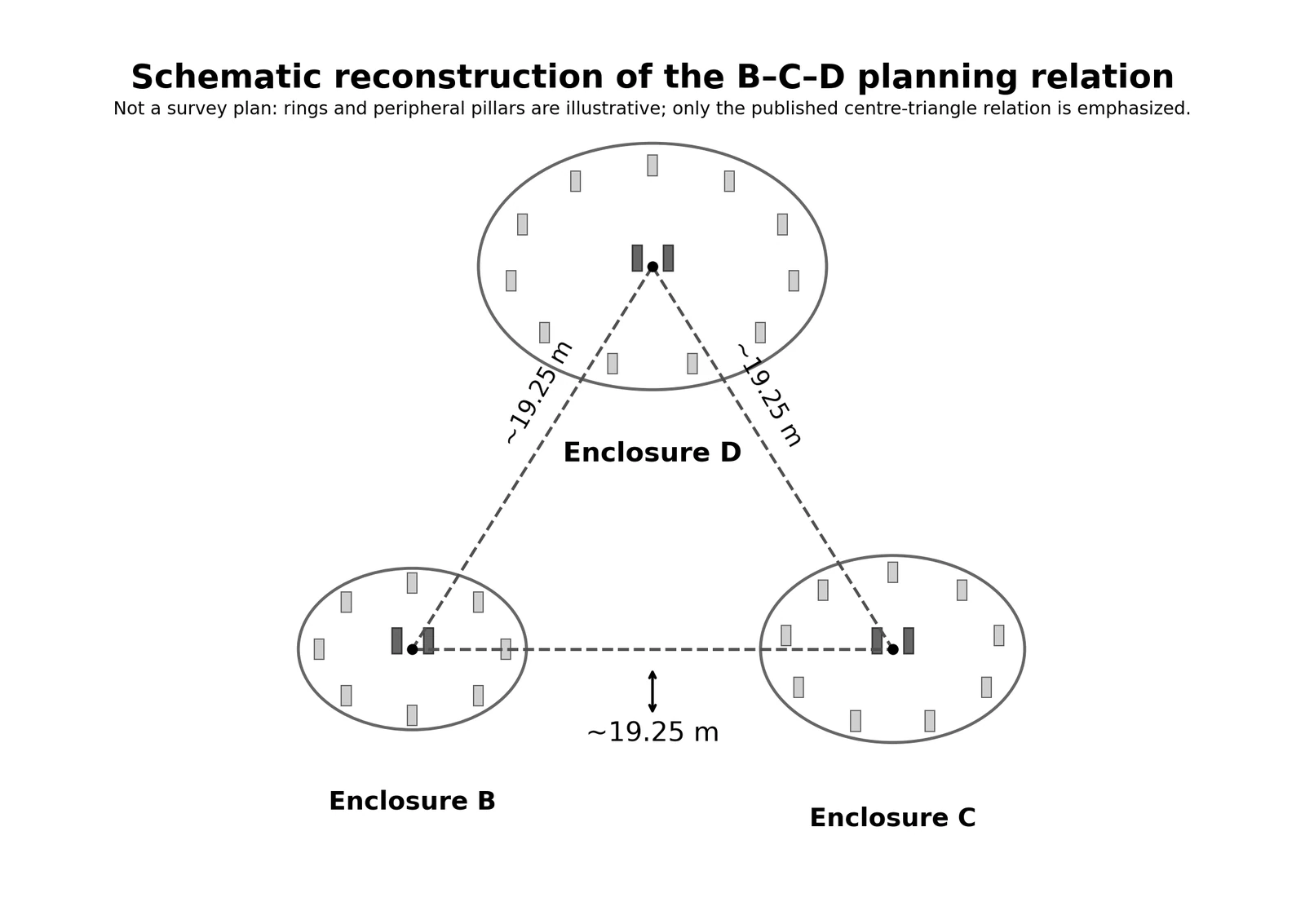
Göbekli Tepe provides a useful initial case because architectural formal analysis has identified non-trivial planning relations among Enclosures B, C, and D. Haklay and Gopher (2020) reported that centre points reconstructed for the three enclosures fall within roughly 25–28 cm of the vertices of an ideal equilateral triangle approximately 19.25 m on a side, a discrepancy below about 1.5% at the scale of the triangle. Their analysis also described axial relationships involving the paired central pillars. These claims concern architectural planning, not wave physics; nevertheless, they supply a geometric constraint precise enough to be used as an input to quantitative physical models.
Alexander Thom’s corpus provides a second, historically important source of testable propositions. Across hundreds of surveys in Britain and Brittany, Thom proposed a recurrent unit of length near 2.72 ft, a family of circles, flattened circles, egg-shaped rings, ellipses, and compound figures, and a programme of horizon astronomy based on solar and lunar declinations (Thom, 1955, 1962, 1967, 1969, 1971; Thom & Thom, 1980). The validity and universality of these interpretations remain contested. Freeman’s Bayesian reassessment, for example, found the evidence for a common quantum to be concentrated mainly in Scottish data and showed that alternative units could fit substantial subsets (Freeman, 1976). Atkinson (1975) and later archaeoastronomical scholarship likewise emphasized archaeological context, selection effects, and the difficulty of assigning intentionality to alignments. These criticisms are not obstacles to the present framework; they are design requirements for it.
The central methodological commitment of this article is therefore separation: measured geometry is separated from reconstructed geometry; established physical mechanisms are separated from claims of prehistoric intentional use; exploratory numerical encodings are separated from unit-invariant observables; and post-hoc pattern discovery is separated from preregistered confirmatory testing. The resulting framework can accommodate unconventional hypotheses without granting them evidentiary status they have not earned.
2. Scope, epistemic architecture and falsifiability
2.1 What the MGFP hypothesis does and does not claim
The strongest scientifically defensible form of the hypothesis is conditional: if a megalithic layout is sufficiently ordered, if its constituent materials have relevant mechanical or electrical properties, and if the monument is coupled to environmental excitation, then the structure can in principle possess a non-trivial transfer function. This is a consequence of classical wave and network physics. The archaeological question—whether such behavior was recognized, selected, exploited, ritualized, or merely incidental—is independent and must be established separately.
This distinction blocks a common inferential error. Demonstrating an acoustic resonance does not demonstrate that the builders designed an acoustic resonator. Demonstrating weak electric potentials in stressed granite does not demonstrate electrical engineering. Demonstrating a geometric ratio does not demonstrate a universal metrological standard. Function requires convergent evidence: repeatable physical effect, archaeological plausibility, design specificity, and superiority to reasonable alternative explanations.
2.2 Evidence tiers
| Tier | Definition | Examples in this study | Permissible inference |
|---|---|---|---|
| A | Direct measurement, standard mathematics, or well-established physics | Survey coordinates; elastic moduli; graph Laplacian; acoustic wave equation; calcite electrokinetics | Can be used quantitatively within its measured domain. |
| B | Established mechanism whose coupling or deliberate use at the archaeological site is unproven | Stress-electric response of some quartz-rich rocks; streaming potentials in wet carbonate; seismic metasurface analogies | Can motivate a site-specific test, not a claim of ancient technological intent. |
| C | Model-derived or contested archaeological interpretation | Megalithic Yard universality; specific lunar-observatory reconstructions; intended acoustic optimization | Must be compared with archaeological and statistical alternatives. |
| D | Speculative, esoteric, numerological, or mechanism-free proposal | Cathie world-grid harmonics; literal “Earth-energy” reservoirs; macroscopic vacuum/gravity manipulation by stone geometry | May generate hypotheses only if converted into quantitative, falsifiable predictions. |
2.3 Falsifiability criteria
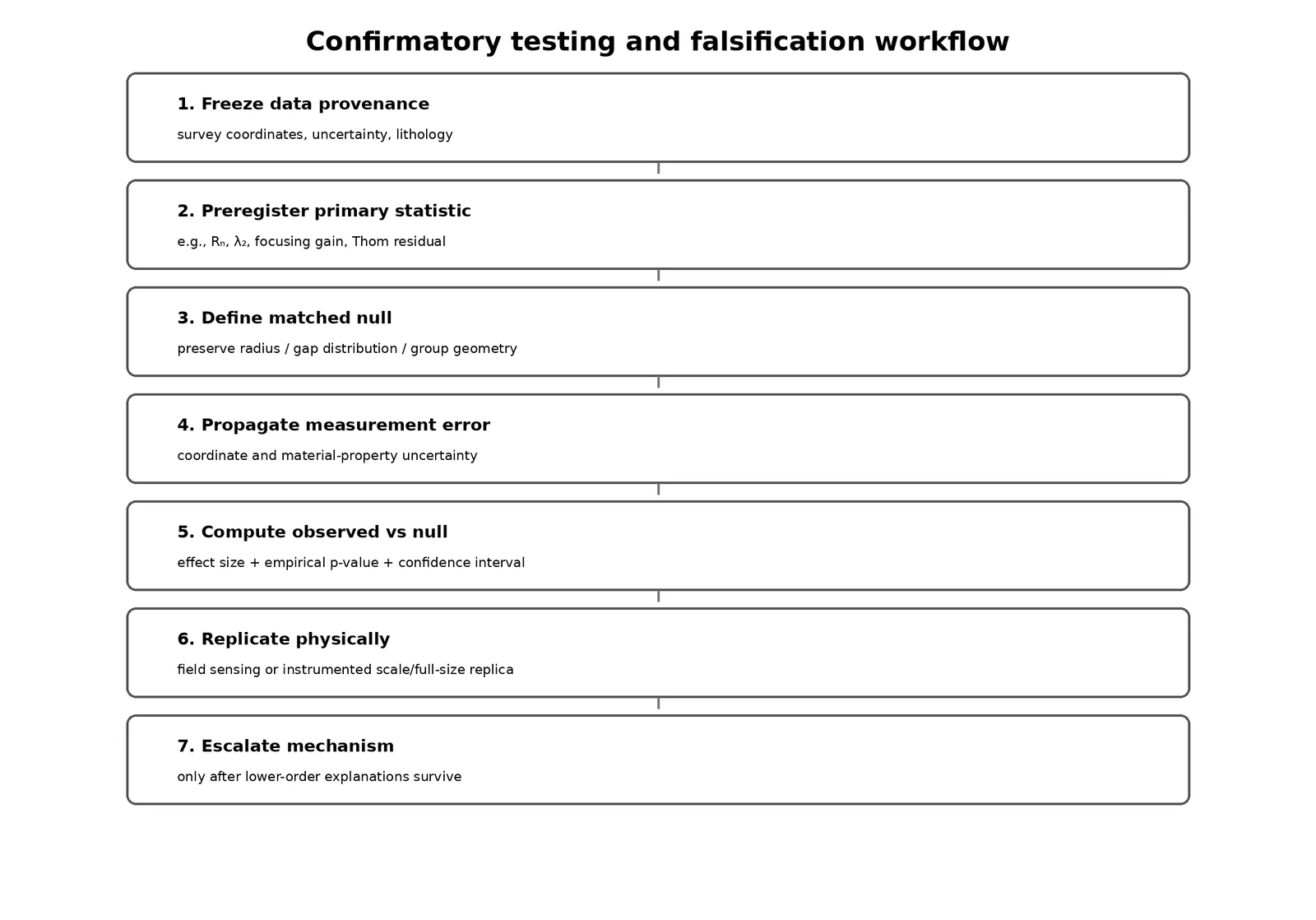
A functional-geometry claim should fail if any of the following conditions holds: (1) the apparent effect disappears when survey uncertainty is propagated; (2) equally constrained randomized layouts produce the same or stronger statistic; (3) the effect depends on arbitrary unit choice, coordinate origin, numeral base, or selective inclusion of distances; (4) the proposed physical coupling is too small by orders of magnitude to account for the claimed outcome; (5) a simpler architectural or environmental variable explains the effect; or (6) the effect cannot be reproduced in an instrumented replica or independent field campaign. These are not merely cautions; they are operational stopping rules.
3. Geometric and metrological foundations
3.1 Göbekli Tepe: planned geometry as a measurable input
Göbekli Tepe, on a limestone ridge in southeastern Türkiye, contains monumental Pre-Pottery Neolithic architecture conventionally dated to the tenth and ninth millennia BCE. The site is not a single static plan: enclosures were constructed, modified, filled, and embedded within later building activity. Any field model must therefore specify which phase and which reconstructed architectural boundaries are being represented. A computational convenience—such as treating all preserved pillars as contemporaneous point scatterers—must not be confused with a stratigraphic claim.
The planning relation reported by Haklay and Gopher (2020) is especially useful because it is expressed geometrically rather than iconographically. Their calculated centre points for Enclosures B, C, and D approximate an equilateral triangle of side ~19.25 m; the reported centre deviations from ideal vertices are on the order of only a few decimetres. This is sufficient to justify testing whether the three-enclosure system has unusual symmetry or spectral properties. It is not sufficient to infer metrology, acoustics, astronomy, or geophysics without further analysis.
3.2 Thom’s metrological hypothesis
Thom’s metrological programme emerged from field surveying rather than from a single monument. He argued that diameters and other construction lengths clustered around multiples of a basic unit he called the Megalithic Yard (MY), estimated near 2.72 ft. In Megalithic Lunar Observatories he quoted 2.720 ± 0.003 ft; the later compilation by A. and A. S. Thom used approximately 2.722 ft. Thom also proposed a Megalithic Rod of 2.5 MY for perimeter regularities and argued for integral or half-integral relationships in some non-circular rings.
The statistical problem is non-trivial because a quantum chosen after inspecting the data enjoys a large look-elsewhere advantage. Thom explicitly relied on Broadbent’s work on quantum hypotheses and distinguished the easier case in which an expected quantum is specified a priori from the more difficult case in which the quantum is discovered from the data (Broadbent, 1955, 1956; Thom, 1966). Modern analysis should retain this distinction. A fixed 2.720-ft test is different from scanning thousands of candidate units and reporting the minimum residual.
1 MY = 2.720 ft = 0.829056 m (reference value used for fixed-unit tests)
For the ~19.25 m Göbekli centre-triangle side, this reference gives approximately 23.22 MY. That is not an especially compelling integer relationship. The absence of an obvious integer match is itself informative: the MGFP framework should not force Göbekli Tepe into British Bronze Age/Neolithic metrology merely because both involve monumental stone architecture.
3.3 Thom’s constructive ring families
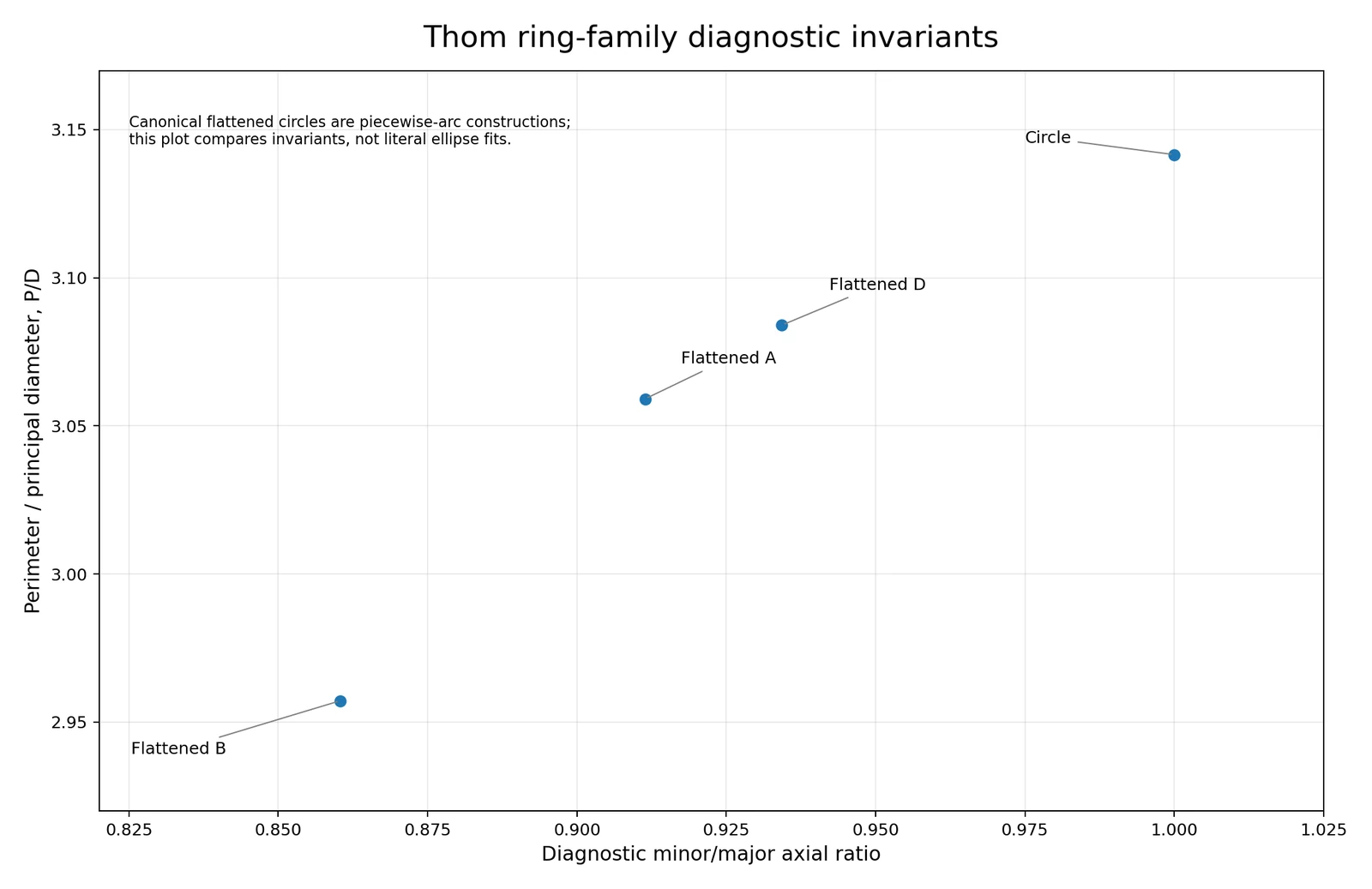
Thom distinguished ordinary circles from several non-circular constructions. In the 1980 ring catalogue he and A. S. Thom gave the following perimeter-to-diameter relations for the principal flattened-circle classes: Type A, P = 3.0591D; Type B, P = 2.9572D; and Type D, P = 3.0840D. Eggs and ellipses were analyzed through constructions intended to preserve integral or near-integral dimensions, frequently invoking Pythagorean relationships. Thom’s 1971 synthesis lists repeated use of 3–4–5, 5–12–13, 8–15–17, and 12–35–37 right triangles, with additional near-Pythagorean constructions where other design constraints were thought to dominate.
| Construction | Key diagnostic | Value / relation | Interpretive status |
|---|---|---|---|
| Circle | P/D | π ≈ 3.14159 | Geometric identity. |
| Flattened circle Type A | P/D | 3.0591 | Thom canonical construction. |
| Flattened circle Type B | P/D | 2.9572 | Thom canonical construction. |
| Flattened circle Type D | P/D | 3.0840 | Thom canonical construction. |
| Ellipse | Focal relation | a² = b² + c² | Identity if c is derived; evidentiary only when axes/foci are independently measured. |
| Eggs | Integral-triangle construction | Type-specific | Contested archaeological reconstruction; must be fitted against alternatives. |
3.4 Unit invariance as a safeguard against numerological overfitting
Physical observables should normally be invariant to a change from metres to feet. Angles, normalized spectra, ratios, topology, and dimensionless structure factors can satisfy this requirement. Raw decimal patterns and digital roots generally cannot. A 19.25 m length may be encoded as 1925 cm, 63.16 ft, or another representation, each producing different digit operations while referring to the same physical segment. Any numerical theory that assigns causal status to decimal sequencing must therefore identify a physically privileged unit and justify it independently. Thom’s proposed unit offers one historical candidate for British monuments, but it cannot be assumed globally and its universality remains disputed (Freeman, 1976; Burl & Freeman, 1977).
4. The Megalithic Geometric Field Processor hypothesis
4.1 Transfer-function formulation
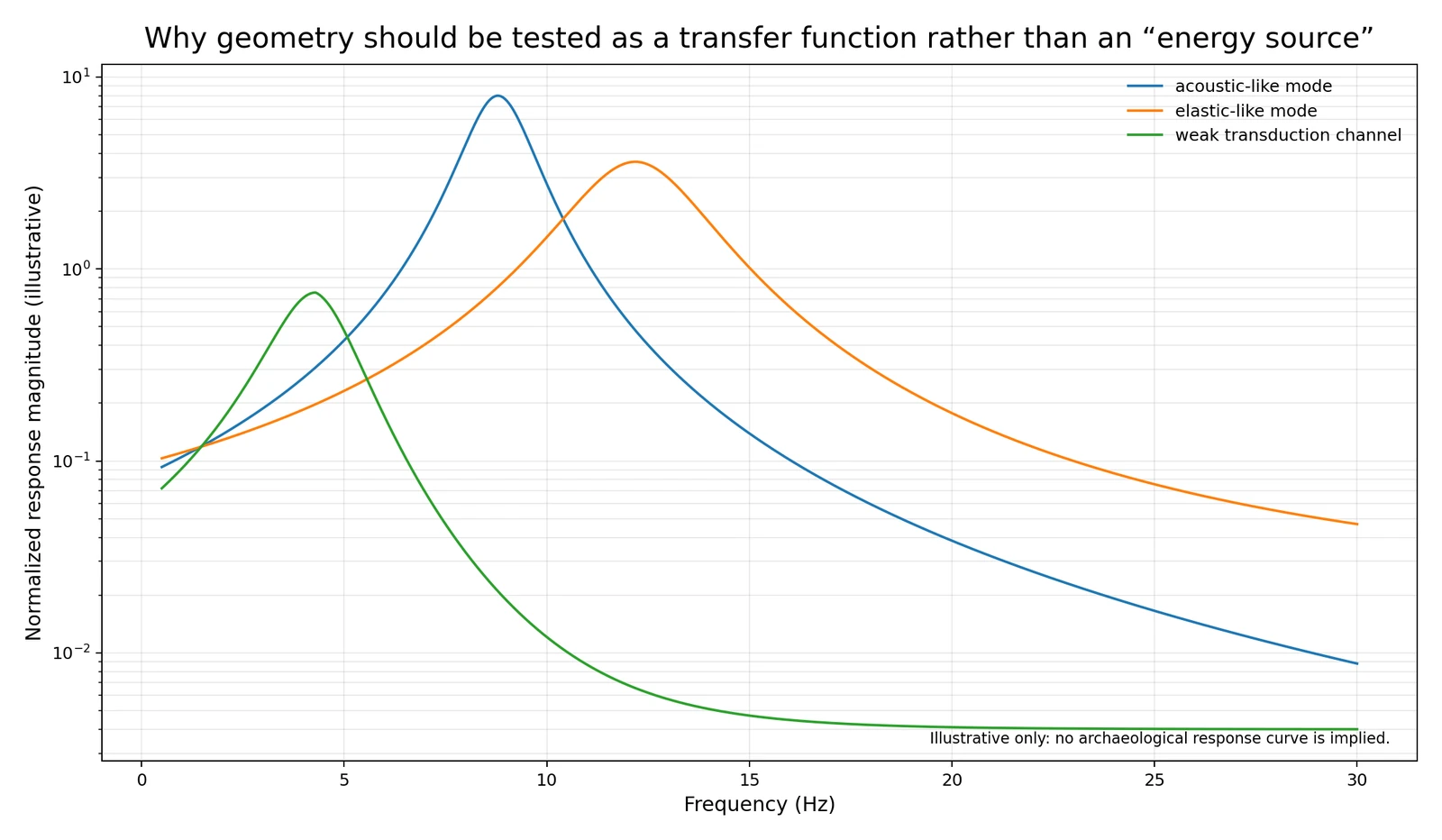
Let X(t) denote the vector of environmental and anthropogenic excitations incident on a monument: ground displacement or acceleration, acoustic pressure, wind pressure, temperature variation, pore-fluid pressure, atmospheric electric field, and time-varying geomagnetic induction. For a fixed geometry and material state, the monument is represented at screening level as a frequency-dependent operator H. The observable output Y is
Y(ω) = H(ω; r, geometry, material, boundary conditions) X(ω).
The central empirical question is whether H for the archaeological geometry differs systematically from H for matched geometries that preserve gross size, stone count, material inventory, and relevant radial statistics but randomize the design feature under test. This formulation shifts the inquiry from “does the site contain energy?” to “what transformation does the site apply to specified inputs?”
4.2 Multi-use architecture
A transfer-function view is compatible with ordinary archaeological functions. A structure can be simultaneously a gathering space, symbolically ordered landscape, astronomical reference system, mnemonic device, and acoustic/elastic scatterer. These roles need not compete. Indeed, intentionality is more plausible when the same construction constraint serves multiple purposes without requiring mutually incompatible modifications. Thom’s discussion of Castle Rigg is relevant in this limited sense: he argued that geometrical construction lines and horizon astronomy were combined in one plan. Whether his specific astronomical identifications are accepted or not, the methodological idea of cross-domain constraint satisfaction is testable.
4.3 Information encoding versus energetic function
Some geometric structures may be better understood as durable information than as power devices. Ratios, centers, axes, topological relations, and horizon directions can remain interpretable after language and ritual context are lost. This suggests an “architectural code” hypothesis in which redundancy and symmetry make information physically persistent. Historical magic-square traditions provide a much later cultural example of geometry treated as a whole-part constraint system; they are not evidence for Neolithic transmission, but they illustrate how numerical balance can be regarded as operative structure in human symbolic systems. The MGFP framework keeps informational and physical channels separate while allowing them to be tested together.
5. Mathematical framework for quantitative testing
5.1 Coordinate representation and uncertainty
Each stone, pillar, wall segment, or modeled scattering element is represented by coordinates rⱼ = (xⱼ, yⱼ, zⱼ), a type label, a construction-group label, and an uncertainty model. Survey-grade analysis should record the coordinate reference frame, datum or local origin, units, northing/easting convention, and whether coordinates represent stone centres, inner faces, outer faces, or reconstructed original bases. Thom himself emphasized measurement convention because fallen, leaning, rebuilt, or wall-forming stones can shift the inferred design line.
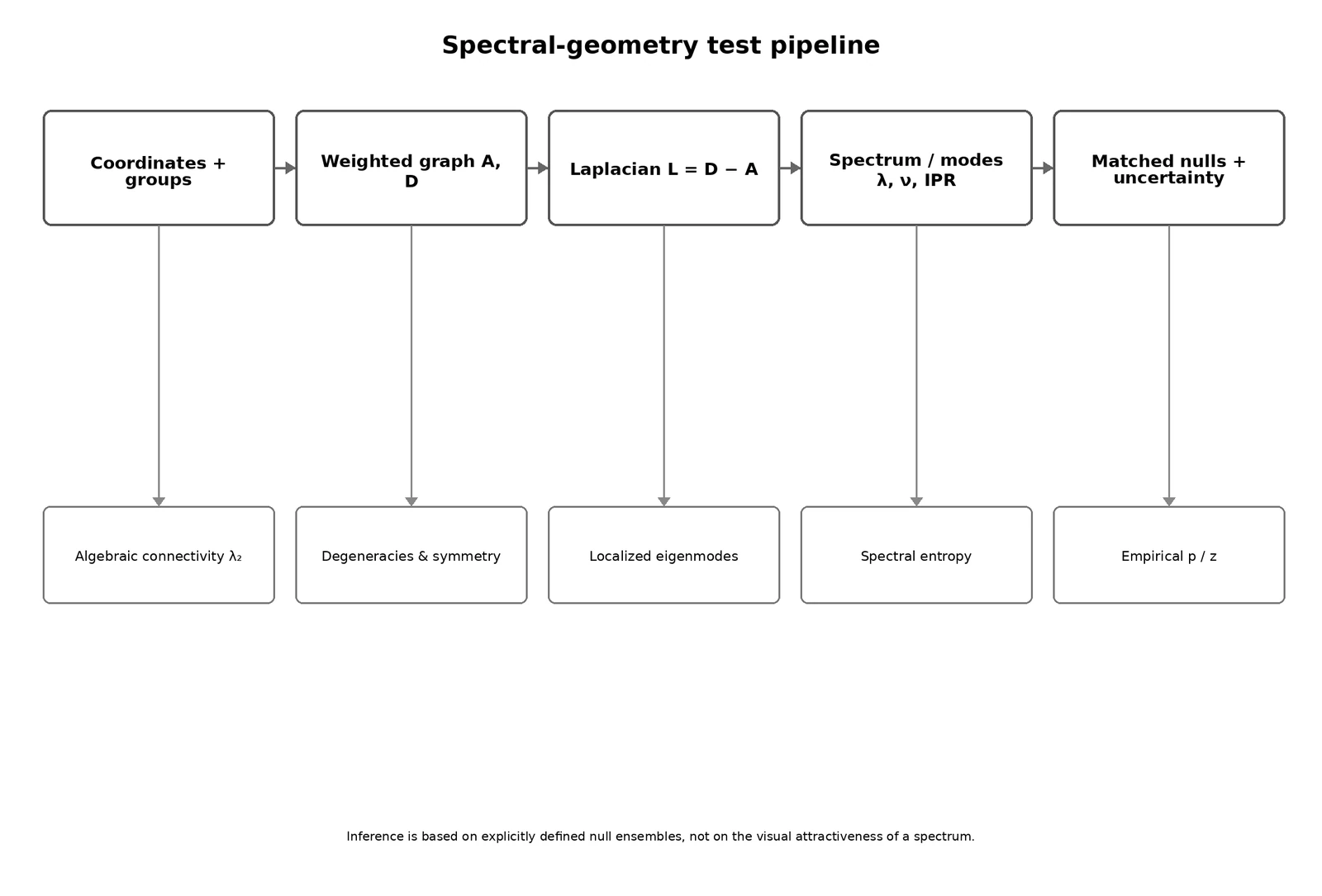
Uncertainty propagation must be conceptually separated from a geometric null model. Coordinate uncertainty asks how much a statistic varies if the true position lies within the stated measurement error. A null model asks how unusual the design is under a specified alternative process. Mixing the two can produce meaningless p-values.
5.2 Angular-order parameters
For points with polar angles θ_j around a chosen center, n-fold angular order can be summarized by
Rₙ = | (1/N) Σⱼ exp(i n θⱼ) |, 0 ≤ Rₙ ≤ 1.
R_n approaches one when points align strongly with n-fold rotational order and tends toward smaller values for angularly diffuse arrangements. Because choosing n after inspecting the data constitutes multiple testing, exploratory scans over n should be followed by preregistration or family-wise / false-discovery correction in confirmatory work. In the MGFP implementation, the full n = 1…24 spectrum is therefore retained rather than reporting only visually attractive harmonics.
5.3 Graph spectral geometry
A monument can be represented as a graph G = (V,E) whose vertices are stones or structural nodes and whose weighted edges encode spatial adjacency, wall connectivity, nearest-neighbor relations, or a distance kernel. For adjacency matrix A and degree matrix D, the combinatorial graph Laplacian is
L = D − A.
The normalized Laplacian may be preferable for dimensionless comparisons across graphs with different degree scale. Its eigenvalues and eigenvectors summarize connectivity and spatial modes. Metrics of interest include the algebraic connectivity λ₂, eigenvalue degeneracies, spectral entropy, and inverse participation ratio (IPR) of eigenvectors. Degeneracy can be a signature of symmetry, while a high IPR can indicate localized graph modes. Neither quantity is evidence of physical resonance by itself; a physical operator must still be defined.
The octahedral graph example discussed by Evdokimov and Meijer is useful here only at the mathematical level: K₂,₂,₂ has Laplacian spectrum {0,4,4,4,6,6}. The broader identification of such spectra with a universal vacuum architecture is speculative, but the graph-spectral machinery is standard and can be applied directly to archaeological layouts.
5.4 Fourier structure factor
For a point set, the reciprocal-space structure factor is
S(k) = | (1/N) Σⱼ exp(i k · rⱼ) |².
Peaks in S(k) indicate reciprocal-space periodicities or preferred spatial scales that can contribute to coherent scattering. The corresponding characteristic real-space scale is approximately 2π/|k|. Because finite point sets always generate structured Fourier patterns, the informative question is not whether peaks exist but whether peak strength, anisotropy, or orientation is exceptional relative to matched randomized layouts and robust to coordinate uncertainty.
5.5 Thom metrology as a lattice-residual problem
For candidate unit q and measured lengths y_i, a simple lattice residual assigns each measurement to the nearest integer or half-integer multiple m_i q and evaluates normalized residuals ε_i/q. Confirmatory tests should specify q and allowed phase or subdivision before examining the result. Exploratory unit scans require a post-selection null distribution that repeats the entire scan for each randomized dataset; otherwise the reported significance is optimistic.
All-pairs distances are convenient but statistically dependent: N points generate N(N−1)/2 distances with extensive geometric covariance. Preferred confirmatory corpora are independently meaningful dimensions—diameters, perimeters, center-to-center baselines, separately measured focal distances, or predefined construction segments.
5.6 Randomized null models
Different hypotheses require different nulls. Independent-angle randomization can preserve each pillar’s radial distance while destroying angular organization. Angular-gap permutation preserves the distribution of gaps while altering their order. Rigid group rotation preserves within-enclosure geometry while disrupting between-enclosure registration. Metrological nulls can randomize dimensions within measurement constraints or generate layouts with the same gross radius/stone-count distribution. No single null model answers every question.
6. Physical mechanisms: what ordinary physics permits
6.1 Acoustic and infrasonic conditioning
Stone enclosures alter sound through reflection, diffraction, scattering, absorption, and enclosure geometry. Stonehenge provides a direct archaeological analogue: Cox, Fazenda, and Greaney (2020) measured a 1:12 acoustic scale model and reported an average mid-frequency reverberation time of approximately 0.64 s and speech amplification of about 4.3 dB within the reconstructed monument. Importantly, alternative bluestone configurations in their study produced changes that were not judged audibly large, which argues against treating acoustic function as the sole determinant of detailed layout.
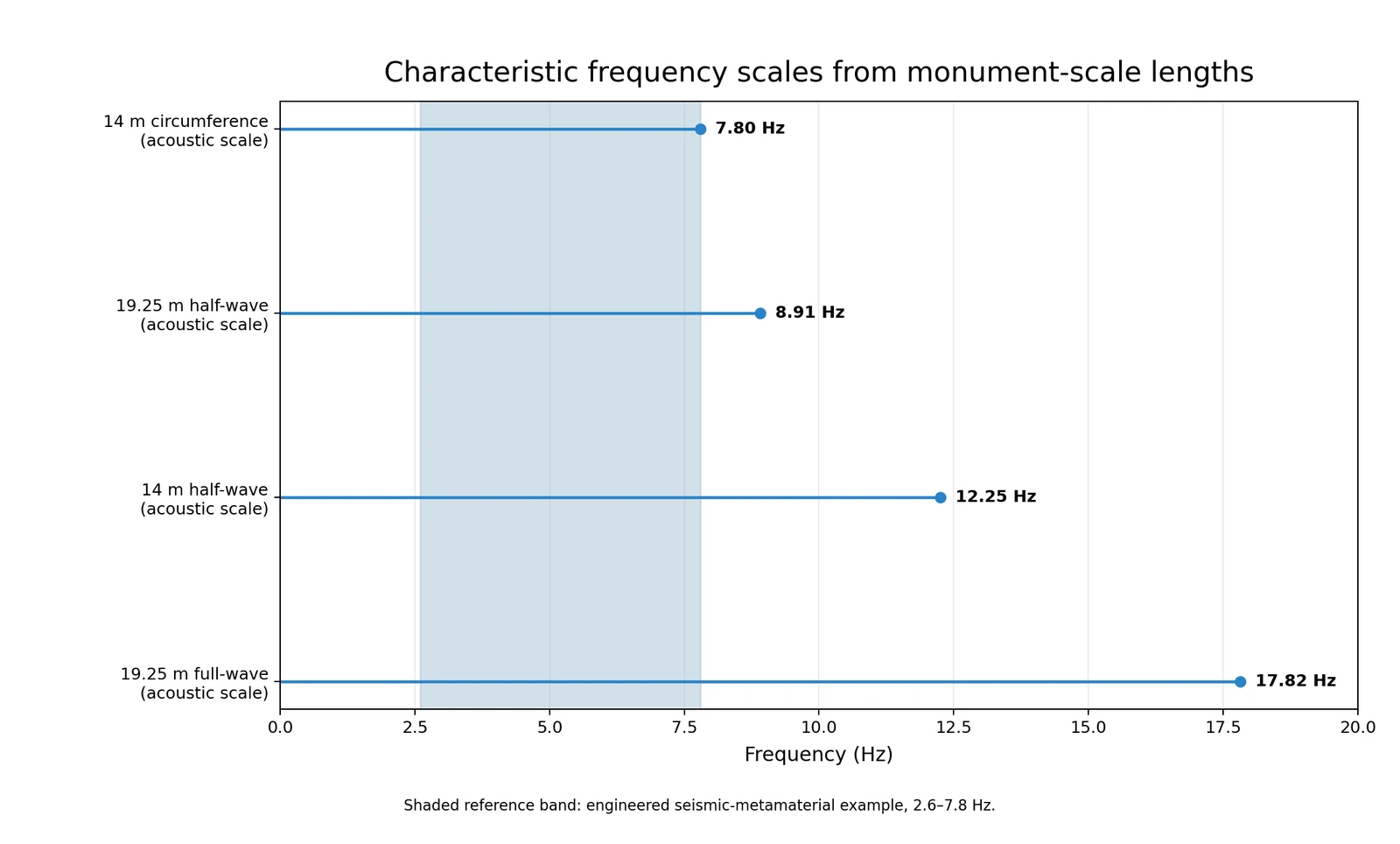
At Göbekli Tepe, monument-scale dimensions fall naturally into low-frequency acoustic screening ranges. Taking c_air ≈ 343 m/s, a 14 m characteristic diameter gives c/(2D) ≈ 12.25 Hz for a half-wave length scale and c/(πD) ≈ 7.80 Hz for one wavelength around a circumference. A 19.25 m baseline gives c/(2L) ≈ 8.91 Hz and c/L ≈ 17.82 Hz. These numbers are not cavity eigenfrequencies: roofing, wall height, openings, temperature, absorption, irregular geometry, and three-dimensional boundary conditions all matter. Their value is to identify frequencies worth testing with proper finite-element, boundary-element, or field measurements.
6.2 Scalar scattering models and their limits
A first screening model represents each pillar as a weak secondary source driven by an incident field. For wavenumber k, an outgoing scalar Green function can be approximated in three dimensions as G(r) ∝ exp(ikr)/r, with attenuation added phenomenologically if required. A Born model neglects interactions among secondary scatterers. A Foldy–Lax multiple-scattering model improves this by solving for mutually coupled scatterer amplitudes. These approximations are useful for comparative geometry, but they do not replace full boundary conditions, frequency-dependent impedance, surface roughness, or vector elasticity.
6.3 Elastic, seismic, torsional and flexural response
Every free-standing or embedded stone has mechanical eigenmodes determined by geometry, density, elastic constants, contact stiffness, cracks, bedding, and foundation conditions. For isotropic screening, the shear modulus and bulk modulus are
G = E / [2(1 + ν)], K = E / [3(1 − 2ν)].
Vₛ = √(G/ρ), Vₚ = √[(K + 4G/3)/ρ].
These velocities set elastic wavelength scales but do not uniquely determine monument modes. A rectangular cantilever approximation can estimate the first flexural frequency with Euler–Bernoulli theory, while torsional response depends on shear modulus, polar mass moment, embedment, and the Saint-Venant torsion constant. The value of such formulas is diagnostic: they identify whether plausible human excitation, wind, or ambient ground motion lies anywhere near structural modes. Site-specific inference requires measured dynamic properties and foundation coupling.
Modern seismic metamaterial research demonstrates that ordered resonators can attenuate low-frequency surface waves. Gupta et al. (2023), for example, modeled a metamaterial foundation with attenuation in approximately the 2.6–7.8 Hz range, and Zhang et al. (2024) reported a field experiment in which an array of rubber-column resonators attenuated Love-wave energy over a broad band. These results establish possibility in engineered systems, not prehistoric intent. They justify asking whether megalithic arrays measurably perturb elastic-wave propagation.
6.4 Stable trapping as a geometry principle
Keir’s rigorous analysis of wave propagation on supersymmetric microstate geometries belongs to general relativity, not archaeology, and should not be cited as evidence for hidden dimensions at megalithic sites. Its legitimate conceptual contribution is narrower: geometry can create stable trapping and exceptionally slow decay of wave energy in a precisely specified physical model. The transferable lesson is methodological—study the spectrum and trapping structure of the operator—rather than ontological.
6.5 Geoelectric and electrokinetic mechanisms
Calcite-water interfaces possess an electrical double layer, and pressure-driven electrolyte flow through pores can generate streaming potentials. Bonto, Eftekhari, and Nick (2022) review the complexity of calcite zeta-potential measurements and surface-complexation models, emphasizing dependence on brine chemistry, temperature, impurities, and non-equilibrium conditions. Consequently, a limestone monument coupled to wet bedrock could in principle exhibit weak mechanically correlated electrical signals, but the magnitude is site-specific and cannot be inferred from geometry alone.
The appropriate experimental chain is therefore ground strain or hydraulic pressure → pore-fluid motion → electrokinetic potential. High-impedance non-polarizable electrodes, hydrological sensors, and simultaneous seismic measurements can test that chain directly. A geometry-derived resistor network may be useful as an exploratory spatial model of current pathways, but its conductances must eventually be calibrated against real resistivity and saturation data.
6.6 Stress-electric effects in quartz-rich and calcitic stone
Quartz is piezoelectric at the crystal level; a polycrystalline rock exhibits a bulk response only if grain orientations and compensating charges do not cancel it. Bishop (1981) demonstrated the concept of piezoelectric fabrics in quartz-rich rocks, while Sasaoka, Yamanaka, and Ikeya (1998) reported transient electrical potentials from stressed granite specimens. Stonehenge’s sarsens are unusually quartz-rich silcrete: Nash et al. (2021) found approximately 99.7 wt% SiO₂ in the analyzed Stone 58 material. Such facts justify instrumented stress-electric tests on representative stone, but they do not demonstrate that Stonehenge functioned electrically.
Calcite is generally not treated as a strong piezoelectric material. Guerin, Tofail, and Thompson (2018) reported weak residual longitudinal responses in natural calcite materials and interpreted them as preliminary evidence requiring careful symmetry and defect considerations. For carbonate monuments the electrokinetic pathway is therefore generally more plausible as a weak-field mechanism than a giant coherent piezoelectric generator.
6.7 Geomagnetic and induction effects
Basaltic and andesitic rocks can contain magnetite or titanomagnetite and may carry magnetic susceptibility and remanent magnetization that vary strongly with composition, oxidation, alteration, and cooling history. This makes volcanic monuments relevant to magnetic mapping. A static geomagnetic field, however, is not a continuous energy supply. Faraday induction requires changing magnetic flux or relative motion. Any claim of geomagnetic “power extraction” must specify dΦB/dt, circuit geometry, impedance, and measurable voltage or current.
6.8 Thermal, geothermal and radiogenic effects
Stone structures exchange heat by conduction, convection, radiation, moisture transport, and contact with the substrate. The ordinary conductive geothermal relation q = −k∇T provides an upper-scale background against which extraordinary thermal claims can be compared. Granitic rocks may have greater radiogenic heat production than pure carbonate because of uranium, thorium, and potassium content, but monument-scale radiogenic power is typically small. Thermal effects are more likely to matter through daily/seasonal expansion, moisture, airflow, and weathering than as a useful power source.
6.9 Biogeochemical surface conditioning
Microbial biofilms, lichens, pore-water chemistry, salts, and mineral dissolution/precipitation alter surface charge, porosity, conductivity, damping, and weathering over long timescales. Such processes can modulate weak electrical and mechanical properties of stone. They should be modeled as material-state variables rather than as an independent “biological energy” reservoir. For field campaigns, moisture, salinity, temperature, and biological surface cover should be logged as covariates.
6.10 Quantum effects: a boundary of interpretation
Elasticity, magnetism, chemical bonding, dielectric polarization, and piezoelectricity are ultimately quantum-mechanical phenomena. That trivial sense of “quantum” does not imply monument-scale quantum coherence, vacuum-energy extraction, gravitational control, or Kaluza–Klein engineering. No mechanism in the reviewed evidence establishes such effects at megalithic energy, temperature, and decoherence scales. These proposals remain Tier D unless they yield a quantitative Hamiltonian or constitutive coupling, an effect-size prediction, and a feasible measurement that distinguishes them from classical physics.
7. Comparative lithic-material architecture
7.1 Why material diversity matters
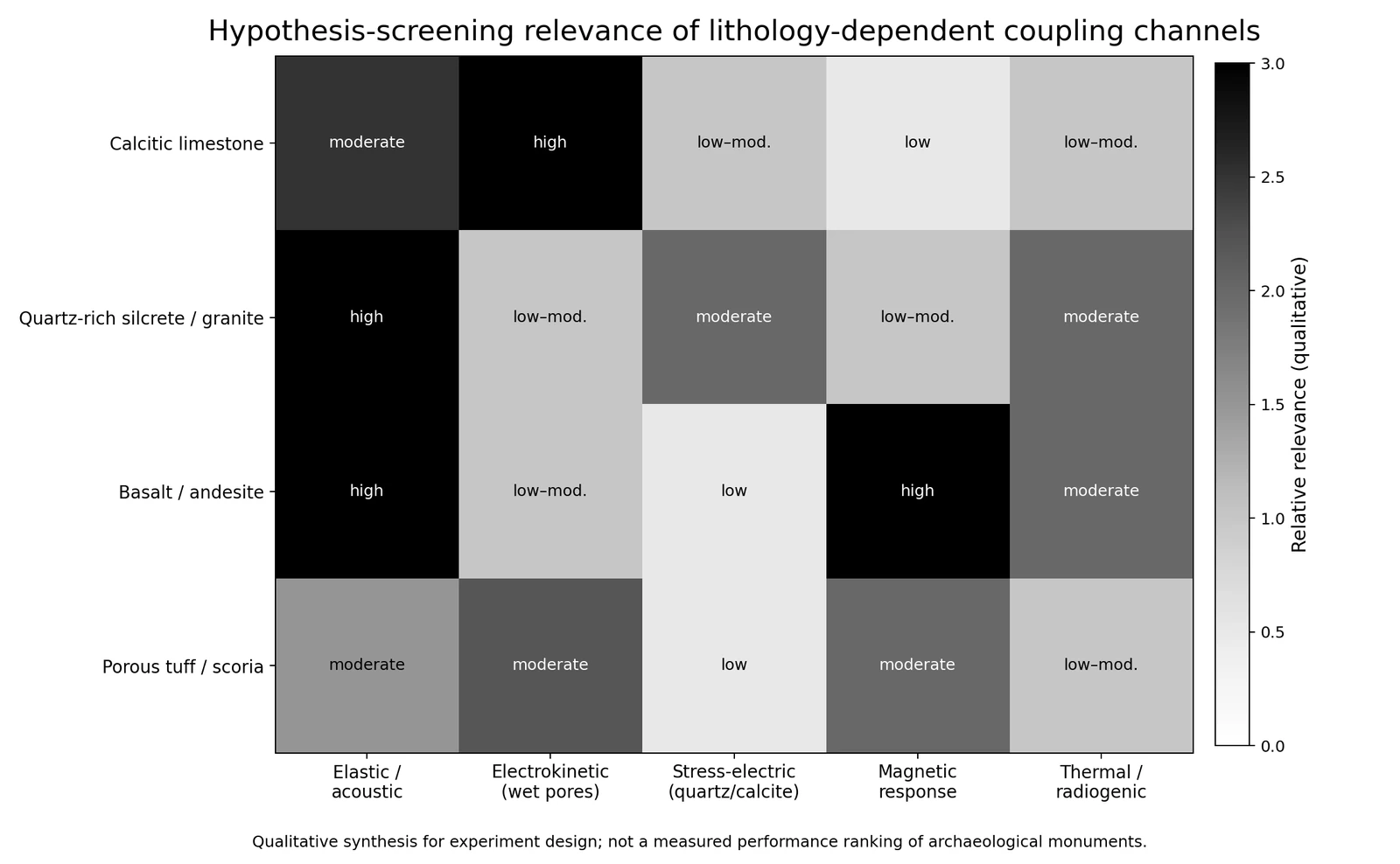
A global megalithic hypothesis should not assume that all stone behaves alike. Limestone, silcrete, granite, gneiss, sandstone, basalt, and volcanic tuff differ in density, elastic modulus, porosity, water sensitivity, electrical resistivity, dielectric constant, magnetic mineral content, thermal conductivity, and weathering. If the proposed function is real, those differences predict different coupling channels. A universal geometry could therefore coexist with local materials while producing non-universal physical responses.
7.2 Selected comparative examples
| Monument / region | Principal relevant lithology | Physical features of interest | Inference boundary |
|---|---|---|---|
| Göbekli Tepe, Türkiye | Local Urfa biomicritic limestone, predominantly calcitic | Moderate porosity; moisture-sensitive strength; acoustic/elastic response; calcite-water electrokinetics | Material properties support testing, not a claim of electrical or seismic design. |
| Stonehenge, Britain | Sarsen silcrete plus diverse bluestones | Quartz-rich sarsen; strong elastic scatterers; potential specimen-scale stress-electric response | Archaeoacoustic effects are measured; electrical function is unproven. |
| Carnac / Brittany | Predominantly local granitic lithologies in many settings | Quartz-bearing crystalline rock; elastic and potential weak stress-electric response | Lithology varies by site; requires local petrography. |
| Callanish, Lewis | Lewisian gneiss | Crystalline anisotropy, strong elastic contrast, possible magnetic/mineral heterogeneity | No demonstrated field-processing function. |
| Malta temple complexes | Globigerina and Coralline limestones | Contrasting porosity and mechanical durability; carbonate-water electrokinetics | Material contrasts can affect acoustics/weathering; intent unproven. |
| Giza complex, Egypt | Limestone, granite, basalt in different architectural contexts | Strong lithologic contrast; granite quartz/feldspar; thermal and elastic contrasts | Do not treat “the pyramid stone” as a single material. |
| Lalibela, Ethiopia | Hydrothermally altered, partially lateritized basaltic scoria | Highly vesicular volcanic rock; alteration minerals; porosity strongly affects damping and conductivity | Rock-hewn system differs fundamentally from free-standing megaliths. |
| Nan Madol, Pohnpei | Columnar basalt and coral construction | Dense magnetic/elastic basalt combined with porous carbonate material | Geochemical sourcing is established; geophysical function is not. |
| Tiwanaku / Pumapunku, Bolivia | Sandstone and andesitic volcanic stones in major elements | Contrasting mechanical and magnetic properties | Site-specific lithologic assignments must be verified by element/context. |
| Rapa Nui, Chile | Volcanic tuff/hyalotuff for many moai; harder volcanic rocks elsewhere | Porous tuff damping/weathering; volcanic magnetic response | Material choice has clear quarry/working implications; field effects unproven. |
| Borobudur, Indonesia | Andesitic volcanic stone | Elastic/magnetic mineral variability and tropical weathering | Monument is historical masonry, not a direct megalithic analogue. |
| Angkor, Cambodia | Sandstone and laterite | Porosity, moisture, iron-bearing laterite, weathering and magnetic susceptibility differences | Useful comparative material system; different chronology/culture. |
7.3 Urfa limestone as the Göbekli material baseline
Dursun (2026) characterized Urfa stone as a biomicritic limestone composed mainly of calcite. The reported dry uniaxial compressive strength was about 16.9 MPa, decreasing to about 10.6 MPa when saturated; sonic velocity was approximately 3418 m/s, with reported porosity near 20% in the associated characterization. These values reinforce two design principles for MGFP modelling: saturation can materially alter mechanical behavior, and generic “limestone” constants are not adequate for site-specific simulation.
7.4 Stonehenge sarsen as a quartz-rich end member
Nash et al. (2021) describe the analyzed sarsen core as a groundwater silcrete dominated by quartz and approximately 99.7 wt% SiO₂. This makes sarsen an informative end member for comparison with carbonate monuments. The same geometry built from quartz-rich silcrete and porous limestone will have different impedance, damping, electrical relaxation, and moisture response. A serious cross-site field-processing theory must predict those differences rather than treating “stone” as a universal medium.
8. Archaeoastronomy as geometry constrained by the horizon
8.1 Thom’s observational model
Thom’s lunar-observatory interpretation relied on distant natural foresights and movable or repeated backsight positions. His 1971 book distinguishes coarse monument-internal alignments from sites in which a clean distant horizon could, in his model, support high angular precision. He corrected declinations for horizon altitude, astronomical refraction, terrestrial refraction, and lunar parallax, and attempted to infer the Moon’s orbital inclination and perturbation. Whether the archaeological interpretation is accepted, the computational point remains valid: an azimuth cannot be interpreted astronomically without latitude and horizon altitude.
sin δ = sin φ sin h + cos φ cos h cos A
Here δ is declination, φ latitude, h reduced true altitude, and A true azimuth measured from geographic north. For the Moon, apparent altitude additionally requires treatment of horizontal parallax and limb choice. Near-horizon refraction can dominate the error budget. Consequently, archaeological claims at arc-minute precision should report meteorological/refraction assumptions rather than quoting a single deterministic declination.
8.2 Calendar and lunar-standstill hypotheses
Thom proposed a solar calendar with divisions of the year represented by horizon declinations and emphasized the approximately 18.6-year regression of the lunar nodes. These claims are historically important, but confirmatory evaluation should use modern ephemerides, documented horizon profiles, uncertainty in original backsight/foresight positions, and corrections for precession, obliquity, refraction, parallax, and monument chronology. A line that approximately intersects a modern or reconstructed celestial target should not be counted as independent evidence if the line itself was selected after searching many possible stone pairs.
8.3 Geometry–astronomy conjunction as a stronger test
The most interesting Thom-style proposition for MGFP is not merely that a line points to a celestial event, but that the same construction geometry generates the line. Castle Rigg was presented by Thom as such a conjunction: a Type A flattened-circle construction allegedly supplied several solar/lunar directions. The appropriate modern test is model comparison: fit candidate construction families to the stone coordinates, propagate survey uncertainty, predict sight-lines before examining celestial matches, and compare the joint fit against flexible circular/smooth alternatives and randomized layouts.
9. Non-mainstream frameworks as constrained hypothesis generators
9.1 Robert Grant’s number-wave theory
Grant and collaborators propose that digital roots, reciprocal sequences, modular families such as [1,4,7], [2,5,8], and [3,6,9], and twelve-fold wave-like matrices encode deep physical structure. The accompanying Number Wave Generator used digital roots as circle radii and connected geometric intersections to produce an interference-style visualization. This is mathematically distinct from solving a physical wave equation. A digital-root pattern may be aesthetically or combinatorially interesting, but without a constitutive mapping from number representation to a measurable field it is not a wave in the physical sense.
The MGFP therefore preserves Grant-style encodings only as exploratory descriptors and adds a representation-sensitivity test. If a result changes when an invariant physical length is expressed in metres rather than feet, the result cannot by itself be a unit-invariant physical observable. Grant’s polygonal/right-triangle spiral work is more directly geometric and can be examined as a family of discrete self-similar constructions, but any archaeological match still requires preregistered fitting and comparative nulls.
9.2 Cathie’s Harmonic 33 and world-grid theory
Bruce Cathie’s Harmonic 33 proposes a global grid linking UFO reports, gravity, Earth dimensions, Stonehenge, the Great Pyramid, and a set of harmonic numbers. Its historical interest lies in explicitly treating ancient monuments as nodes in a planetary field system. Methodologically, however, the framework permits decimal shifting, reciprocals, unit changes, selected angles, and harmonic rescaling after inspection. This creates an extreme multiple-comparison problem. The MGFP does not reject such claims because they are unconventional; it requires them to specify one preregistered physical prediction—such as a frequency, voltage, field gradient, or acceleration anomaly—that can be measured blindly at a designated location.
9.3 Octahedral spectral models and scale-invariant resonance claims
The Evdokimov–Meijer manuscript links octahedral graph spectra, musical ratios, and proposed electromagnetic eigenfrequencies within a broader ontological framework. The graph-theoretic statements about the octahedron are standard and useful; the inference from those spectra to a universal vacuum network remains speculative. MGFP adopts the former and does not assume the latter. This separation illustrates a general strategy: retain mathematically valid operators while independently testing the physical ontology proposed around them.
9.4 Ritual-energy narratives and measurable excitation
The Geoffrey Hodson texts supplied for this study describe Pueblo ceremonial dance, drumming, stamping, chanting, color, collective concentration, and alleged “earth forces,” devas, and astral energies. The supernatural claims are not empirical geophysical evidence. The physical components are measurable: dozens or hundreds of synchronized impacts, voices, drums, bells, and bodies can drive airborne sound and ground vibration for hours. An instrumented ceremonial-excitation model can therefore test whether rhythmic input overlaps monument or ground modes without adopting the esoteric explanation.
9.5 Quantum-entropy and transcendental-number proposals
The supplied quantum-entropy manuscript proposes mapping random quantum data to transcendental numbers. Several claims in that document require correction before scientific use: a random or prescribed path through the ternary Cantor set does not guarantee a transcendental limit point, because the Cantor set contains rational and algebraic numbers as well as transcendentals; apparent digit normality or non-repetition does not prove transcendence; and statistical tests cannot substitute for a mathematical proof of transcendence. The useful transferable idea is information encoding, not a demonstrated entropy–transcendence law.
10. Computational implementation: Megalithic Geometric Field Processor v3
10.1 Architecture
A single-file HTML/JavaScript research prototype, Megalithic Geometric Field Processor v3 (MGFP v3), was developed to integrate the analysis layers described above. The application accepts arbitrary site/group labels and CSV coordinate input (id, enclosure, type, x, y, z, uncertainty), preserves a literature-constrained Göbekli B–C–D reconstruction for demonstration, and separates data provenance from model output. The built-in reconstruction is explicitly not represented as survey-grade archaeology.
The application contains modules for geometry diagnostics; full R₁…R₂₄ angular-order spectra; graph construction and Laplacian eigendecomposition; spatial eigenmode visualization; acoustic Born and Foldy–Lax scalar scattering; acoustic and seismic frequency sweeps; reciprocal-space structure factors and pair-distance distributions; a connectivity-checked geoelectric resistor network; Thom metrology and unit scans; Thom ring/egg/ellipse diagnostics; horizon, solar, and lunar astronomy; a global lithic atlas; material multiphysics; ceremonial excitation screening; Grant-wave sensitivity analysis; randomized null models; coordinate-uncertainty propagation; an evidence registry; and reproducible session export.
10.2 Acoustic and elastic screening equations
The Born acoustic mode treats each structural point as an independently driven secondary scatterer. The Foldy–Lax mode solves a linear system for mutually coupled scalar amplitudes. Both are deliberately labelled screening models because pillar shape, finite wall surfaces, roof reconstruction, ground impedance, viscous/thermal losses, and full vector elasticity are not resolved. The elastic/seismic module uses an effective surface-wave speed and optional resonator transfer function
χ(f) = 1 / [1 − (f/f₀)² + i (f/f₀)/Q].
Such a transfer function is suitable for sensitivity analysis but must not be interpreted as a measured archaeological resonance. It is a parametric way to ask how a periodic or quasi-periodic layout would interact with a resonant scatterer population if those parameters were independently observed.
10.3 Material multiphysics module
Material presets in the prototype are engineering priors, not assays of individual archaeological stones. The module derives isotropic elastic quantities from E, ν, and ρ; estimates longitudinal, shear, flexural, and torsional scales for idealized monoliths; computes electromagnetic skin depth and Maxwell relaxation time from resistivity, permeability, and permittivity; and permits user-supplied stress-electric or streaming-potential coefficients. Defaults for speculative couplings are not treated as evidence. Site-specific work should replace every relevant prior with laboratory measurement on representative stone and substrate.
10.4 Reproducibility
MGFP v3 exports coordinates, parameters, random seeds, and major outputs to JSON and a human-readable methods/results report. A confirmatory publication should additionally archive the exact HTML source, input dataset, cryptographic hashes, analysis protocol, and null-generator specification in a DOI-bearing repository. Versioning is essential because numerical conclusions can change when reconstruction choices or parameter defaults change.
11. Worked screening example: Göbekli-scale geometry
11.1 Dimensional estimates
This section illustrates what can and cannot be concluded from dimensional screening before survey-grade simulation. Using the published ~19.25 m centre-triangle side and a representative ~14 m enclosure-scale diameter, Table 4 gives characteristic acoustic frequencies for c = 343 m/s. These values should be treated as candidate measurement bands, not as predicted resonances.
| Length / path | Screening relation | Frequency | Interpretation |
|---|---|---|---|
| 14 m diameter | c/(2D) | 12.25 Hz | Half-wave length scale across an enclosure-sized diameter. |
| 14 m diameter | c/(πD) | 7.80 Hz | One acoustic wavelength equal to an idealized circumference. |
| 19.25 m centre baseline | c/(2L) | 8.91 Hz | Half-wave length scale along the published centre separation. |
| 19.25 m centre baseline | c/L | 17.82 Hz | One wavelength equal to the centre separation. |
The ~7.8 Hz value is numerically near the fundamental Schumann resonance, but the comparison has no demonstrated physical significance. Schumann resonances are electromagnetic modes of the Earth–ionosphere cavity with planetary wavelengths; the ~7.8 Hz estimate above is an acoustic geometric scale in air. Numerical coincidence across physically unrelated dispersion relations is precisely the type of observation that must not be promoted to mechanism without a coupling model.
11.2 Metrological screening
Using 1 MY = 0.829056 m, the ~19.25 m centre separation corresponds to ~23.22 MY. A later 2.722-ft value changes this slightly to ~23.20 MY. Neither is an unusually close integer, and no conclusion about Thom metrology at Göbekli follows. A proper analysis would require a predeclared corpus of independent dimensions and a null distribution that repeats the candidate-unit scan, if any scan is performed.
11.3 Spectral and null-model screening
A meaningful next step is to replace schematic coordinates with photogrammetric or excavation GIS coordinates, define the construction phase, and calculate multiple independent descriptors: Rₙ angular order, graph spectra, S(k), pair-distance distributions, and selected wave-field metrics. Each statistic should be compared with at least one null that preserves gross enclosure radii and stone counts. If the observed layout is extreme across several preregistered domains, the joint evidence becomes more interesting than any single geometric coincidence.
12. Experimental programme
12.1 Stage 1: survey and provenance
The first requirement is not a more elaborate simulation but better input data. Every modeled point should have a source, coordinate frame, uncertainty, architectural phase, and material assignment. Where the original stone position is reconstructed, the reconstruction method should be explicit. Horizon profiles should be surveyed independently for archaeoastronomical analysis. Lithology should be verified petrographically where possible rather than assigned by visual appearance alone.
12.2 Stage 2: passive field monitoring
Non-invasive instrumentation can test whether existing monuments measurably condition ambient fields without striking, drilling, or modifying archaeological fabric. A deployment could include broadband microphones/infrasound sensors, geophones or compact seismometers, temperature/humidity probes, non-polarizable electrodes for self-potential, electrical resistivity electrodes where permitted, magnetometers, soil moisture/groundwater sensors, and synchronized GNSS-disciplined timing. Reference sensors outside the monument are essential for common-mode rejection.
12.3 Stage 3: controlled replicas
The most decisive physical experiments may be performed away from protected sites. A scale model can be used for high-frequency acoustic similarity; a full-size or reduced outdoor array of concrete/stone resonators can test elastic surface-wave scattering; interchangeable blocks with measured material properties can isolate lithology. The observed archaeological geometry and matched randomized controls should be built or digitally simulated under identical boundary conditions.
12.4 Stage 4: preregistered cross-domain test
| Domain | Primary observable | Instrumentation / model | Matched null or control | Result that would weaken the functional hypothesis |
|---|---|---|---|---|
| Geometry | Rₙ, fitted construction residual, centre-triangle error | Survey GIS / photogrammetry | Radius-preserving random angles; alternative smooth curves | Observed statistic typical under null or unstable to survey error. |
| Graph spectrum | λ₂, degeneracies, IPR, spectral entropy | Weighted graph analysis | Degree/radius-matched randomized graphs | Spectral features common under null. |
| Acoustics | Transfer gain, decay time, pressure-node location | Microphone array / BEM-FDTD / replica | Same envelope with randomized pillars | No reproducible geometry-dependent difference. |
| Elastic / seismic | Transmission loss, mode frequency, spatial localization | Geophones / shaker replica / FEM | Randomized resonator placement | No band-specific attenuation/localization beyond ordinary scattering. |
| Geoelectric | Self-potential / transfer impedance correlated with strain or pore pressure | Non-polarizable electrodes + hydrology + seismic sensors | Outside-site and dry controls | Signal follows electrode chemistry/weather only, not geometry or forcing. |
| Magnetic | Field gradient / susceptibility map / induction under known variation | Fluxgate/OPM + rock magnetic assays | Geological background model | Anomaly explained entirely by natural lithologic heterogeneity. |
| Metrology | Fixed-unit residual / post-selection corrected statistic | Survey dimensions + Monte Carlo | Random lengths with same range/error | MY or other unit not exceptional after selection correction. |
| Astronomy | Predicted declination residual | True azimuth + horizon profile + ephemeris | All plausible stone-pair lines / alternative constructions | Match rate consistent with selection opportunities. |
12.5 Joint evidence and replication
A decisive result would not be a single small p-value. It would be a preregistered pattern in which (a) unusual geometry survives survey uncertainty; (b) the same design produces a reproducible field effect in measured or high-fidelity replicated physics; (c) material-specific predictions are satisfied; (d) alternative layouts fail under the same test; and (e) the result replicates independently. Only after those conditions are met does it become reasonable to ask whether archaeological evidence supports intentional exploitation.
13. Discussion
13.1 What is most plausible
Among the mechanisms reviewed here, acoustic and mechanical/elastic conditioning have the strongest combination of physical plausibility and direct testability. Large stones are unavoidable scatterers; enclosures unavoidably shape sound; pillars and walls possess mechanical modes; and modern engineering demonstrates that periodic structures can alter surface-wave propagation. These statements do not require speculative physics.
Weak electrical effects are plausible secondary channels where lithology and hydrology permit them. Calcite electrokinetics makes saturated carbonate especially relevant to self-potential studies, while quartz-rich rocks justify specimen-scale stress-electric testing. Volcanic rocks warrant magnetic characterization. In each case, expected magnitudes are likely to be modest and highly site-dependent.
13.2 What is less plausible but still testable
A deliberately designed seismic metasurface at a prehistoric monument would be extraordinary but not physically incoherent. The correct path is magnitude-first: estimate relevant wavelengths, impedance contrasts, resonator frequencies, and attenuation. If the geometry cannot produce a measurable effect under realistic material parameters, the hypothesis should be rejected without appeal to hidden energy. If a robust effect is predicted and observed, the archaeological question of intentionality remains separate.
13.3 What currently lacks a credible mechanism
Macroscopic manipulation of gravity, vacuum energy, spacetime, Kaluza–Klein dimensions, or a planetary harmonic grid by ordinary stone geometry currently lacks a supported coupling law and replicated effect in the evidence reviewed here. Cathie-style harmonics and related number correspondences do not supply such a law. They can be transformed into science only by specifying a pre-measurement prediction with units, effect size, instrument, uncertainty, and failure criterion.
13.4 Why cross-domain convergence matters
The most interesting future result would be a geometry that simultaneously exhibits statistically unusual constructive order, an archaeologically coherent horizon alignment, and a material-appropriate transfer-function anomaly. The joint requirement sharply reduces the freedom available for post-hoc storytelling. It also suggests a possible mechanism for cultural persistence: a geometry could be symbolically meaningful precisely because it reliably changes sensory or environmental experience, even if its builders understood that effect empirically rather than through formal wave theory.
14. Limitations
• The published B–C–D relation at Göbekli Tepe does not provide a complete, survey-grade three-dimensional dataset for every pillar, wall, roof, floor, and construction phase. Schematic or reconstructed coordinates must not be treated as excavation measurements.
• Most physical modules described here are screening models. Scalar Green functions, point scatterers, simplified graph conductances, and idealized beam/torsion formulas cannot replace full material characterization and boundary-value simulation.
• Lithic properties vary within the same named rock type. Weathering, cracks, saturation, anisotropy, bedding, mineral fabric, and foundation contact can dominate laboratory handbook values.
• Archaeoastronomical intentionality is vulnerable to selection effects because many stone pairs, horizon features, celestial targets, and chronological reconstructions can be searched. Multiple-testing control is mandatory.
• Thom’s Megalithic Yard and ring-family interpretations remain contested; the present framework treats them as hypotheses to test, not established standards.
• The comparative global material survey is selective rather than exhaustive. It is intended to stratify mechanism testing by lithology, not to imply a single cultural tradition across continents.
• Numerical frameworks based on digital roots or decimal sequencing are representation-dependent unless a privileged unit/base is independently justified.
• Esoteric historical sources included here are primary evidence for particular belief narratives, not empirical validation of invisible fields or ancient advanced physics.
• A physically real field effect does not establish prehistoric awareness or design intent. Archaeological function requires independent contextual evidence.
15. Conclusions
The Megalithic Geometric Field Processor concept is best understood as a research programme rather than a claim about a discovered ancient technology. Its core proposition is conservative in physics but ambitious in archaeology: monumental geometry can be analyzed as a passive operator that modifies fields already present in the environment. The hypothesis becomes scientifically useful only when it predicts measurable differences between an archaeological arrangement and carefully matched alternatives.
Göbekli Tepe supplies a compelling planning problem because the B–C–D centre relation is geometrically structured at a scale large enough to support meaningful spectral and wave analysis. Thom’s work supplies a complementary historical programme in metrology, constructive geometry, and horizon astronomy, together with an early recognition of the statistical dangers of post-hoc quantum discovery. Modern acoustics, elasticity, seismic metamaterials, electrokinetics, rock piezoelectricity, and graph/Fourier methods supply the physical and mathematical vocabulary needed to convert those questions into experiments.
The most defensible working hierarchy is therefore: geometry → boundary conditions → modes and interference → spatial concentration or attenuation → material-specific transduction. Evidence for this chain can be gathered with ordinary instruments. The more radical chain—geometry → exotic energy creation or gravitational/vacuum control—currently lacks the intermediate mechanism and should remain explicitly speculative.
If future survey-grade analyses find that specific megalithic layouts are extreme under preregistered null models and that the same geometries produce reproducible, lithology-consistent physical effects in field measurements or replicas, the result would justify a new interdisciplinary category of functional monumental architecture. If they do not, the MGFP framework will still have served its purpose by turning visually persuasive but ambiguous pattern claims into quantitative tests capable of failure.
Frequently Asked Questions
What is a Megalithic Geometric Field Processor?
In this framework a “processor” is a passive, scale-dependent arrangement of stone whose boundary conditions and material composition may modify fields already present — acoustic, elastic or seismic, thermal, hydrological, weak electrical or magnetic. The hypothesis is tested against matched null geometries rather than assumed.
Does the paper claim that megaliths produced energy?
No. The article states that its central proposal is not that megaliths created exotic energy. Claims of gravitational or vacuum control lack an intermediate mechanism and are kept explicitly speculative.
Why is Göbekli Tepe the main case study?
Because the reported ~19.25 m equilateral relation among the centres of Enclosures B, C and D is a structured planning problem at a scale large enough to support meaningful spectral and wave analysis.
How does the framework avoid numerological overfitting?
Through unit-invariance checks, coordinate-uncertainty propagation, Thom-style lattice residuals and preregistered randomised null models: a layout counts as unusual only if it is extreme against carefully matched alternatives.
What experiments does the paper propose?
A staged programme: survey and provenance work, passive field monitoring, instrumented controlled replicas, a preregistered cross-domain test, and independent replication of any positive result.
16. Software, data and reproducibility statement
The research framework described in this article has been implemented as Megalithic Geometric Field Processor v3, a single-file HTML/JavaScript prototype developed by the author. The prototype includes data provenance controls, importable survey coordinates, spectral and wave modules, Thom analysis, lithic-material screening, null generators, coordinate-uncertainty propagation, and export of reproducible session parameters. A publication release should be deposited together with input datasets, version hash, and analysis protocol in a DOI-bearing repository. Author website: https://nonlinearplatform.com.
The article does not distribute excavation-team survey data. The built-in Göbekli geometry used for software demonstration is a literature-constrained reconstruction and must be replaced by authoritative coordinates for confirmatory archaeological inference.
17. Mathematical observables and implementation checklist
| Quantity | Definition / equation | What it tests | Primary caveat |
|---|---|---|---|
| Angular order Rₙ | |N⁻¹Σ exp(inθⱼ)| | n-fold rotational coherence | n must be preregistered or multiple testing corrected. |
| Graph Laplacian | L = D − A (or normalized form) | Connectivity and discrete spatial modes | Edge definition can dominate spectrum. |
| Structure factor | S(k)=|N⁻¹Σ exp(ik·r_j)|² | Reciprocal-space periodicity / coherent scattering scales | Finite sets always produce peaks; compare nulls. |
| Acoustic field | Green-function superposition / Foldy–Lax coupling | Pressure interference and multiple scattering | Point-scalar approximation; boundaries simplified. |
| Elastic screen | Wave propagation + optional χ(f) | Potential resonant scattering / attenuation | Requires real material and foundation properties. |
| Geoelectric network | L_G V = I | Geometry-conditioned resistive pathways | Graph conductance is an analogue until calibrated. |
| Thom residual | distance to nearest lattice node in units of q | Length quantization | Dependent distances and post-hoc unit scans inflate significance. |
| Astronomical declination | sinδ = sinφ sinh + cosφ cosh cosA | Horizon direction mapped to celestial coordinate | Refraction, parallax, chronology, horizon uncertainty. |
| Shear/longitudinal speeds | Vs=√(G/ρ); Vp=√[(K+4G/3)/ρ] | Elastic wavelength scale | Isotropic approximation. |
| Maxwell relaxation | τ_M = ερ_e | Charge-relaxation timescale in material | Strongly moisture and chemistry dependent. |
| EM skin depth | δ = √[2ρ_e/(ωμ)] | Penetration of time-varying fields | Quasi-static assumptions and material variability. |
| Null p-value | (1 + # null ≥ observed)/(1 + N_null), or appropriate tail | Rarity under stated null | Only valid for the full preregistered analysis pipeline. |
17.1 Minimum reproducibility checklist
• Archive the exact coordinate file and report its source, coordinate frame, units, and uncertainty model.
• Report which stones/pillars were included, their phase/context, and whether positions are measured or reconstructed.
• Freeze the primary statistic, frequency band, graph rule, metrological unit, and null generator before confirmatory analysis.
• Repeat parameter searches inside every null realization if the observed analysis used a search.
• Propagate coordinate and material uncertainty separately from structural randomization.
• Report effect sizes and confidence intervals, not only p-values.
• Retain negative results and failed frequencies to prevent selective reporting.
• For field physics, record sensor calibration, timing method, weather/hydrology, and reference-station data.
• For replicas, document scale laws and dimensional similarity; acoustic, elastic, and electromagnetic scaling are not interchangeable.
• Archive software source and cryptographic hash, together with a plain-text methods report sufficient to reproduce the run.
References
- Atkinson, R. J. C. (1975). Megalithic astronomy—A prehistorian’s comments. Journal for the History of Astronomy, 6(1), 42–52. https://doi.org/10.1177/002182867500600105
- Bishop, J. R. (1981). Piezoelectric effects in quartz-rich rocks. Tectonophysics, 77(3–4), 297–321. https://doi.org/10.1016/0040-1951(81)90268-7
- Bonto, M., Eftekhari, A. A., & Nick, H. M. (2022). Electrokinetic behavior of artificial and natural calcites: A review of experimental measurements and surface complexation models. Advances in Colloid and Interface Science, 301, 102600. https://doi.org/10.1016/j.cis.2022.102600
- Broadbent, S. R. (1955). Quantum hypothesis. Biometrika, 42, 45–57.
- Broadbent, S. R. (1956). Examination of a quantum hypothesis based on a single set of data. Biometrika, 43(1–2), 32–44. https://doi.org/10.1093/biomet/43.1-2.32
- Burl, H. A. W., & Freeman, P. R. (1977). Local units of measurement in prehistoric Britain. Antiquity, 51(202), 152–154. https://doi.org/10.1017/S0003598X00103242
- Cathie, B. L. (1968). Harmonic 33. Wellington: A. H. & A. W. Reed. [Historical speculative source.]
- Cox, T. J., Fazenda, B. M., & Greaney, S. E. (2020). Using scale modelling to assess the prehistoric acoustics of Stonehenge. Journal of Archaeological Science, 122, 105218. https://doi.org/10.1016/j.jas.2020.105218
- Dursun, F. (2026). Urfa stone: Evaluating the durability of the oldest known building stone in history. Bulletin of Engineering Geology and the Environment, 85, 157. https://doi.org/10.1007/s10064-026-04810-9
- Evdokimov, O., & Meijer, D. K. F. (n.d.). A unified geometric framework for the architecture of reality, based on octahedral geometry and an acoustic, scale-invariant, power spectrum. Unpublished manuscript supplied for this study.
- Freeman, P. R. (1976). A Bayesian analysis of the Megalithic Yard. Journal of the Royal Statistical Society: Series A (General), 139(1), 20–35. https://doi.org/10.2307/2344382
- Grant, R. E. (n.d.). The Wave Theory of Constants. Unpublished manuscript supplied for this study.
- Grant, R. E., & Ghannam, T. (n.d.). The Wave Theory of Numbers. Unpublished manuscript supplied for this study.
- Grant, R. E., & Ghannam, T. (2021). Philomath: The Geometric Unification of Science & Art Through Number. Self-published/KDP edition.
- Grant, R. E., Ghannam, T., & Kennedy, A. (2021). A novel geometric model of natural spirals based on right triangle polygonal modular formations. arXiv:2111.02895.
- Guerin, S., Tofail, S. A. M., & Thompson, D. (2018). Longitudinal piezoelectricity in natural calcite materials: Preliminary studies. IEEE Transactions on Dielectrics and Electrical Insulation, 25(3), 803–807. https://doi.org/10.1109/TDEI.2017.007045
- Gupta, A., Sharma, R., Thakur, A., & Gulia, P. (2023). Metamaterial foundation for seismic wave attenuation for low and wide frequency band. Scientific Reports, 13, 2293. https://doi.org/10.1038/s41598-023-27678-1
- Haklay, G., & Gopher, A. (2020). Geometry and architectural planning at Göbekli Tepe, Turkey. Cambridge Archaeological Journal, 30(2), 343–357. https://doi.org/10.1017/S0959774319000660
- Hodson, G. (1936a). Relics of Atlantean occultism I: The inner side of American Indian life. The Theosophist, 57. [Historical esoteric primary source; later reformatted edition supplied for this study.]
- Hodson, G. (1936b). Relics of Atlantean occultism II–III: The Cacique; The legend of Poseiyemo. The Theosophist, 57. [Historical esoteric primary source; later reformatted edition supplied for this study.]
- Hodson, G. (1936c). Relics of Atlantean occultism IV: San Domingo Corn Dance. The Theosophist, 57. [Historical esoteric primary source; later reformatted edition supplied for this study.]
- Keir, J. (2020). Wave propagation on microstate geometries. Annales Henri Poincaré, 21, 705–760. https://doi.org/10.1007/s00023-019-00874-4
- McCoy, M. D., Alderson, H. A., Hemi, R., Cheng, H., & Edwards, R. L. (2016). Earliest direct evidence of monument building at the archaeological site of Nan Madol (Pohnpei, Micronesia) identified using 230Th/U coral dating and geochemical sourcing of megalithic architectural stone. Quaternary Research, 86(3), 295–303. https://doi.org/10.1016/j.yqres.2016.08.002
- Nash, D. J., Ciborowski, T. J. R., Darvill, T., Parker Pearson, M., Ullyott, J. S., Damaschke, M., Evans, J. A., Goderis, S., Greaney, S., Huggett, J. M., Ixer, R. A., Pirrie, D., Power, M. R., Salge, T., & Wilkinson, N. (2021). Petrological and geochemical characterisation of the sarsen stones at Stonehenge. PLOS ONE, 16(8), e0254760. https://doi.org/10.1371/journal.pone.0254760
- Renzulli, A., Antonelli, F., Margottini, C., Santi, P., & Fratini, F. (2011). What kind of volcanite the rock-hewn churches of the Lalibela UNESCO’s World Heritage Site are made of? Journal of Cultural Heritage, 12(2), 227–235. https://doi.org/10.1016/j.culher.2010.11.003
- Ruggles, C. L. N. (1999). Astronomy in Prehistoric Britain and Ireland. New Haven: Yale University Press.
- Sasaoka, H., Yamanaka, C., & Ikeya, M. (1998). Measurements of electric potential variation by piezoelectricity of granite. Geophysical Research Letters, 25(12), 2225–2228. https://doi.org/10.1029/98GL51179
- Suprun, A. (2026). Megalithic Geometric Field Processor v3 [Single-file HTML/JavaScript research software prototype]. Nonlinear Platform.
- Thom, A. (1954). The solar observatories of Megalithic man. Journal of the British Astronomical Association, 64, 396–404.
- Thom, A. (1955). A statistical examination of the megalithic sites in Britain. Journal of the Royal Statistical Society: Series A, 118, 275–295.
- Thom, A. (1961). The geometry of Megalithic man. The Mathematical Gazette, 45, 83–93.
- Thom, A. (1961). The egg-shaped standing stone rings of Britain. Archives Internationales d’Histoire des Sciences, 14, 291–303.
- Thom, A. (1962). The Megalithic Unit of Length. Journal of the Royal Statistical Society: Series A, 125(2), 243–251. https://doi.org/10.2307/2982328
- Thom, A. (1964). The larger units of length of Megalithic man. Journal of the Royal Statistical Society: Series A, 127, 527–533.
- Thom, A. (1966). Megaliths and mathematics. Antiquity, 40(158), 121–128. https://doi.org/10.1017/S0003598X00032294
- Thom, A. (1967). Megalithic Sites in Britain. Oxford: Clarendon Press.
- Thom, A. (1969). The lunar observatories of Megalithic man. Vistas in Astronomy, 11, 1–29. https://doi.org/10.1016/0083-6656(69)90002-6
- Thom, A. (1971). Megalithic Lunar Observatories. Oxford: Clarendon Press.
- Thom, A., & Thom, A. S. (1973). A Megalithic lunar observatory in Orkney: The Ring of Brogar and its cairns. Journal for the History of Astronomy, 4, 111–123. https://doi.org/10.1177/002182867300400203
- Thom, A., Thom, A. S., & Thom, A. S. (1975). Stonehenge as a possible lunar observatory. Journal for the History of Astronomy, 6(1), 19–30. https://doi.org/10.1177/002182867500600103
- Thom, A., & Thom, A. S. (1975). Further work on the Brogar lunar observatory. Journal for the History of Astronomy, 6(2), 100–114. https://doi.org/10.1177/002182867500600203
- Thom, A., Thom, A. S., & Foord, T. R. (1976). Avebury (1): A new assessment of the geometry and metrology of the ring. Journal for the History of Astronomy, 7(3), 183–192. https://doi.org/10.1177/002182867600700303
- Thom, A., & Thom, A. S. (1980). Megalithic Rings: Plans and Data for 229 Monuments in Britain (A. Burl, archaeological notes). BAR British Series 81. Oxford: British Archaeological Reports.
- Zhang, X., Shi, Q., Ji, C., Zheng, N., & Lu, Y. (2024). Attenuation of seismic waves using resonant metasurfaces: A field study on an array of rubber oscillators. Materials Today Communications, 41, 110659. https://doi.org/10.1016/j.mtcomm.2024.110659
- American Roads. (n.d.). Archaeoastronomy papers by Alexander Thom and family [digital archive index]. https://www.americanroads.us/thom_papers.html
- The Geometry of Presence: Magic Squares, ʿIlm al-Ḥurūf, and the Structural Logic of Talismanic Practice in Islamic Metaphysics. (n.d.). Unpublished manuscript supplied for this study. [Used for comparative history of geometric cosmologies, not as evidence of prehistoric transmission.]
- Converting Quantum Entropy to a Transcendental Irrational Number. (n.d.). Unpublished manuscript supplied for this study. [Discussed critically; several transcendence claims are not mathematically established.]
Author note
Alexander Suprun, MSc. — https://nonlinearplatform.com
This manuscript is framed as a hypothesis-and-methods contribution. It does not claim that prehistoric builders possessed modern wave theory, metamaterial engineering, quantum technology, or a unified “Earth-energy” science. Its purpose is to define a computational and experimental framework capable of supporting or falsifying narrower functional hypotheses.
How to Cite This Article
Suprun, A. (2026). Megalithic Geometric Field Processing. Nonlinear Platform Development. https://nonlinearplatform.com/blog/megalithic-geometric-field-processing-gobekli-tepe/
© 2026 Alexander Suprun, MSc. All rights reserved.